
How to Be the Best Version of Yourself: A Guide to Reimagining Personal Growth
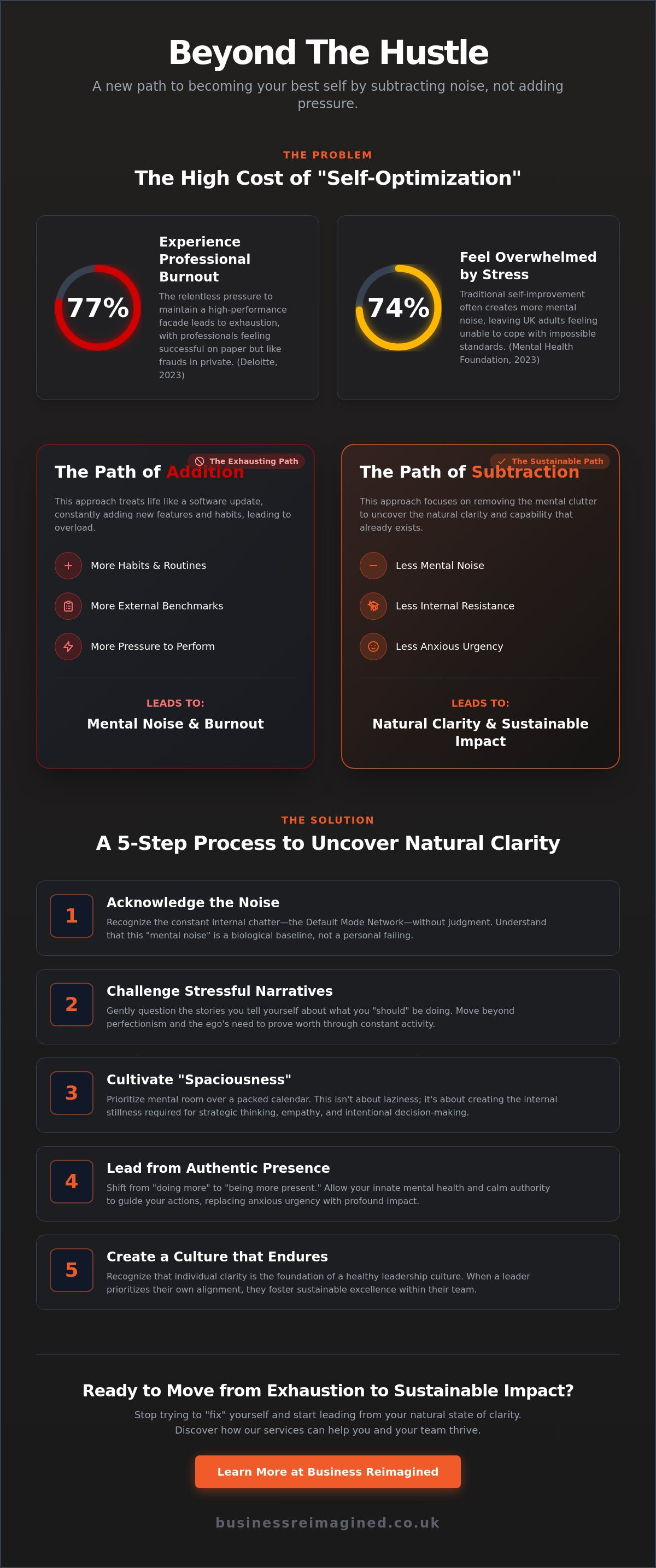
What if the relentless pursuit of self-improvement is actually the very thing standing in your way? We often treat our lives like a software update, constantly adding new features and habits in a frantic attempt to learn how to be the best version of yourself. Yet, for many, this leads to a state of mental fatigue rather than mastery. A 2023 study by Deloitte revealed that 77% of professionals have experienced burnout at their current job, often driven by the pressure to maintain a high-performance facade. It's common to find yourself succeeding on paper while feeling like a fraud in private, exhausted by the weight of endless expectations.
It's natural to feel that more effort is the only path to greater impact. However, true growth often comes from subtraction rather than addition. This guide explores how to uncover your natural clarity by moving beyond the traditional hustle and embracing a more intentional, gentle approach to personal evolution. We will examine how to strip away the noise of "self-optimisation" to foster a leadership culture that can actually endure, allowing your authentic presence to lead the way without the risk of burnout.
Key Takeaways
- Move beyond the exhausting pursuit of external optimisation and discover how to access a state of natural clarity through internal alignment.
- Uncover the neuroscience behind "mental noise" and why traditional self-help often fails by favouring addition over essential subtraction.
- Master a gentle, five-step process to challenge stressful narratives and learn how to be the best version of yourself without the pressure of the hustle.
- Explore how individual clarity translates into a leadership culture that can actually endure, fostering sustainable excellence within your team.
What Does It Truly Mean to Be the Best Version of Yourself?
We often view personal growth as a distant destination. It's framed as a version of ourselves that exists only after we've hit a specific revenue target or mastered a new discipline. This perspective is exhausting. To understand how to be the best version of yourself, we must shift our gaze from future optimisation to present alignment. It's about clarity, not a constant state of repair. When we operate from a place of internal stillness, our decisions become more intentional and our impact more profound.
Traditional personal development frequently focuses on external optimisation. It suggests that if we just wake up earlier or work harder, we'll finally arrive. However, a 2023 study by the Mental Health Foundation revealed that 74% of UK adults felt so stressed they were overwhelmed or unable to cope (Mental Health Foundation). This suggests that traditional self-improvement often creates more mental noise than it resolves by pressuring us to meet impossible standards.
To better understand how this shift in perspective changes your trajectory, watch this helpful video:
Choosing intentionality over the hustle culture trap requires a quiet rebellion. It means prioritising your internal state over external benchmarks. When we stop trying to fix ourselves, we create space for genuine evolution. This shift allows us to move away from the frantic energy of grinding and toward a more sustainable way of working. By valuing well-being as much as profit, we can discover how to be the best version of yourself without sacrificing your peace of mind.
The Trap of Perfectionism vs. Authentic Growth
The ego thrives on perfection. It creates a rigid standard that triggers resistance whenever we fall short. In professional settings, this manifests as a frantic need to prove our worth through constant activity. Shifting from doing more to being more present allows us to lead with a sense of calm authority rather than anxious urgency. This transition isn't about laziness; it's about efficiency born from a quiet mind. Authentic growth is a return to our innate mental health.
The "Quiet Rebel" Approach to Personal Evolution
Challenging standard business norms is vital for clarity. We've been taught that busyness equals value, but we propose "spaciousness" as a superior metric for success. Spaciousness isn't just about having a clear calendar. It's about having the mental room to think strategically and respond with empathy. A healthy leadership culture begins with the individual's state of mind. When a leader prioritises their own alignment, they create a leadership culture that can actually endure. This intentional approach is at the heart of our services, helping professionals move from exhaustion to sustainable impact.
The Neuroscience of the Self: Why Your Brain Resists Change
Change is not merely a matter of willpower; it is a biological negotiation. Your brain is designed for efficiency, not necessarily for evolution. At the heart of this resistance lies the Default Mode Network (DMN), a web of brain regions that becomes active when the mind is at rest. While essential for creativity, the DMN is also the primary source of "mental noise," the internal chatter that often keeps you tethered to old versions of yourself. Understanding this biological baseline is the first step in learning how to be the best version of yourself without the exhaustion of the hustle.
When stress enters the frame, the prefrontal cortex, your "CEO" brain, begins to go offline. A study published in Cerebral Cortex (2022) found that even moderate stress can significantly reduce the neural connectivity required for complex decision-making. This shift forces you into reactive patterns, making it nearly impossible to maintain a leadership and personal development practice that feels sustainable. You can explore the mechanics of this shift in our deeper look at the neuroscience of leadership development.
Breaking the Cycle of Mental Habituation
Habituation is the brain's way of filtering out repetitive stimuli to save energy. In a psychological context, it explains why leaders often stop noticing their own counter-productive behaviours. You might find yourself snapping at a colleague or rushing a strategic review, not because you lack skill, but because your brain has automated these responses. This "blindness" is a core reason why growth feels stagnant. You can read more about this phenomenon in our exploration of the psychology habituation definition. To build a leadership culture that can actually endure, you must first learn to see the invisible patterns you've stopped noticing.
The Role of Subtractive Psychology
Most personal growth programmes focus on what you need to add: more habits, more discipline, more grit. Subtractive psychology suggests the opposite. Your brain is already wired for high performance; it's simply obscured by the noise of thought. By understanding the "Three Principles" of Mind, Thought, and Consciousness, you can begin to peel back the layers of mental clutter. Clarity is the factory setting of the human mind. When you stop trying to "fix" your thoughts and instead observe them, you find the spaciousness needed to decide how to be the best version of yourself with quiet confidence. If you feel ready to explore this internal alignment, you might find a gentle conversation helpful.
Why Traditional Self-Help Fails High-Performers
For many high-achievers, the pursuit of personal growth feels like an exhausting second job. We often fall into the "Addition Bias," a cognitive tendency to solve problems by adding more tasks, tools, or habits rather than stripping away what doesn't serve us. You buy the latest productivity app or a stack of books, hoping the next one holds the secret to how to be the best version of yourself. A 2021 study published in Nature found that people systematically default to addition when asked to improve a situation, even when subtraction is more effective. This leads to cluttered schedules and a sense of mental weight that stifles true creativity.
This constant self-critique creates a space where Imposter Syndrome thrives. When you view yourself as a "project" that is permanently under construction, you're subconsciously telling yourself that you aren't enough as you are. It's a heavy way to live. This mindset leads to the most common objection: "I don't have time for a 10-step morning routine." You're right to feel that way. True growth shouldn't feel like a burden. It should feel like a return to clarity. Yale University's course on The Science of Well-Being highlights that happiness and performance aren't found in relentless self-optimisation, but in intentional habits that foster genuine presence and connection.
Understanding the Problem with Authority
Looking for external gurus often disconnects you from your own wisdom. While advice has its place, relying solely on external frameworks can erode your internal authority. Leadership requires a deep trust in your own intuition and the courage to listen to your inner voice. When you stop looking for permission from others, you begin to build a leadership culture that can actually endure. You can explore this further in our guide on The Problem With Authority.
Navigating Self-Doubt and the Ego
The ego often creates a fragmented version of the self at work, a mask designed to meet external expectations and hide perceived flaws. This mask is heavy. It fuels the fear that you'll eventually be found out. Understanding how your mind functions is the first step to Overcome Imposter Syndrome and lead with authenticity. The goal is to distinguish between ego-driven goals, which crave external validation, and soul-driven intentions, which seek internal alignment. When your work stems from a place of soul-driven purpose, the need for frantic hustle fades. It is replaced by a steady, intentional pace that allows you to discover how to be the best version of yourself without losing your peace of mind.
Five Steps to Uncover Your Best Version Through Clarity
Learning how to be the best version of yourself is less about addition and more about uncovering the clarity that already exists within you. It's a journey of subtraction where we remove the layers of conditioning and mental noise that obscure our natural wisdom. When we stop trying to build a better person and start revealing the one who is already present, growth becomes a sustainable path rather than a frantic race.
- Step 1: Notice the Noise. Start by observing your internal weather. A 2020 study by researchers at Queen’s University found that the average person experiences roughly 6,200 "thought worms" every day. Most of this is background static. Learning to notice this noise without becoming it is the first step toward mental freedom.
- Step 2: Question the Narrative. We often treat our stressful thoughts as absolute authorities. When you feel the pressure to perform or the sting of self-doubt, ask if that thought is objectively true. Challenging the authority of your own mind breaks the cycle of reactive behaviour.
- Step 3: Embrace Subtraction. Identify which habits or beliefs you can let go of. Growth isn't always about acquisition; it's often about identifying the "shoulds" that no longer serve your vision and allowing them to fall away.
- Step 4: Create Spaciousness. Clarity needs room to breathe. By intentionally creating gaps in your schedule, you allow fresh insights to emerge from the silence that follows the noise.
- Step 5: Act from Alignment. Decisions made from a state of frantic urgency rarely endure. When you act from a grounded, calm state, your choices reflect your true values and lead to more impactful results.
Practical Tools for Mental Subtraction
The Clarity Wellbeing Programme operates on the principle that the mind is a self-correcting system. To reduce mental clutter during the workday, try "closing the tabs" of your mind every ninety minutes by sitting in silence for just sixty seconds. This simple pause resets your cognitive load. Unlike information, which often adds to the weight of your mental burden, insight transforms your perspective and lightens the load entirely. This shift allows you to discover how to be the best version of yourself by operating from peace rather than pressure.
Leading from a State of Clarity
Your internal state is the blueprint for your leadership environment. When a leader is grounded, they naturally foster a leadership environment that supports long-term success. This isn't just about personal peace; it's about the ripple effect. A calm leader creates a culture where the team feels safe to innovate rather than just react. This grounded presence improves retention and collective focus across the entire organisation. For those ready to deepen this practice, exploring Executive Business Coaching can provide the strategic partnership needed to lead with quiet authority.
Ready to lead with more intentionality? Book a discovery call to explore your path to clarity.
Beyond the Individual: Creating a Leadership Culture that Endures
Personal growth is a quiet, internal revolution that eventually demands an external expression. When you understand how to be the best version of yourself, you stop being a cog in a machine and start becoming a catalyst for change. True organisational transformation doesn't happen through top-down mandates; it flourishes when leaders bring their most aligned, grounded selves to the table. A leadership culture that can actually endure is built on the collective wellbeing of its people rather than the short-term gains of a burnout-driven cycle.
Sustainable team performance relies on this shift in perspective. Research by Gallup in 2023 found that managers who feel burnt out are 2.5 times more likely to leave their current employer. When leaders prioritise their own mental clarity, they create a permission structure for their teams to do the same. This isn't just about feeling better; it's a strategic necessity. A leader who is intentional and rested can see opportunities that a frantic leader will inevitably miss. Strategic transformation requires a level of spaciousness that hustle culture simply cannot provide.
The Role of Transformation Accelerators
Individual clarity is powerful, but collective intelligence is what moves the needle. Our team development services are designed to bridge this gap. We help teams align their personal values with the wider mission of the organisation. By using workshops as accelerators, we move past surface-level cooperation. Instead, we foster a leadership environment that supports long-term success, where every member understands how their individual growth contributes to the whole. This creates a rhythmic, steady flow of work that rejects the chaos of traditional corporate pressure.
Your Invitation to Reimagine Success
Success isn't a destination you reach by exhausting yourself. It's a personal, grounded, and intentional way of being. Learning how to be the best version of yourself means entering into a steady, strategic partnership with your own mind. You don't have to choose between high-level achievement and profound peace of mind. Both can exist together if you're willing to rewrite the rules of your professional life. It's about building a career that supports your life, not one that consumes it.
If you're ready to step away from the noise and lead with a sense of spaciousness, let's talk. You can book a Clarity Call with Kay Tear to explore how we can reimagine your path forward. Your leadership is a living part of your life; let's make sure it's a part that nourishes you and those you lead.
Step Into Your New Narrative
Learning how to be the best version of yourself isn't a matter of working harder or subscribing to the latest productivity hack. It's an intentional process of returning to your natural state of clarity. We've seen that while the brain's survival mechanisms often trigger resistance to change, a neuroscience-backed approach allows you to navigate these shifts with grace rather than grit. By prioritising internal alignment over external pressure, you cultivate a leadership culture that can actually endure. This isn't just theory; it's the foundation of sustainable high performance in a demanding world.
Business Reimagined, founded by international speaker and leadership consultant Chantal Burns, specialises in helping senior leaders move beyond the exhaustion of traditional self-help. Through our specialist Clarity Wellbeing Programme, we provide the strategic partnership needed to transform your professional life into something that supports you. Your potential is not a destination to reach, but a way of moving through the world with purpose and ease.
Ready to reimagine your leadership? Book a discovery call with Kay Tear to find your clarity.
The journey toward a more balanced, impactful life begins with a single, quiet decision to do things differently. You have everything you need to lead with heart and wisdom.
Frequently Asked Questions
Is being the best version of yourself about working harder?
No, being the best version of yourself isn't about increasing your workload or "grinding" harder. It's about intentional subtraction. Research from the University of California found that workers are interrupted every 3 minutes and 5 seconds, leading to a frantic pace that obscures clarity. Instead of adding tasks, focus on alignment and creating a leadership culture that can actually endure without constant exhaustion.
How does neuroscience help with personal growth?
Neuroscience provides the biological map for how to be the best version of yourself by leveraging neuroplasticity. In 1998, researchers led by Peter Eriksson proved that the human brain continues to produce new neurons throughout adulthood. This means your current habits aren't fixed. You can intentionally rewire your neural pathways to support a more grounded, sustainable way of leading and living.
Can I be my best self while working in a high-stress environment?
You can certainly thrive in high-pressure roles, provided you cultivate internal spaciousness. A 2022 study by Deloitte revealed that 77% of employees have experienced burnout at their current job. To remain authentic in these settings, you must shift from a reactive state to a reflective one. It's about maintaining your integrity even when the external leadership environment feels chaotic or demanding.
What is the difference between self-improvement and self-realisation?
Self-improvement usually involves adding new skills or "fixing" perceived flaws, while self-realisation is the process of uncovering your existing, inherent nature. Think of it as removing the layers of social conditioning that no longer serve you. While improvement focuses on external benchmarks, self-realisation asks deeper questions about internal alignment. It's a journey from "doing" more to "being" more intentional.
How do I know if I am acting from my "ego" or my "authentic self"?
Your ego typically speaks through the language of fear, comparison, and a need for external validation. In contrast, your authentic self operates from a place of quiet confidence and soulful empathy. When you're in alignment, your decisions feel heavy with purpose rather than light with temporary pride. Ask yourself if your current ambition is driven by a desire to be seen or a desire to be true.
What happens if I feel like I have "lost" my best version?
You haven't lost your best self; you've simply become disconnected from your core values through the noise of daily life. This feeling often arises when we prioritise "hustle" over health. A 2023 survey by Future Forum found that 42% of the global workforce feels burned out, which naturally clouds our sense of identity. To return to yourself, start by reclaiming small pockets of silence.
How long does it take to see results from a subtractive approach?
You'll likely begin to feel a shift in your mental clarity within the first few weeks, though deep habit change takes longer. A 2009 study by Phillippa Lally at University College London found that it takes 66 days on average for a new behaviour to become automatic. By subtracting one non-essential commitment this week, you create immediate breathing room for how to be the best version of yourself.
Can executive coaching help me find this clarity?
Executive coaching acts as a strategic mirror, helping you see the patterns that are currently blocking your path to clarity. It provides a dedicated space to reimagine your role and your impact without the pressure of the boardroom. A 2020 report by the International Coaching Federation noted that 86% of companies saw a return on investment from coaching, largely through improved leadership alignment.