
Neuroscience of Leadership Development: From Mental Noise to Strategic Clarity
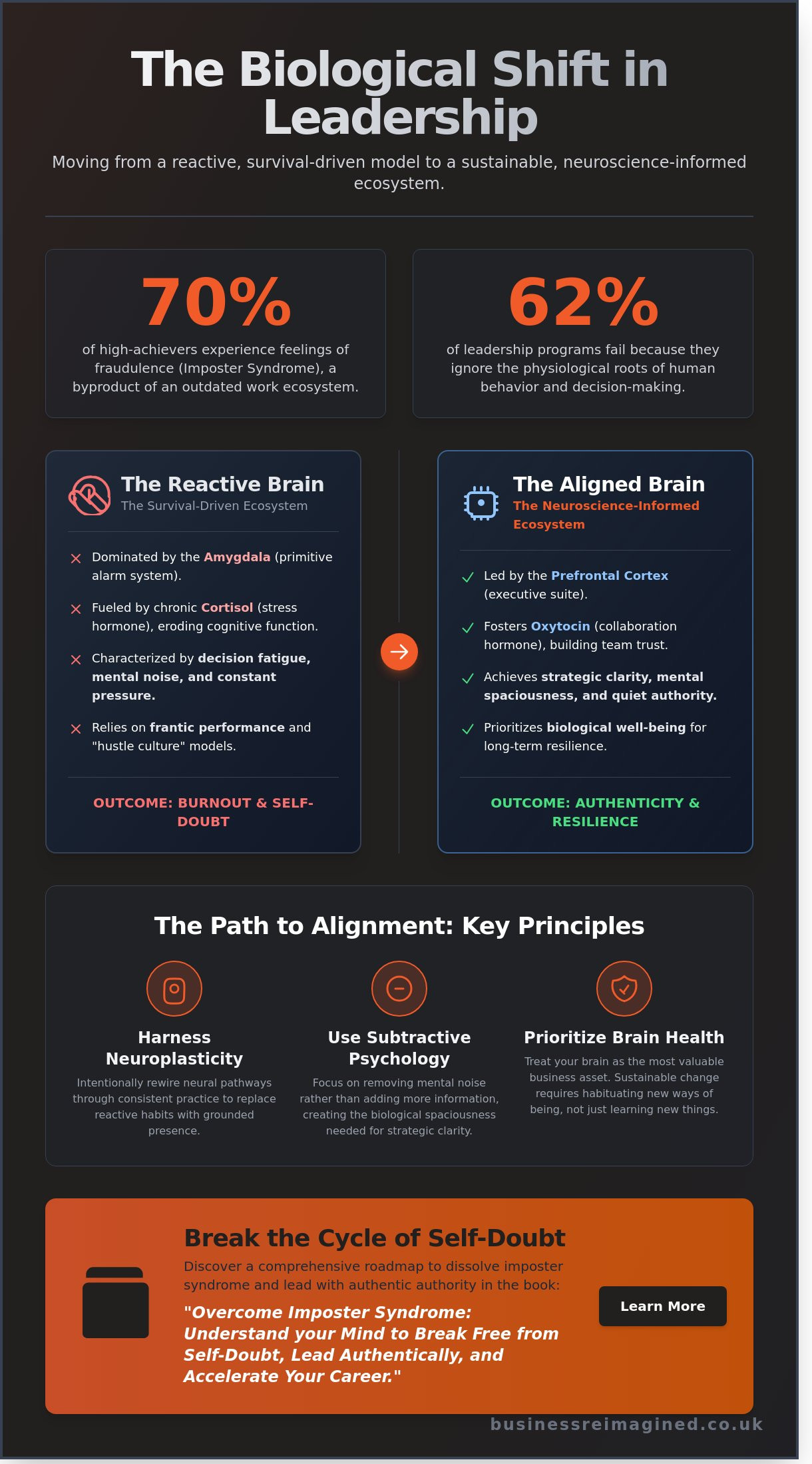
What if the persistent self-doubt you feel isn't a sign of personal failure, but a biological byproduct of an outdated work ecosystem that prioritizes speed over alignment? You likely agree that the constant pressure to perform at an unsustainable pace often leads to a crowded mind and a depleted spirit. A 2020 study published in the Journal of Behavioral Science found that 70% of high achievers experience these feelings of fraudulence. This internal friction isn't just exhausting; it's a barrier to the strategic clarity you need to thrive. By grounding your growth in leadership development neuroscience, you can stop fighting your biological design and start leading with a sense of quiet authority.
In this article, you'll discover how understanding your brain's architecture can dissolve imposter syndrome and replace decision fatigue with genuine mental spaciousness. We'll explore how to move away from reactive habits toward a more intentional, high-performance leadership style. If you're ready to dive deeper into these concepts, my book, "Overcome Imposter Syndrome: Understand your Mind to Break Free from Self-Doubt, Lead Authentically, and Accelerate Your Career," provides a comprehensive roadmap for this transformation. Learn more here. We're going to examine the biological roots of mental noise and how to reclaim your focus for a more sustainable path to success.
Key Takeaways
- Discover how leadership development neuroscience facilitates lasting neural change by rewiring your biological response to high-pressure stakes and professional demands.
- Learn to navigate the internal battle between strategic focus and survival instincts to reclaim a state of grounded, intentional clarity in your decision-making.
- Explore how subtractive psychology can quiet mental noise, creating the spaciousness required for your innate leadership wisdom and authentic alignment to emerge.
- Break the cycle of self-doubt by understanding the biological architecture of the "imposter" brain, a journey detailed in the book Overcome Imposter Syndrome—Learn more here.
- Transition from frantic performance models to a sustainable leadership ecosystem that prioritizes biological well-being as a metric for long-term team resilience.
What is Leadership Development Neuroscience?
Leadership is not a performance. It is a biological reality. While traditional corporate training often focuses on mimicking external behaviors, leadership development neuroscience dives deeper into the neural architecture that dictates how we think, feel, and decide. A 2024 survey of HR executives revealed that 62% of leadership programs fail because they ignore the physiological roots of behavior. True growth requires more than a weekend workshop. It demands a rewiring of the brain.
We are witnessing a shift from surface-level training to brain-based development. This evolution focuses on neuroplasticity, the brain's ability to form new connections through intentional practice. When you understand the mechanics of your mind, you can finally address the internal friction that slows your progress. This self-awareness is the key to overcoming the self-doubt that keeps many high-achievers stagnant. This shift toward leadership development neuroscience represents a move toward clarity and away from the frantic noise of traditional management. By mastering your internal ecosystem, you unlock authentic authority and accelerate your career path without the burnout of hustle culture.
If you are ready to dismantle the mental noise and step into your full potential, my book, Overcome Imposter Syndrome: Understand your Mind to Break Free from Self-Doubt, Lead Authentically, and Accelerate Your Career, provides the roadmap you need. Learn more here.
The Biological Basis of Leading Others
Every human interaction is governed by biology. The prefrontal cortex acts as the brain's executive suite, managing complex decision-making and emotional regulation. We also operate within a "Social Brain" that is hyper-sensitive to status and connection. Integrating the principles of Neuroleadership allows us to see teams as living ecosystems. This perspective helps leaders move from a place of control to one of alignment and collective safety. It's about working with our nature rather than against it.
Why Neuroscience Matters in 2026
The workplace has changed. By 2026, the rise of hybrid models has increased digital cognitive load by 35% compared to 2019. We can't simply learn our way out of this overwhelm. We must habituate new ways of being. Neural pathways strengthen through consistent, gentle discipline rather than frantic effort. Sustainable change happens when we move beyond intellectual understanding and focus on the daily repetition that turns strategic clarity into a natural instinct. It's time to prioritize your brain's health as your most valuable business asset.
The Biological Architecture of Executive Performance
The human brain isn't a static machine; it's a living ecosystem that often finds itself in a state of internal friction. At the heart of this tension lies the struggle between the prefrontal cortex, your center for logic and long-term vision, and the amygdala, the primitive alarm system designed for survival. When we explore leadership development neuroscience, we realize that effective leading is less about "grinding" and more about regulating this biological tug-of-war. If the amygdala stays hyper-reactive, it drowns out the strategic clarity needed for high-level impact.
Neuroplasticity offers a bridge from reactive stress to intentional presence. Leaders can physically rewire their neural pathways to remain grounded during high-stakes negotiations or market shifts. This process involves shifting our internal chemistry. While cortisol, the stress hormone, can sharpen focus in short bursts, its chronic presence erodes cognitive function and destroys team trust. Conversely, oxytocin acts as a biological lubricant for collaboration. By Leveraging Neuroscience to Enhance Leadership, executives can foster an environment where safety and innovation coexist. When trust is high, the brain is free to move from survival mode into a state of creative alignment.
True strategic depth requires what we call biological spaciousness. This isn't just a luxury; it's a physiological necessity for the brain's Default Mode Network to engage. This network is responsible for the "aha" moments that define visionary leadership. Without moments of stillness, the brain lacks the resources to connect disparate ideas into a cohesive strategy. Spaciousness allows the mind to breathe, turning frantic reactions into considered actions.
The Brain Under Pressure
Chronic stress effectively hijacks the rational brain. A 2023 study indicated that prolonged exposure to high-pressure environments can reduce gray matter volume in the prefrontal cortex by up to 14 percent. This physiological cost of hustle culture limits a leader's perspective, forcing them into "tunnel vision" where only immediate threats are visible. Fostering resilience requires nervous system regulation. Simple practices like rhythmic breathing or intentional pauses can signal safety to the brain, allowing the executive functions to come back online and restoring a sense of calm authority.
The Neuroscience of Decision-Making
Making choices at the highest level requires a sophisticated filtering system to prevent decision fatigue. The brain uses interoception, often called a "gut feeling," to process subtle physiological signals that inform strategic choices. This internal awareness is often clouded by self-limiting beliefs or "mental noise." In the book "Overcome Imposter Syndrome: Understand your Mind to Break Free from Self-Doubt, Lead Authentically, and Accelerate Your Career," this intersection of mindset and biology is explored to help leaders navigate internal barriers. Understanding your mind is the first step toward authentic leadership. Learn more here: https://www.amazon.co.uk/Overcome-Imposter-Syndrome-Understand-Authentically/dp/B0FMRZD395. If you are ready to refine your own executive ecosystem, consider how strategic alignment can support your long-term growth.
Subtractive Psychology: Why Your Brain Needs Less, Not More
Traditional corporate training often feels like an endless exercise in addition. We're told to add new habits, add more frameworks, and add complex strategies to our already overstimulated minds. This additive model creates a heavy burden for the modern executive. A quiet rebellion is rising against this hustle mentality, favoring a subtractive approach instead. In the context of leadership development neuroscience, subtraction isn't about doing less; it's about clearing the mental interference that prevents your innate wisdom from surfacing.
This framework is built upon three fundamental principles: Mind, Consciousness, and Thought. When you understand that your experience is generated from the inside out, the need for external hacks dissolves. You begin to see the mind not as a vessel to be filled, but as an ecosystem that thrives when it's not cluttered by unnecessary pressure. This shift represents a move toward intentional, sustainable leadership that values clarity over volume.
Dissolving the "Mental Noise"
Most leaders operate within a busy-mind state, characterized by a constant stream of analytical chatter and future-based anxiety. This mental noise acts as a barrier to strategic clarity. We don't need more tools to manage the noise. We need a deeper understanding of the tool-maker, which is the mind itself. When a leader recognizes that their feelings of stress are simply the shadow of transient thoughts, they regain their footing. This realization is crucial for organizational health. Research in The Neuroscience of Leadership indicates that leaders who understand these cognitive drivers are better equipped to guide their teams through complex transitions without the typical friction.
- Clear-mind state: Decisions are made with grounded authority and intuitive speed.
- Busy-mind state: Decisions are delayed by over-analysis and the fear of making a mistake.
Creating a Spacious Ecosystem
Leading from a place of spaciousness allows for natural alignment within a team. You no longer have to force strategic implementation because your presence creates a calm, high-performance environment. Frantic energy is contagious; however, so is grounded clarity. Gallup’s 2023 data suggests that low engagement costs the global economy $8.8 trillion. Much of this stems from leaders who are too overwhelmed to connect authentically with their people.
If you find yourself trapped in cycles of self-doubt or feel like a fraud despite your success, you're likely experiencing the mental noise of imposter syndrome. Breaking free requires understanding your mind rather than just working harder. To explore how to lead authentically and accelerate your career through this psychological shift, consider the insights in "Overcome Imposter Syndrome: Understand your Mind to Break Free from Self-Doubt, Lead Authentically, and Accelerate Your Career." Learn more here: https://www.amazon.co.uk/Overcome-Imposter-Syndrome-Understand-Authentically/dp/B0FMRZD395. By integrating leadership development neuroscience with subtractive psychology, you move from a state of constant doing to a more powerful state of being.
Breaking the Cycle of Imposter Syndrome and Self-Doubt
The internal landscape of a high-achieving leader is often a crowded ecosystem. While your external metrics might suggest success, your internal narrative may tell a different story. This dissonance is the hallmark of the "Imposter" brain. Within the framework of leadership development neuroscience, we recognize this as a biological conflict between the amygdala’s survival response and the prefrontal cortex’s analytical capacity. It's a glitch where your brain interprets professional visibility as a threat rather than an achievement.
A 2020 KPMG study found that 75% of female executives across various industries have experienced imposter syndrome. This isn't just a personal hurdle; it creates "double binds" that trap entire teams. When a leader doubts their own value, they often overcompensate through micromanagement or withdrawal. This creates a ripple effect of uncertainty. Breaking this habituation requires more than positive thinking. It demands a sophisticated understanding of how your neural pathways have been wired to prioritize safety over authentic expression.
Understanding Your Mind to Break Free
The common advice to "fake it until you make it" is biologically unsustainable. It forces the brain to remain in a state of high-alert, leading to elevated cortisol levels that eventually erode strategic clarity. Authentic leadership emerges when the internal critic is silenced through physiological awareness rather than sheer willpower. By recognizing the mechanics of thought, you can stop projecting your insecurities onto your team. This creates a spacious environment where collective potential can flourish without the interference of ego-driven anxieties.
Accelerating Your Career through Clarity
Psychological self-awareness is the most undervalued asset in high-potential talent. Moving beyond self-doubt isn't about reaching a state of perfection; it's about embracing your "Beyond Limits" potential through intentional alignment. When you understand the neurological roots of your hesitation, you gain the agency to rewrite your professional narrative. This clarity is what separates those who plateau from those who ascend with grace and impact. To deepen your journey into this psychological mastery, Learn more here about breaking free from imposter syndrome and leading with a sense of grounded authority.
Ready to align your leadership style with your neurological strengths? Schedule a strategic clarity session to explore your path forward.
Reimagining Leadership: Integrating Neuroscience into Your Ecosystem
Theory remains dormant until it's woven into the daily rhythm of your organization. Transitioning from abstract concepts to a high-performing ecosystem requires more than just intent; it demands a biological blueprint. Through the Clarity Wellbeing Programme, we move beyond the surface of leadership development neuroscience to create sustainable change. This isn't about temporary fixes. It's about recognizing that a leader's brain is the central hub of an organizational nervous system. When 77% of professionals report burnout, as recorded in a 2023 Deloitte study, the traditional hustle becomes a liability. We replace it with intentional, grounded strategy.
Bespoke Leadership Development
Standardized, "off-the-shelf" training often ignores the specific cognitive architecture of the individual. These programs fail because they treat every mind as an identical processor. Authentic leadership requires a deeper dive into the self-limiting beliefs that create mental friction. To truly accelerate your career and lead with clarity, you must understand the mechanics of your own mind. My book, Overcome Imposter Syndrome: Understand your Mind to Break Free from Self-Doubt, Lead Authentically, and Accelerate Your Career, serves as a primary resource for this transformation. Learn more here.
By integrating wellbeing as a core metric of professional impact, we turn senior management into transformation accelerators. This shift isn't just ethical; it's biological. Keynote speaking serves as the initial spark, shifting organizational culture from a state of constant noise to one of collective resonance. We build resilient teams by teaching them how to regulate their internal environments. This ensures that pressure leads to growth rather than fracture.
Start Your Journey to Clarity
Your mental ecosystem is likely crowded with legacy patterns and external expectations. Assessing this noise is the first step toward reclaiming your spaciousness. Executive coaching provides the mirror needed to identify blind spots that remain invisible to the solitary mind. We focus on three key areas of assessment:
- Identifying the physiological triggers of imposter syndrome.
- Mapping the current cognitive load versus available mental spaciousness.
- Aligning internal values with external leadership benchmarks.
Are you ready for a pivotal moment in your professional life? Book a conversation here to begin aligning your output with your biological capacity. It's time to lead from a place of quiet authority and intentional purpose. Success is personal, and your business should support your life, not consume it.
Step into Your Natural State of Clarity
True executive performance isn't about adding more to your mental plate; it's about the subtractive psychology of removing the noise. By understanding leadership development neuroscience, you can navigate the biological architecture of your brain to move from self-doubt to strategic alignment. Chantal Burns, an international speaker with over 15 years of experience in high-level executive transformation, has demonstrated that your internal ecosystem thrives when you lean into the 3 Principles rather than the frantic demands of hustle culture.
To deepen your understanding of these mental mechanics, explore Chantal’s book, Overcome Imposter Syndrome: Understand your Mind to Break Free from Self-Doubt, Lead Authentically, and Accelerate Your Career. It serves as a vital resource for anyone ready to break the cycle of self-limiting beliefs. Learn more here to begin your journey toward authentic leadership.
Success doesn't have to be a grind. It's time to reimagine your professional life as a sustainable, intentional practice. Discover how to lead with clarity: Learn more about the Clarity Programme. You're closer to a quiet, powerful confidence than you think.
Frequently Asked Questions
How does neuroscience improve leadership development?
Integrating leadership development neuroscience into your practice provides a biological map for behavior and emotional regulation. Research from the NeuroLeadership Institute suggests that leaders who understand brain function increase their effectiveness by 30 percent compared to those using standard methods. This approach moves beyond surface-level habits. It focuses on how the prefrontal cortex manages the amygdala's threat response, allowing for a more intentional presence in the boardroom.
Can neuroscience help in overcoming imposter syndrome?
Neuroscience offers a biological framework to dismantle the chronic self-doubt associated with imposter syndrome. By recognizing that these feelings are often a misfiring of the brain's survival circuitry, you can begin to rewire your response to success. The book "Overcome Imposter Syndrome: Understand your Mind to Break Free from Self-Doubt, Lead Authentically, and Accelerate Your Career" serves as a primary resource for this transformation. Learn more here: https://www.amazon.co.uk/Overcome-Imposter-Syndrome-Understand-Authentically/dp/B0FMRZD395.
What is the "Social Brain" in a business context?
The Social Brain refers to the neural networks, such as the medial prefrontal cortex, that prioritize human connection over task execution. Matthew Lieberman's 2013 research demonstrates that our brains are wired to treat social rejection with the same intensity as physical pain. In a business ecosystem, this means fostering a culture where 100 percent of team members feel psychologically safe. This alignment is vital for maintaining a healthy organizational nervous system.
How does stress affect a leader’s decision-making biologically?
Stress triggers a cortisol release that physically bypasses the prefrontal cortex, the area responsible for strategic clarity. When a leader is in a state of "hustle," their cognitive capacity can drop by 20 percent according to biological studies. This shift forces the brain into a reactive, binary mode. Instead of seeing a spectrum of possibilities, the mind sees only threats. Creating spaciousness isn't a luxury; it's a biological necessity for sound judgment.
Is neuroplasticity relevant for senior executives?
Neuroplasticity is highly relevant for senior executives because the brain's 86 billion neurons retain the ability to reorganize throughout a lifetime. A 2019 study published in Nature Medicine confirmed that neurogenesis continues well into the eighth decade of life. This means that even the most seasoned leaders can unlearn rigid habits and adopt a more soulful leadership style. Growth isn't about grinding harder. It's about intentionally sculpting new neural pathways for better alignment.
What is the difference between traditional coaching and neuroscience-based coaching?
Traditional coaching often focuses on external performance metrics, while leadership development neuroscience targets the internal mental architecture. One method manages the symptoms; the other addresses the root cause. A 2017 study found that neuro-based interventions lead to a 25 percent higher retention of new leadership behaviors. This shift ensures that professional growth is sustainable rather than a temporary spike followed by burnout. It's a more grounded way to evolve.
How can I start applying neuroscience to my team today?
You can start by implementing "brain breaks" every 90 minutes to respect the body's ultradian rhythms. Google's 2012 Project Aristotle proved that psychological safety is the number one predictor of team success. Start your meetings by acknowledging the human element. This simple act lowers the collective amygdala activation of the group. It replaces the noise of anxiety with the clarity of a shared, intentional mission within your business ecosystem.
What is subtractive psychology in leadership?
Subtractive psychology is the practice of removing mental interference to reveal your innate wisdom. Rather than adding more productivity hacks to an already cluttered mind, this approach focuses on clearing the mental noise that obscures strategic vision. It's a quiet rebellion against the idea that we need more tools to be effective. When you subtract the pressure of external benchmarks, you find the grounded clarity needed to lead with soul and purpose.