
The Problem With Authority: Myth-Busting the Rebellious Leader’s Mindset
What if the friction you feel every time your manager speaks isn't actually about their incompetence? It's a heavy realization to carry, but often, a perceived problem with authority is a mirror reflecting our own internal unrest. You've likely spent years priding yourself on being a disruptor or a rebel, yet you find yourself ending the week feeling depleted rather than empowered. It’s a cycle of constant workplace battles that leaves very little room for the intentional work you actually want to do. You deserve to feel grounded in your role, not constantly on the defensive.
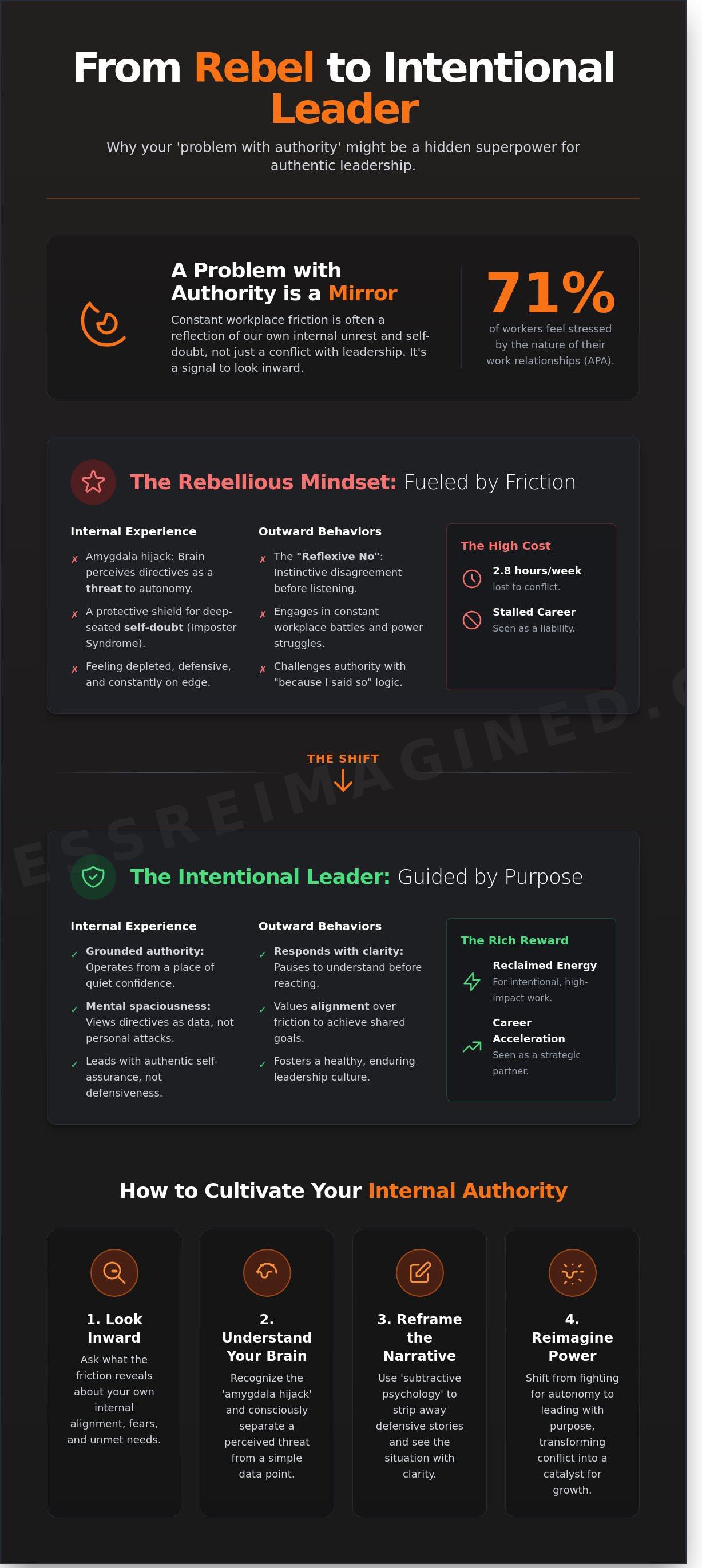
You aren't alone in this struggle; research from the American Psychological Association shows that 71% of workers feel stressed by the nature of their work relationships. In her book, "Overcome Imposter Syndrome: Understand your Mind to Break Free from Self-Doubt, Lead Authentically, and Accelerate Your Career," Kay Tear suggests that this external resistance is frequently a defense mechanism against our own self-doubt. This article will show you why your rebellion might actually be imposter syndrome in disguise and how to pivot toward a healthy leadership culture that can actually endure. We'll explore how to reclaim your mental spaciousness and lead with a quiet, grounded authority that doesn't require a fight to be heard.
Key Takeaways
- Recognize that a perceived problem with authority is often an internal protective mechanism rather than a simple conflict with leadership.
- Uncover the neuroscience of resistance to understand why your brain may interpret a directive as a threat to your personal autonomy and sense of space.
- Identify how chronic rebellion can mask deep-seated self-doubt, reflecting insights from Kay Tear’s Overcome Imposter Syndrome to help you lead with authentic confidence.
- Move from friction to flow by cultivating internal groundedness, allowing you to thrive within a healthy leadership culture that supports long-term success.
- Reimagine your relationship with power to transition from a "rebellious" mindset into that of a pivotal, intentional leader who values alignment over friction.
Beyond the "Difficult" Label: What a Problem with Authority Really Signifies
Labeling a leader as "difficult" is a lazy shortcut. It ignores the complex psychological drivers behind why a talented professional might push back against the status quo. Often, what we categorize as a problem with authority is actually a protective mechanism of the ego. It's a shield used to guard one's autonomy or to mask a fear of being led by someone perceived as incompetent. For the high-performer, this friction is rarely about being a contrarian for its own sake. It's usually about a deep-seated commitment to excellence that feels stifled by rigid, illogical hierarchies.
High-performers are particularly susceptible to clashing with hierarchy because they're driven by a vision that often outpaces the current structure. They don't just want to follow; they want to improve. When that drive meets a rigid "command and control" style, the resulting friction creates significant mental noise. This noise isn't just a minor annoyance. It's a strategic drain. A study by CPP Inc. found that employees spend 2.8 hours per week dealing with conflict. For a leader, that's time stolen from high-level strategy and creative problem-solving. Distinguishing between healthy skepticism and chronic power struggles is vital for maintaining a leadership environment that supports long-term success.
The Symptoms of Authority Friction in the Workplace
Authority friction often manifests as a "reflexive no." This is the instinctive urge to disagree or find flaws in a proposal before the other person has even finished speaking. It's a defensive posture designed to prove others wrong as a way to feel secure in one's own expertise. When a manager relies on "because I said so" logic, it triggers an immediate loss of respect. This doesn't just damage the relationship; it erodes your personal brand. You risk being seen as a liability rather than a strategic partner, which can significantly stall your career acceleration regardless of your technical talent.
Authority as a Mirror for Internal Alignment
Workplace conflict is a powerful signal to look inward. If you're constantly at odds with those above you, it's worth asking what that friction is trying to tell you about your own internal alignment. In her book, Overcome Imposter Syndrome: Understand your Mind to Break Free from Self-Doubt, Lead Authentically, and Accelerate Your Career, Kay Tear explores how internal narratives often drive our external defiance. Sometimes, we fight authority because we're afraid of being found wanting ourselves.
Viewing your workplace as a living system where friction indicates a blockage allows for a more intentional approach to leadership. Instead of reacting, you can begin to respond with clarity. To explore how to navigate these power dynamics and foster a leadership culture that can actually endure, you may find that Executive Coaching London offers the spaciousness needed to transform conflict into a catalyst for growth.
The Neuroscience of Resistance: Why Your Brain Views Authority as a Threat
Your brain is a survival machine, not a productivity tool. When a leader issues a directive, your amygdala doesn't always see a strategic goal; it often sees a threat to your autonomy. This neural hijack triggers a cascade of stress hormones that cloud your judgment and limit your perspective. Often, the problem with authority isn't about the person in the high-back chair. It's about how your biological hardware interprets power dynamics. Research from the NeuroLeadership Institute indicates that a perceived drop in status or autonomy activates the same brain regions as physical pain, making the "rebel" response feel like a matter of self-preservation.
This reaction is frequently a result of habituation. We project early experiences with parental figures or strict teachers onto our current professional relationships. If you felt stifled as a child, your brain has built efficient, high-speed neural highways to trigger resistance at the first sign of control. By using a subtractive psychology approach, you can begin to remove the mental noise of the "fight." This involves stripping away the layers of defensive storytelling to see the directive for what it is: a simple data point, not a personal attack on your identity.
The Cognitive Load of Workplace Rebellion
Rebellion is expensive. When you view every mandate as a battle, your brain wastes significant energy on defensive mental rehearsals. You might spend hours crafting the perfect rebuttal in your head before a meeting even starts. This process floods your system with cortisol, which impairs the very creativity you need to lead. A 2022 study published in the Journal of Occupational Health Psychology found that interpersonal conflict at work can lead to a 15% reduction in cognitive performance. Choosing to push against every boundary isn't a sign of strength; it's a low-performance strategy that drains your creative reserves. To explore how to navigate these internal hurdles, you might find clarity in the insights shared in Overcome Imposter Syndrome by Kay Tear, which examines how our internal narratives shape our leadership presence.
Breaking the Habit of Conflict
Breaking the cycle requires creating spaciousness between a trigger and your reaction. When you feel that familiar heat of resistance, pause. This intentional breath allows your prefrontal cortex to come back online, overriding the reflexive "rebel" response. Habituation in leadership occurs when the brain’s neural pathways become deeply etched with reactive patterns, causing a leader to bypass the prefrontal cortex and respond to modern feedback with ancient, defensive instincts. By slowing down, you can build a leadership culture that can actually endure. If you're looking to refine this intentional approach, consider how strategic support can help you realign your internal responses with your professional goals.
Myth-Busting: Why Rebellion is Often Masked Self-Doubt
The common narrative suggests that clashing with a manager is a badge of intellectual superiority. We tell ourselves we’re just too innovative for the current structure or that we possess a vision others can’t grasp. In reality, a persistent problem with authority often stems from a internal place of protection rather than external competence. When we feel the need to constantly devalue those in leadership, we’re usually building a fortress to hide our own perceived inadequacies. It’s a psychological mechanism designed to make us feel safe by lowering the status of others; if the boss is "wrong," then their opinion of us can't be "right."
The Imposter Syndrome Connection
Fear of being "found out" creates a reflexive defensive posture. If you can convince yourself that leadership is incompetent, their evaluation of your work no longer carries weight. This self-projection turns every piece of feedback into a threat. You can explore these psychological patterns and learn how to lead with more clarity in Kay Tear’s book, Overcome Imposter Syndrome. Research published in the International Journal of Behavioral Science indicates that 70% of people experience these feelings at some point in their lives. This internal friction manifests as external rebellion, masking the quiet anxiety of not belonging.
- Mistrusting leadership motives as a way to avoid vulnerability.
- Devaluing a "healthy leadership culture" to justify poor performance.
- Projecting personal insecurities onto organizational structures.
Authentic Leadership vs. Performative Defiance
True leaders don’t need to perform defiance to prove their worth. There’s a sharp distinction between being a "disruptor" who brings intentional change and being "disruptive" just to cause friction. The "Noisy Reactor" fights for the sake of the fight, often stalling progress to soothe their own ego. In contrast, the "Quiet Rebel" operates from a place of internal alignment. They seek to build a leadership culture that can actually endure, focusing on grounded shifts rather than loud protests. Leading authentically requires you to understand your own mind before you try to change the minds of others. It’s about moving away from the problem with authority and toward a sense of personal spaciousness where your value isn't tied to being right, but to being effective.
Cultivating Internal Authority: Moving from Friction to Flow
The problem with authority often begins as a search for external validation. When we look to others to define our professional worth, we hand over our power. We become reactive. Every decision from above feels like a personal slight or a barrier to our progress. Moving toward a healthy leadership culture requires a shift in perspective. We must move from friction to flow by finding a grounded sense of internal authority that doesn't rely on the approval of a hierarchy.
In the Clarity Wellbeing Programme, we help leaders find peace within existing structures. This isn't about passive compliance. It's about maintaining your identity even when the leadership above you feels misaligned. According to 2023 data from Gallup, managers account for 70% of the variance in team engagement levels. If you're dealing with incompetent leadership, your mental clarity is your most valuable asset. You don't have to let someone else's lack of vision dictate your internal state. You can re-engage with your role by anchoring yourself in your own values rather than the whims of a supervisor.
Developing a "Wise Visionary" Perspective
Becoming a wise visionary means viewing bosses as colleagues in a leadership environment that supports long-term success. They aren't obstacles. They're individuals navigating their own pressures. When you stop viewing the problem with authority as a battle to be won, you can practice intentional listening over reactive arguing. This allows you to hear the strategic need behind a request. Applying subtractive psychology helps here; instead of adding more defensive layers, try removing the assumptions and judgments that cloud your workplace interactions.
Next Steps for Personal Transformation
Real change requires intentional practice. For the next seven days, audit your "authority triggers" to see which specific behaviors spark a defensive response. During your next high-stakes meeting, practice "spaciousness" by pausing for three seconds before speaking. This small gap creates room for a more considered response. If you're struggling to find this balance, Kay Tear’s book, Overcome Imposter Syndrome, offers profound insights into leading with authenticity while managing self-doubt. It's time to reclaim your calm.
Reimagining Your Relationship with Power and Purpose
The rules of the professional world are far more fluid than we are led to believe. Many leaders carry a heavy problem with authority because they view power as a rigid, external force designed to constrain them. In reality, power is a tool for alignment. When you stop seeing yourself as a "problem child" and start seeing yourself as a pivotal leader, the friction disappears. You aren't here to break the system; you're here to reimagine it into something more human.
Sustainable success doesn't come from the frantic energy of hustle culture. It comes from understanding your own mind. A 2023 study by Gallup found that 70% of team engagement rests on the shoulders of the leader, yet many leaders are too busy "crushing" goals to notice their own internal exhaustion. Shifting your focus from external benchmarks to internal clarity accelerates your career faster than any eighty-hour work week. If you continue to struggle with a problem with authority, it's likely because you haven't yet claimed your own.
The Path to Authentic Career Acceleration
Authentic leadership requires zero internal friction. When your actions align with your values, you no longer feel the need to rebel against every directive. You become a "Quiet Rebel." This philosophy isn't about loud disruption; it's about building a healthy leadership culture that supports long-term success. It starts with your state of mind. If you are at peace with your purpose, the workplace becomes a canvas rather than a cage. This clarity allows you to lead with a sense of spaciousness that others can feel and respect.
Deepen Your Understanding
To truly shift your perspective, you must address the underlying patterns that keep you feeling like an outsider. I encourage you to read Overcome Imposter Syndrome by Kay Tear. This book provides the psychological tools needed to understand your mind and lead with grounded confidence. Authentic leadership is the ultimate antidote to authority anxiety because it replaces the need for external validation with internal certainty. Breaking free from the self-limiting belief of the "rebel" allows you to finally step into the impact you were meant to make.
Stepping into Your Natural Authority
Your relationship with power doesn't have to be a source of constant friction. What many label a problem with authority is frequently the brain's limbic system reacting to a perceived loss of autonomy. When you shift your focus from external resistance to internal alignment, you begin to build a leadership culture that can actually endure. This transition requires moving past the "difficult" label to understand the neuroscience of your own resistance. As Kay Tear explores in her book, Overcome Imposter Syndrome: Understand your Mind to Break Free from Self-Doubt, Lead Authentically, and Accelerate Your Career, true leadership emerges when we stop fighting the system and start leading from a place of clarity.
Business Reimagined, founded by international speaker and author Chantal Burns, has spent over 15 years using neuroscience-based development to help leaders find this sense of spaciousness. Research from Gallup indicates that highly engaged teams see a 43% difference in turnover rates compared to those with low engagement. It's time to stop the hustle and start leading with intention.
Learn how to lead authentically and break free from self-doubt
You possess the capacity to rewrite the rules of your professional life with grace and purpose.
Frequently Asked Questions
Is a problem with authority a sign of a personality disorder?
No, a problem with authority is rarely a clinical personality disorder on its own. While the DSM-5 (2013) defines Oppositional Defiant Disorder as a specific diagnosis for children, adult friction with hierarchy usually stems from a high need for autonomy. Most rebellious leaders simply value logic over rank. You're likely not disordered; you're just seeking a leadership culture that can actually endure through mutual respect rather than blind obedience.
How do I tell my boss they are the reason I have a problem with authority?
You should approach this conversation by focusing on work triggers rather than character flaws. A 2023 Gallup report found that 70% of team engagement depends on the manager. Frame your feedback around productivity by saying, "I work most effectively with clear outcomes rather than step by step instructions." This shifts the focus from their personality to the intentional alignment of your working relationship.
Can executive coaching help someone who hates being told what to do?
Executive coaching provides a spacious environment to transform a reflexive problem with authority into intentional leadership. In the book "Overcome Imposter Syndrome" by Kay Tear, the author explains that understanding your mind helps you lead authentically and break free from self-doubt. A coach helps you see rules as strategic data points. This shift allows you to navigate corporate structures without losing your sense of quiet rebellion.
What is the link between imposter syndrome and being "difficult" at work?
The link lies in the defensive walls professionals build when they fear exposure. A 2020 study in the Journal of General Internal Medicine found that 82% of people face imposter syndrome. This often manifests as "difficult" behavior because you're protecting your ego. When you feel like a fraud, you might resist feedback or challenge authority to maintain a sense of control over your professional environment.
How can I stay authentic while following rules I disagree with?
Authenticity requires you to view compliance as a conscious choice rather than a submission. A 2021 Deloitte study found that 77% of employees feel more engaged when they can be their authentic selves. You don't have to agree with every policy to remain grounded. Instead, identify which rules are non-negotiable for the business and which ones you can gently reimagine to better support your team's long-term success.
What happens if I don’t address my problem with authority?
Ignoring a persistent problem with authority often leads to a cycle of career stagnation and chronic stress. When you're constantly in a state of reactive rebellion, your nervous system stays on high alert. This friction prevents you from finding a leadership environment that supports long-term success. Without self-reflection, you'll likely repeat the same conflict patterns in every new role, leading to burnout by age 45.
Is there a difference between a problem with authority and being an INTJ?
Yes, being an INTJ is a cognitive preference for logic, whereas an authority issue is often a reactive emotional pattern. The Myers-Briggs Company notes that INTJs prioritize competence over title. If a leader is incompetent, an INTJ will naturally resist their direction. This isn't necessarily a rebellion against power itself; it's a commitment to doing things right. Understanding this distinction helps you move from frustration to strategic alignment.
How does the "The Clarity Wellbeing Programme" address workplace conflict?
The Clarity Wellbeing Programme helps teams build a leadership culture that can actually endure by prioritizing internal alignment over external pressure. We move away from the frantic pace of hustle culture to create a more human-centric work environment. By focusing on emotional intelligence and clear communication, the programme reduces the friction caused by hierarchy. It allows every team member to feel heard, which naturally softens the urge to rebel.