
Psychology Habituation Definition: Why Leaders Stop Noticing What Matters
What if the very focus that helps you survive a busy day is actually narrowing your vision? You've likely noticed how a once-urgent notification or a recurring error in a report eventually becomes part of the furniture. This isn't a lack of discipline; it's biology. The psychology habituation definition describes this as a natural reduction in psychological or emotional response to a stimulus after repeated exposure. A 2021 study from University College London highlights that as behaviours become automatic, typically over 66 days, our conscious attention to them fades. You're not failing; your brain is simply trying to find a quiet rhythm in the noise.
In this article, you'll discover how this biological process creates leadership blind spots and learn practical, grounded ways to regain your strategic clarity. We'll explore the neuroscience behind your habits and provide tools to "wake up" your awareness, helping you move beyond the numbness of the status quo. By understanding these neurological triggers, you can cultivate a leadership culture that can actually endure, ensuring your business remains as vibrant and intentional as you first imagined.
Key Takeaways
- Understand the psychology habituation definition to recognise how your brain naturally filters out repetitive information, often at the cost of your strategic awareness.
- Identify how emotional desensitisation can lead to "hustle culture" blind spots, where high-pressure environments become an unnoticed norm rather than a conscious choice.
- Learn why habituation creates mental echo chambers and how breaking these patterns allows you to invite fresh, innovative perspectives back into your leadership.
- Discover practical techniques for "dishabituation," including intentional environmental shifts that reset your brain’s filters and restore your internal clarity.
- Explore how a structured approach to mental spaciousness can help you move beyond habituated performance toward a leadership culture that can actually endure.
Understanding the Psychology Habituation Definition
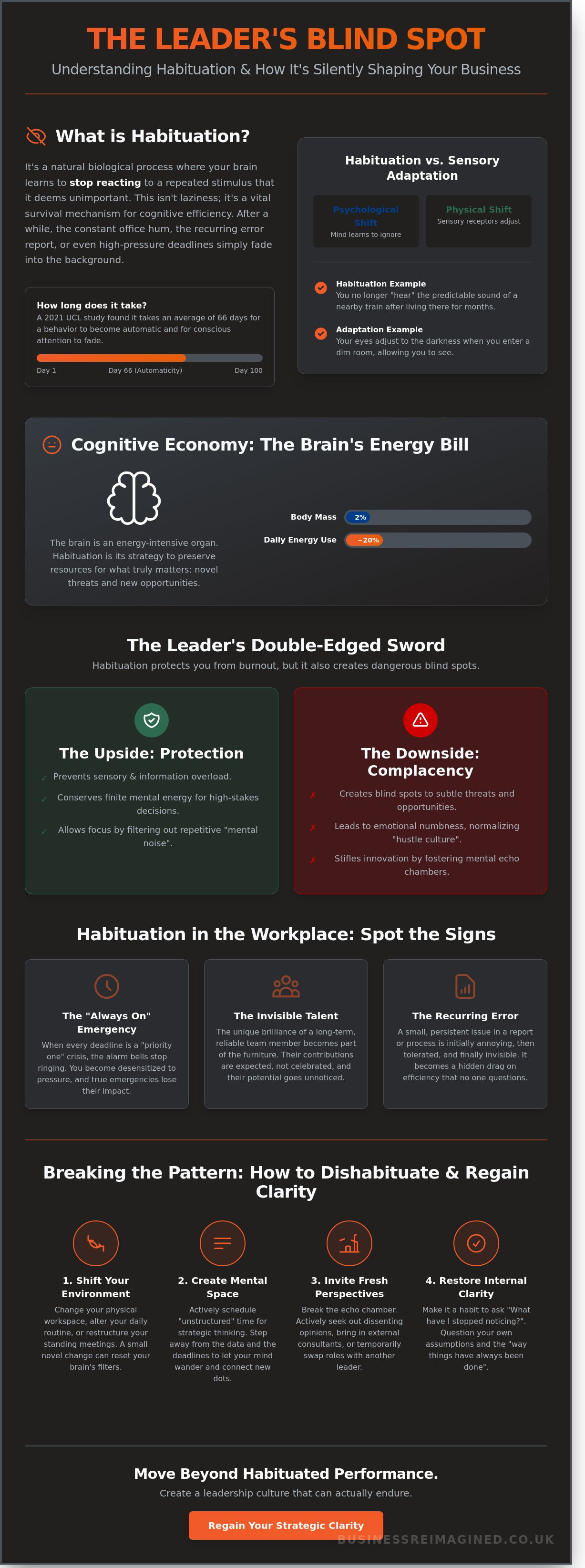
At its heart, the Habituation definition describes a fundamental process where our response to a specific stimulus decreases after repeated, inconsequential exposure. It's the simplest form of non-associative learning. We don't learn to link two events together; instead, we simply learn to stop reacting to things that don't change. This isn't the same as sensory adaptation. While adaptation involves a physical change in our sensory receptors, like our eyes adjusting to a dim room, habituation is a psychological shift. Your ears still hear the hum of the office air conditioner, but your mind has decided it's no longer worth your attention.
This mechanism serves a vital purpose called cognitive economy. The human brain is an energy-intensive organ, consuming roughly 20% of our daily metabolic energy despite making up only 2% of our body mass. To maintain a healthy leadership culture, our brains must be selective about where that energy goes. By ignoring the familiar and the repetitive, the brain preserves its resources for novel threats or unexpected rewards. It's a biological strategy for efficiency that allows us to function without becoming overwhelmed by the sheer volume of data our senses collect every second.
To better understand this concept, watch this helpful video:
The Neuroscience of the Familiar
Our brains are wired to filter out "noise" so we can focus on what truly matters for survival. Research dating back to the 1966 Thompson and Spencer study identified that habituation is a universal trait across species. It prevents sensory overload by dampening our neural response to predictable patterns. In our work on leadership development, we often refer to this as managing "mental noise." When your mind is cluttered with the familiar, it struggles to find the strategic clarity needed for high-level decision making. Habituation is the brain's way of clearing that clutter, yet it can also inadvertently hide the very signals we need to see.
Why Habituation Matters for Leaders
For those in positions of influence, this biological filter is a double-edged sword. While it protects you from exhaustion, it can also breed a dangerous form of professional complacency. When you've walked the same corridors or looked at the same data sets for years, you naturally stop seeing the subtle shifts that indicate trouble or opportunity. It's how a leadership culture that can actually endure begins to stagnate without anyone noticing. Take a moment to pause and reflect. What have you stopped noticing in your organisation simply because it's always there?
Habituation Examples: From Daily Life to the Boardroom
Habituation is the brain's way of filtering out the background noise of existence. If you live near a railway line, the initial roar of the midnight freight train eventually becomes silence. You don't hear it because your brain has decided it isn't a threat. This is a classic psychology habituation definition in action; it's the diminishing of a response to a repeated stimulus. The "new car smell" that delighted you on Monday is invisible by Friday. It's a mental economy. Our minds conserve energy by ignoring the predictable.
In a professional context, this process is more subtle and often more damaging. Leaders frequently become desensitised to high-pressure deadlines. When every project is a "priority one" emergency, the body’s alarm system stops ringing. Research shows that habituation to repeated stress can lead to a dangerous state of emotional numbness. You might stop feeling the anxiety of "hustle culture," but the physiological toll remains. The pressure hasn't disappeared; you've just stopped noticing the weight.
We see this in relationships and operations too. You might overlook the unique brilliance of a long-term team member simply because they've been reliable for five years. Cognitively, this manifests as "seeing what we expect to see." If you review a weekly report that has looked the same for 24 months, your brain will likely skip over a 15% drop in efficiency because it "knows" what the page usually says. These blind spots aren't failures of character. They're biological shortcuts.
The Sensory vs. The Strategic
While the hum of an air conditioner is a harmless sensory filter, strategic habituation is a silent risk. A leader's state of mind dictates what they filter. If you're operating from a place of exhaustion, you might habituate to a slow, 2% monthly decline in customer satisfaction. You stop seeing it as a crisis and start seeing it as "the new normal." This shift from acute observation to passive acceptance happens when we lose our intentional focus. Presence is the only cure for this strategic fog.
Habituation in Workplace Culture
Teams often habituate to poor communication or a total lack of strategic clarity. They stop asking "why" because the confusion has become part of the wallpaper. By engaging with the psychology habituation definition, we can begin to identify where our teams have settled for mediocrity. Overcoming these patterns requires a conscious return to presence. The goal is to build a leadership environment that supports long-term success, where we notice the small shifts before they become systemic failures. If you feel your team has become stagnant, it might be time to explore how our bespoke leadership support can help sharpen your collective vision.
The Leadership Blind Spot: When Habituation Stifles Innovation
Habituation is the brain's way of conserving precious energy. It's the reason you don't hear the hum of your office air conditioner or feel the weight of your watch on your wrist. While the behavioral characteristics of habituation are vital for survival, they create a dangerous silence in the boardroom. You might ask why a natural, biological process poses a threat. The answer lies in the filter. When a leader's brain decides that a recurring team tension or a dip in morale is just "background noise," innovation dies. You cannot solve a problem you no longer perceive. A psychology habituation definition describes this as the waning of a response to a stimulus after repeated exposure, which, for a leader, translates to losing the ability to notice what truly matters.
This mental filtering creates echo chambers. We become habituated to our own perspectives, causing us to dismiss fresh ideas as irrelevant distractions. It's a double bind. You need efficiency to manage a complex workload, yet that same efficiency blinds you to the subtle shifts in your industry. A 2017 study by the Project Management Institute found that 14% of IT projects fail utterly. Many of these failures stem from leaders who have become habituated to minor "glitches" that were actually systemic warnings. To lead a business that is truly reimagined, one must cultivate the spaciousness required to see these signals before they become crises.
The Risk of the "Invisible" Problem
Leaders often grow accustomed to "red flags" until they disappear into the wallpaper of daily operations. A high turnover rate or a lack of psychological safety becomes "just the way things are." This is why it's vital to identify the problem with authority before these dynamics become an invisible norm. When you stop questioning the status quo, you stop creating a leadership culture that can actually endure. True clarity comes from refusing to let the familiar go unexamined.
Breaking the Cycle of Self-Doubt
Habituation doesn't only apply to external signals; it shapes our internal world. Many leaders become habituated to self-doubt. They ignore evidence of their success because their brain is wired to focus on the familiar hum of "not being enough." In her book, Overcome Imposter Syndrome, Kay Tear explains how understanding these mental loops helps us break free from habituated patterns of thought. By bringing intentionality to our internal dialogue, we reclaim the mental energy needed to lead with soul and purpose. Breaking these loops is not about "grinding" harder, but about choosing a more gentle, intentional way of observing our own minds.
Breaking the Pattern: How to Dishabituate and Regain Clarity
If habituation is the brain's way of turning down the volume on the familiar, dishabituation is the sudden, intentional restoration of that signal. Within a standard psychology habituation definition, this process involves the recovery of a response to a stimulus after a change in the environment or the introduction of a new variable. For those in leadership, dishabituation is the tool that allows you to see the cracks in the foundation before they become structural failures. It's about waking up the neural pathways that have gone dormant from repetition.
To break the cycle of "not noticing," you can implement four practical shifts:
- Change the physical environment: A 2015 study by the University of Amsterdam found that altering one's physical surroundings can increase cognitive flexibility by approximately 15 percent. Move your workstation, change your meeting route, or work from a different space to force the brain to re-map its surroundings.
- Cultivate intentional spaciousness: This is the practice of creating a buffer between stimulus and response. Instead of reacting to every notification, set aside 20 minutes of quiet reflection to let the most important priorities rise to the surface.
- Apply subtractive psychology: Research published in Nature in April 2021 revealed that humans have a biological bias toward adding rather than subtracting. To regain clarity, identify one process or meeting to remove entirely this week.
- Invite external perspectives: Use outside observers to point out what you've become blind to. This external lens is often the only way to see the "invisible" habits that are stalling your progress.
Creating a Healthy Leadership Culture
A leadership culture that can actually endure requires a collective commitment to dishabituation. You can encourage your team to question long-standing processes by introducing intentional pivotal moments. These are scheduled pauses, perhaps quarterly, where the only goal is to audit current workflows. By creating a safe space for this inquiry, you prevent the team from drifting into a state of collective unconsciousness where errors are accepted as standard procedure.
The Power of Fresh Eyes
The most difficult aspect of habituation is that you can't see it while you're in it. Understanding the psychology habituation definition is the first step; engaging in executive coaching is the second. This partnership provides a mirror that reflects your blind spots back to you with clarity. Kay Tear discusses the importance of breaking these mental loops in her book, Overcome Imposter Syndrome, where she explores how understanding your mind allows for more authentic leadership. You can also explore visual guides on regaining perspective by visiting the Business Reimagined YouTube channel.
Are you ready to see your business with fresh clarity? Book a discovery call today to begin dishabituating from the habits that no longer serve you.
Reimagining Awareness through the Clarity Wellbeing Programme
Business Reimagined acts as a steady, strategic partner for leaders who feel they have become passengers in their own careers. When we look closely at the psychology habituation definition, we see it describes the way our brains naturally stop responding to repeated stimuli. For a leader, this often means that the red flags of exhaustion or the subtle shifts in team culture eventually become background noise. You stop noticing the friction because it has become your daily reality. The Clarity Wellbeing Programme is designed to interrupt this cycle. It doesn't ask you to work harder or add more to your plate. Instead, it addresses the root of mental noise, clearing the path for intentional action.
We embrace the "Quiet Rebel" approach. This is a deliberate rejection of the grind that modern corporate life often demands. By choosing to step back from the frantic pace, you allow yourself the spaciousness to achieve higher-level insight. Habituation numbs your ability to see new opportunities; clarity restores it. This programme isn't about ticking boxes. It's a process of self-reflection that helps you distinguish between what is urgent and what is truly important.
A Strategic Alternative to the Hustle
Traditional leadership coaching often focuses on external benchmarks like quarterly growth or aggressive scaling. We pivot toward internal alignment. Our programmes help you build a leadership culture that can actually endure, rather than one that relies on the constant, unsustainable adrenaline of the hustle. Statistics highlight the necessity of this shift. A 2023 report by Deloitte found that 77% of employees have experienced burnout at their current job, often because they have habituated to toxic levels of stress until it feels normal. We help you break that normalcy.
By focusing on a leadership environment that supports long-term success, we ensure that your professional life supports your personal wellbeing. We replace the "always-on" mentality with a rhythmic, reflective flow. This shift allows you to lead from a place of calm authority rather than reactive panic. When you stop habituating to stress, you start noticing the vital details that lead to genuine innovation and sustainable profit.
Your Next Step Toward Clarity
Breaking the patterns of habituation requires a conscious choice to see your business and your role through a different lens. It starts with a simple conversation. We invite you to book a discovery call to identify your own habituation patterns and explore how we can help you regain your strategic edge. This is an opportunity to move beyond the mental noise and rediscover the clarity that once drove your ambition.
Leadership doesn't have to be a journey of quiet depletion. It can be a source of energy and purpose. To join a community of like-minded professionals who are choosing a different path, connect with Kay Tear on LinkedIn. Together, we can join the conversation on reimagined leadership and build a professional future that is both successful and deeply human.
Reclaim Your Perspective and Lead with Intention
Leading effectively requires more than just stamina; it demands a conscious resistance to the mental fog that sets in over time. When we look at the psychology habituation definition, we find a natural process where the brain filters out repetitive stimuli to save energy. While efficient for survival, this often creates a leadership environment that struggles to adapt because the most vital cues have become background noise. You've seen how these blind spots can stifle innovation and quiet the very signals your business needs to thrive.
At Business Reimagined, we've spent over 15 years guiding leaders through deep transformation and change. Founded by international speaker and leadership consultant Chantal Burns, our neuroscience-backed approach focuses on restoring clarity where habit has taken hold. You don't have to stay stuck in a cycle of autopilot. By choosing to dishabituate, you foster a healthy leadership culture that can actually endure.
Ready to see what you've been missing? Book a Clarity Call to uncover your leadership blind spots and start leading with a renewed sense of purpose. It's time to bring your vision back into focus.
Frequently Asked Questions
What is the simplest definition of habituation in psychology?
The simplest psychology habituation definition is the gradual decrease in response to a stimulus after repeated, non-threatening exposure. Your brain filters out the "noise" to save energy and focus on what's new. While this helps us ignore the hum of an air conditioner, it also means leaders stop seeing the subtle signals of team burnout or shifting market trends.
How is habituation different from boredom?
Boredom is an emotional state of dissatisfaction when your environment lacks challenge or interest. Habituation is a deeper, neurological shift where you no longer perceive the stimulus at all. A 2021 study published in the journal Nature suggests that habituation occurs at the cellular level, helping the nervous system ignore the familiar so it can prioritise novel information.
Can habituation be reversed in a workplace setting?
You can reverse this process through intentional "dishabituation," which involves introducing a new stimulus or changing your perspective. Research from the University of Queensland in 2019 shows that even small shifts in routine can reset our neural pathways. To build a healthy leadership culture, try rotating meeting chairs or changing your physical workspace to force your brain to pay attention again.
What is an example of habituation in a leadership context?
Imagine a leader who walks past a cluttered, disorganised office every morning. Initially, the mess feels stressful, but after three weeks, they don't even see the piles of paper. This is a classic psychology habituation definition in action. They've stopped noticing the friction that slows their team down, which eventually erodes the clarity and spaciousness needed for high-level strategic work.
Is habituation always a negative thing for performance?
It isn't always a negative force for your team. Habituation is actually vital for survival as it prevents sensory overload in busy environments. If we didn't habituate, we'd be constantly distracted by the feel of our clothes or the sound of our own breathing. In a professional setting, it allows you to focus on complex tasks without being derailed by every passing conversation.
How does habituation affect team decision-making?
It can lead to "perceptual blindness" where a group ignores recurring risks because they've become part of the furniture. A 2015 report by the Harvard Business Review found that 72% of managers admitted to ignoring red flags because they had become "normal" over time. This creates a leadership environment that supports long-term success only if the team consciously practices radical curiosity.
How can I tell if I have habituated to a toxic culture?
You've likely habituated if you no longer feel a "jolt" of discomfort when witnessing micro-aggressions or unethical shortcuts. When "crunch time" becomes a permanent state rather than an exception, your nervous system has adjusted to a high-stress baseline. In her book, Overcome Imposter Syndrome, Kay Tear explores how we must understand our minds to break free from these damaging, normalised patterns and lead authentically.
What is the difference between habituation and desensitisation?
Habituation is a passive, natural reduction in response to a neutral stimulus. Desensitisation is usually a deliberate process, often used in clinical settings to reduce an emotional reaction to a negative stimulus, like a fear of public speaking. While both involve a decrease in sensitivity, habituation is your brain's way of seeking efficiency, whereas desensitisation is about building intentional emotional resilience.