
Team Development vs Leadership Development: Reimagining the Path to Strategic Clarity
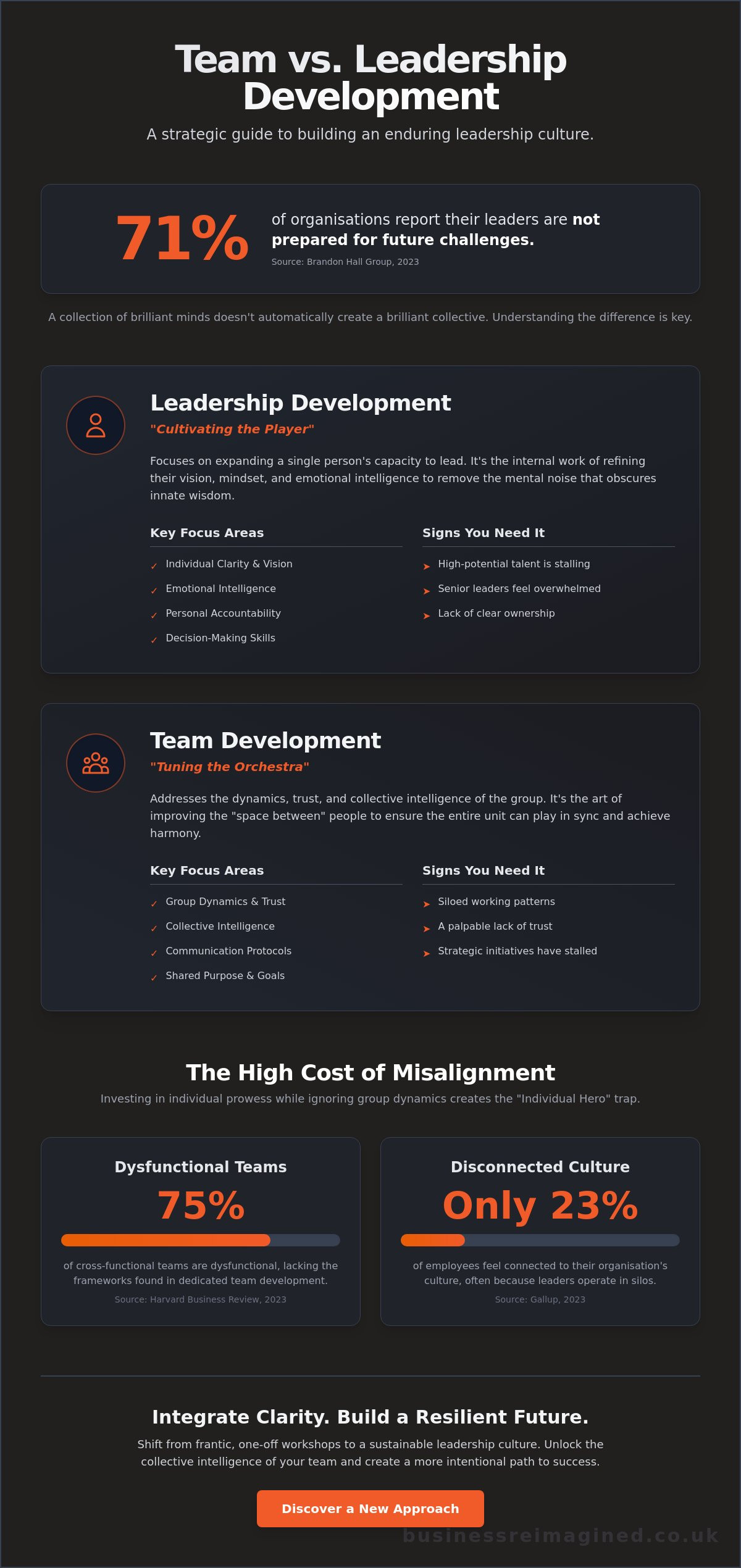
What if the reason your senior team feels stuck isn't a lack of talent, but a misunderstanding of how that talent connects? We often pour resources into refining the individual, yet 71% of organisations still report that their leaders aren't prepared for future challenges, according to a 2023 Brandon Hall Group study. Understanding the nuances of team development vs leadership development is the first step toward moving away from the frantic cycle of one-off workshops that fail to stick. It's about recognising that a collection of brilliant minds doesn't automatically create a brilliant collective.
You likely feel the weight of this misalignment. The mental fatigue of "hustle culture" often stems from trying to compensate for a lack of collective clarity. This article promises to reveal the fundamental distinctions between individual growth and team dynamics, ensuring your budget builds a leadership culture that can actually endure. We will explore a decision-making framework designed to foster collective intelligence and create a more spacious, intentional path to strategic success.
Key Takeaways
- Understand how cultivating internal clarity and mental alignment within individual leaders serves as the foundational driver for sustainable organisational performance.
- Discover how to shift your focus from individual output to the 'space between' people, unlocking the collective intelligence and resilience found in team dynamics.
- Learn to distinguish which intervention your business truly needs by exploring the strategic differences between team development vs leadership development.
- Gain a clear framework for measuring the ROI of your development investments to ensure you are building a leadership culture that can actually endure.
- Explore the philosophy of 'Quiet Rebellion' and how bridging the gap between individual and collective growth leads to a more intentional and human-centric path to success.
Team Development vs Leadership Development: Defining the Core Distinctions
In the quiet pursuit of organisational excellence, we often conflate two distinct paths. This confusion isn't just a matter of semantics; it results in millions of pounds of misdirected investment. When we mistake individual growth for collective harmony, we create a culture that feels fractured despite having talented people at the helm. True strategic clarity begins by recognising that a room full of brilliant individuals does not automatically constitute a high-performing unit.
To better understand this concept, watch this helpful video:
Leadership development focuses on the expansion of a single person's capacity to lead with clarity and intention. It's about the internal work of the "player," refining their vision and emotional intelligence. In contrast, team development addresses the dynamics, trust, and collective intelligence of the group. It's the art of tuning the "orchestra." Understanding the difference between team development vs leadership development is the first step toward a leadership culture that can actually endure. While the leader sets the tempo, the team must learn to play in sync. When moving through Tuckman's stages of group development, the focus shifts from individual performance to the rhythmic harmony of the whole.
The Cost of Misalignment in Your Development Strategy
Investing in individual prowess while ignoring the group creates a friction-heavy environment. We call this the "Individual Hero" trap. A 2023 study by Gallup found that only 23% of employees feel connected to their organisation’s culture, often because brilliant leaders are operating in silos. Treating leadership and team development as interchangeable risks building a collection of high-performing silos that lack the structural integrity to support a healthy leadership culture.
Identifying Your Organisation’s Current Needs
Moving beyond the hustle means looking at the gaps with honesty. Are your leaders struggling with their own shadows, or is the group struggling with each other? You can explore tailored support for these gaps through our bespoke services. Consider these markers:
- Signs you need leadership development: High-potential talent stalling, senior leaders feeling overwhelmed, or a lack of personal accountability in decision-making.
- Signs you need team development: Siloed working patterns, a palpable lack of trust, or strategic transitions that have stalled despite clear directives.
A 2023 Harvard Business Review analysis indicated that nearly 75% of cross-functional teams are dysfunctional because they lack the collective intelligence frameworks found in dedicated team development. Recognising these signs allows for a more intentional allocation of resources, ensuring that your path to growth is both sustainable and human-centric.
Leadership Development: Cultivating Individual Clarity and Internal Alignment
Leadership development is often misunderstood as a quest to acquire more tools. We're told that better leaders have bigger toolkits. This approach fails because it ignores the leader's state of mind as the primary driver of performance. When we compare team development vs leadership development, we see that the latter must begin with the individual's internal clarity. High performance isn't about adding more "how-to" guides; it's about removing the mental noise that obscures innate wisdom. Traditional skills training often falls flat because a cluttered mind cannot effectively apply new techniques.
True growth happens through subtractive psychology. We don't need to learn how to be resilient; we need to understand what's getting in the way of our natural resilience. This is why executive business coaching is so vital. It provides a space for deep self-reflection, allowing leaders to see through their own habitual thinking. By clearing this internal fog, a leader can operate from a place of grounded presence rather than reactive habit. This shift transforms the dynamic of team development vs leadership development, as a clear leader naturally fosters a more stable environment for their staff.
The Neuroscience of the Leader’s Mind
Biological factors play a massive role in how we lead. When an executive is under constant pressure, the brain's prefrontal cortex, responsible for strategic thinking, effectively goes offline. This creates a "Double Bind" where the leader feels they must work harder to solve problems, yet the very act of "grinding" prevents them from accessing the clarity needed for a solution. Insights from federal leadership development programs suggest that structured growth is essential for professional standards. However, without addressing the underlying neuroscience of stress, these programs only scratch the surface. When the mind is quiet, decision-making becomes effortless and precise.
Sustainable High Performance vs. Hustle Culture
We've been sold a lie that success requires constant hustle. This narrative is exhausting and unsustainable. Real impact comes from intentionality, not frantic activity. According to a Deloitte survey, 77% of professionals have experienced burnout in their current roles, highlighting the desperate need for a different approach. Our Clarity Wellbeing Programme shifts the focus from "doing more" to "being clearer."
Internal barriers often masquerade as professional hurdles. In her book, Overcome Imposter Syndrome, Kay Tear explores how understanding the mind helps leaders break free from self-doubt and lead authentically. Addressing these internal blocks is the first step toward building a leadership culture that can actually endure. If you're ready to explore a more grounded way of working, you can connect with Kay Tear on LinkedIn to begin the conversation. Success doesn't have to feel like a fight; it can feel like a natural expression of clarity.
Team Development: Unlocking Collective Intelligence and Resilience
Traditional growth strategies often fixate on the individual. We polish the skills of the leader, hoping the excellence will trickle down. Yet, true strategic clarity emerges from the space between people. This is the core distinction in team development vs leadership development. While the latter refines the person, the former nurtures the relationship. It's the difference between tuning a single instrument and conducting a symphony.
Collective intelligence is more than the sum of individual IQs. Research indicates that a group's performance isn't necessarily correlated with the average intelligence of its members, but rather their social sensitivity and the equality of conversation. When we unlock this hidden power, the team becomes a living, breathing entity capable of navigating transitions that would break a solo leader. It creates a sense of spaciousness where ideas can breathe.
Dynamics Over Mechanics: The Heart of Team Growth
Processes and checklists provide a sense of control, but they don't drive real change. We focus on dynamics. Many corporate environments are trapped in "polite compliance." People nod in agreement during meetings while harbouring quiet doubts. This silence is expensive. Our team development workshops function as Transformation and Change Accelerators, designed to move teams into radical transparency. Trust is the foundation here.
When trust exists, teams stop performing and start producing. They find a rhythm where ideas flow without the friction of ego. You can explore the mechanics of this collective intelligence to understand how teams move from individual effort to unified momentum. It’s about creating a space where everyone feels safe enough to be honest. This transparency is what allows a team to pivot quickly without losing its sense of purpose.
Nurturing a Healthy Leadership Culture
We believe in building a healthy leadership culture rather than a frantic one. This isn't a passive outcome; it's an intentional environment. A leader's state of mind is the most potent tool in the room. If you operate from a place of quiet authority, you create psychological safety for everyone else. This academic thesis on leadership and team development from the Karolinska Institutet illustrates how collective interventions foster resilience differently than individual coaching.
Success shouldn't require your constant intervention. A leadership culture that can actually endure is one where the team has the clarity to act independently. It’s about alignment over control. By focusing on the health of the collective, you ensure the business remains sustainable and grounded, even when the strategy shifts. You aren't just building a team; you're cultivating a leadership environment that supports long-term success. This allows you to step back, knowing the work will continue with purpose and heart.
Strategic Comparison: Choosing the Right Intervention
Deciding between team development vs leadership development is not about choosing one over the other. It is about identifying where the "noise" in your organisation is currently most disruptive. When a leadership culture feels frantic, the lack of clarity often stems from either individual misalignment or collective friction. We must look through a lens of intentionality to see which intervention will restore a sense of calm and purpose.
Leadership development focuses on the internal world of the individual. It is an investment in the person's ability to hold space for others without losing their own grounding. Team development, conversely, addresses the space between people. It focuses on the relational architecture that allows a group to move as one. Measuring the return on these investments requires different metrics:
- Individual ROI: This is seen in increased retention rates, higher scores in emotional intelligence assessments, and a reduction in leader burnout.
- Collective ROI: This manifests as faster decision-making cycles, reduced "re-work" caused by miscommunication, and a measurable increase in psychological safety.
A 2023 study by the Brandon Hall Group found that organisations with high-maturity leadership development are 11 times more likely to have a leadership culture that can actually endure (Source: Brandon Hall Group 2023). Most successful organisations move away from a binary choice, opting for a hybrid approach that addresses both the individual's inner clarity and the team's shared vision.
When to Prioritise Leadership Development
This path is most effective for high-potential talent or executives stepping into "pivotal moments" such as a significant promotion. The focus remains on emotional intelligence, personal resilience, and strategic vision. By engaging with bespoke Leadership Development Programmes, leaders can strip away the mental noise of imposter syndrome and lead from a place of authentic authority rather than frantic effort.
When to Prioritise Team Development
Choose this intervention for newly formed boards or teams suffering from "transformation fatigue" after a merger. The goal is to build trust and align everyone on a singular purpose. We use "Transformation Accelerators" to bypass the typical friction of team forming. This ensures the communication flow is gentle yet efficient; it allows the team to focus on strategic transitions without the weight of unresolved interpersonal conflict.
Integrating Clarity: The Path to Reimagined Business Success
The debate between team development vs leadership development often feels like a choice between two separate paths. One focuses on the individual's inner world; the other on the group's collective output. At Business Reimagined, we see these not as competing priorities, but as two sides of the same intentional practice. This is the essence of our 'Quiet Rebellion.' It's a refusal to accept the exhaustion of hustle culture as the price of entry for success. Instead, we prioritise mental clarity as the golden thread. Clarity allows a leader to see their own biases and an employee to understand their unique contribution. When clarity is present, the friction of misalignment disappears, replaced by a sense of calm, purposeful momentum.
This bridge between individual and collective growth is essential for a healthy leadership culture that can actually endure. When we focus solely on leadership, we risk creating isolated visionaries. When we focus only on teams, we risk losing individual accountability. Reimagining business success means integrating these efforts. It requires us to look at the business as a living entity where well-being and strategic clarity are inextricably linked. By auditing your current culture, you can identify where the disconnect lies. Is it a lack of individual confidence, or a breakdown in team communication? Identifying this starting point is the first step toward a more sustainable way of working.
To begin this process, consider these reflective questions:
- Does our current development strategy feel like a tick-box exercise or a genuine transformation?
- Are we rewarding the "grind," or are we rewarding the clarity that leads to better results?
- How much spaciousness exists in our weekly schedule for deep, strategic thinking?
The Role of Bespoke Programmes
Standardised training often ignores the specific psychology of your performance. It treats humans like software that needs a generic update. We design tailored workshops that address the specific tensions within your team. This often involves addressing internal barriers, as explored in Kay Tear's book, Overcome Imposter Syndrome. Success shouldn't be measured by the number of hours worked. Instead, consider your 'spaciousness' as a primary metric for long-term health.
Starting Your Journey Toward Clarity
According to a 2023 Gallup report, 59% of employees are 'quiet quitting' globally, often due to a lack of purpose or clarity (https://www.gallup.com/workplace/506820/state-global-workplace-2023-report.aspx). Start a conversation with stakeholders about what sustainable growth looks like. If you're ready to move beyond the binary of team development vs leadership development, you can book a discovery call here to explore tailored solutions for your team. Let's build a leadership environment that supports your success.
Moving Toward a More Intentional Leadership Culture
Deciding between team development vs leadership development doesn't have to be a source of friction. It's about recognising where the pressure points lie within your organisation. Leadership development focuses on the internal alignment of the individual, while team development fosters the collective intelligence required for resilience. Both are essential components of a leadership environment that supports long-term success. Chantal Burns, an international speaker and consultant with over a decade of experience in executive transformation, has shown that subtractive psychology is the key to this clarity. When we stop adding more tasks and start understanding the 3 Principles, we create space for genuine strategy to emerge.
It's possible to achieve your goals without succumbing to the exhaustion of modern work culture. You can foster a healthy leadership culture that values well-being as much as it values results. This isn't just about better management; it's about a fundamental shift in how you and your team show up every day. If you're ready to move beyond the frantic pace and find a steadier rhythm, we're here to help. Reimagine your leadership culture; book a clarity call today. A more spacious, purposeful way of working is waiting for you.
Frequently Asked Questions
Is team development the same as team building?
No, team development isn't the same as team building. While team building often focuses on short-term social bonding or a single afternoon of activities, team development is a sustained, intentional process. It aims to create a healthy leadership culture by aligning collective goals and improving how people actually work together. Research suggests that structured team development interventions can improve performance by 20% (Source: APA PsycNet).
Can leadership development be done in a group setting?
Leadership development thrives in a group setting because it allows leaders to mirror one another's challenges and insights. This collective approach shifts the focus from individual "heroic" leadership to a more sustainable, shared responsibility. According to a 2023 report by the Brandon Hall Group, 56% of organisations now prioritise social or collaborative learning for their leaders. It creates a space where vulnerability becomes a strategic strength rather than a weakness.
How do I know if my team needs individual coaching or a workshop?
You can determine the right path by looking at the source of the friction. If a specific leader feels stuck in their own narrative or needs to navigate a personal transition, individual coaching offers the necessary spaciousness for deep reflection. If the group lacks strategic clarity or struggles with collective decision-making, a workshop is better. Often, a blend of both creates the most alignment, ensuring the team development vs leadership development balance is maintained.
What is the typical ROI for leadership development programmes in the UK?
The ROI for leadership development is substantial, with a 2021 study by the International Coaching Federation (ICF) indicating that companies see a median return of 700% on their initial investment. In the UK, organisations that invest in a leadership culture that can actually endure often see a 10% increase in employee retention. These figures reflect more than just profit; they represent the value of a grounded, intentional workplace where people feel seen and supported.
How does neuroscience help in team development?
Neuroscience provides a map for understanding how our brains react to social dynamics within a professional environment. By recognising the "SCARF" model developed by David Rock in 2008, teams can identify when they're in a "threat" state versus a "reward" state. This knowledge helps create a sense of psychological safety. When the brain isn't busy scanning for social threats, it has more capacity for the creative thinking and strategic clarity required for high-level performance.
Can you do team development without leadership development?
You can attempt team development in isolation, but it's rarely sustainable without parallel leadership development. A team's growth is often capped by the self-awareness and "state of mind" of its leader. If the person at the helm remains trapped in a hustle-centric mindset, the team will eventually mirror that exhaustion. True transformation requires a leadership environment that supports long-term success, where the leader grows alongside their people to maintain lasting alignment.
How long does it take to see results from a clarity-based programme?
Initial shifts in perspective often happen within the first 48 hours of a clarity-based retreat or session. However, embedding these changes into a healthy leadership culture typically takes between 6 and 12 months. This timeline allows for the gentle repetition of new habits and the dismantling of old, frantic patterns. Real change isn't about a quick fix; it's about a steady, rhythmic progression toward a more intentional way of working.
What is the role of 'state of mind' in collective performance?
State of mind is the invisible filter through which all work happens. When a team operates from a cluttered, stressed state, they perceive problems as insurmountable obstacles. Conversely, a clear state of mind allows for a sense of spaciousness where solutions emerge naturally. Research published in the Journal of Occupational and Organizational Psychology in 2017 found that psychological well-being accounts for up to 25% of the variance in employee performance. It's the foundation of a reimagined workplace.