
Leadership Development Programmes: Reimagining Performance Through Clarity (2026 Guide)
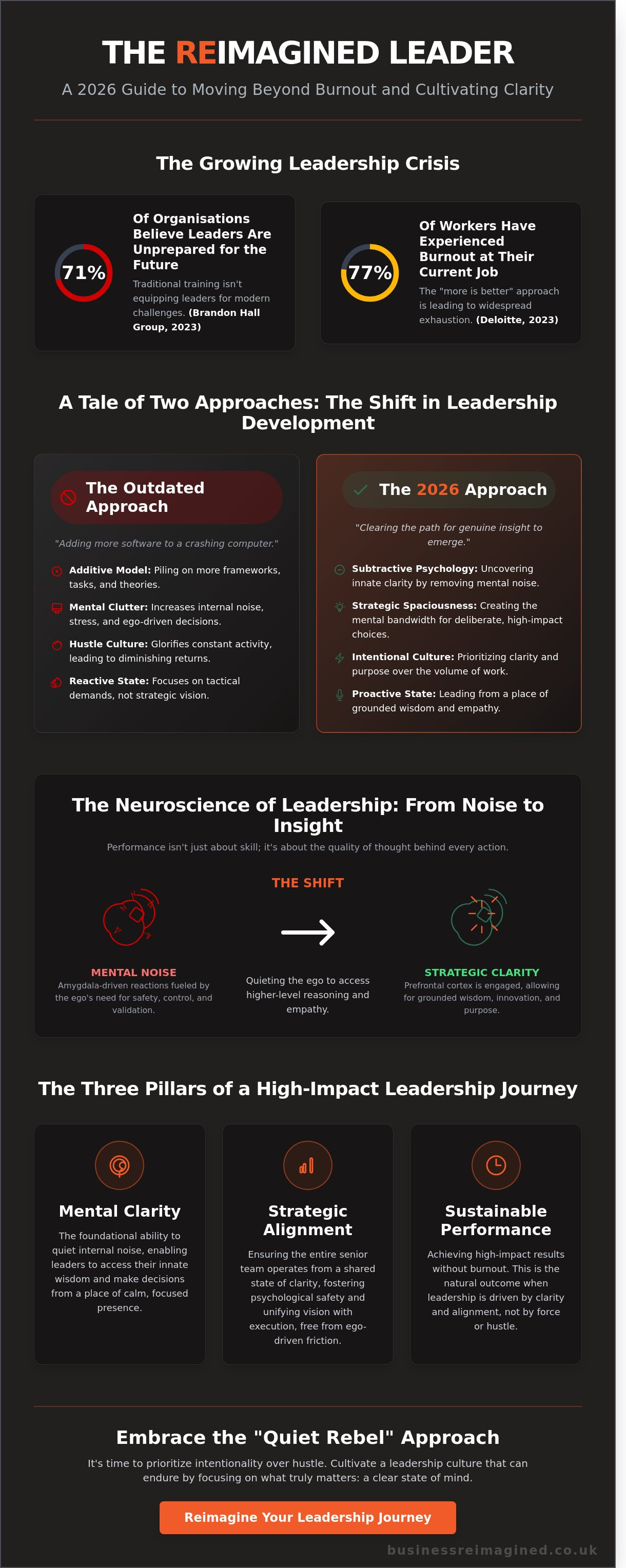
What if the greatest barrier to your team’s success isn't a lack of talent, but a surplus of mental noise? In 2023, research by the Brandon Hall Group revealed that 71% of organisations believe their leaders aren't prepared to guide them into the future. This gap suggests that traditional, one-size-fits-all Leadership Development Programmes are failing to address the quiet exhaustion felt by high-potential talent. You've likely sat through workshops that offer plenty of theory but very little space to breathe or think.
It's frustrating to invest in training that feels disconnected from the daily pressure of strategic decision-making. You're right to be skeptical of generic solutions that ignore the human need for clarity. This 2026 guide promises a different approach. You'll learn how to move beyond standard corporate training to find development that fosters mental clarity and sustainable performance. We'll explore how to cultivate a leadership culture that can actually endure, ensuring your team finds the intentionality needed to lead with purpose rather than just reacting to the next tactical demand.
Key Takeaways
- Learn why effective Leadership Development Programmes in 2026 focus on refining a leader's state of mind rather than adding to the mental clutter of traditional frameworks.
- Discover how understanding the neuroscience of leadership allows you to move beyond mental noise and ego-driven decisions toward strategic clarity.
- Explore the three essential pillars-Mental Clarity, Strategic Alignment, and Sustainable Performance-that form the foundation of a high-impact leadership journey.
- Understand how to cultivate a leadership culture that can actually endure by prioritising psychological safety and the internal alignment of your senior team.
- Identify your own pivotal moment for change and embrace a "Quiet Rebel" approach to leadership that values intentionality over traditional hustle.
Beyond the Hustle: Why Traditional Leadership Development Programmes Often Miss the Mark
As we look toward 2026, the definition of success is shifting. It isn't about collecting more frameworks or mastering another productivity hack. True leadership development now focuses on refining a leader's state of mind rather than simply filling their toolkit. Many current Leadership development initiatives fail because they treat the human mind like an infinitely expandable storage drive. This additive model creates a heavy burden that eventually breaks the very people it's designed to support.
We expect leaders to absorb more tasks and more complex strategies while their mental capacity is already stretched thin. This relentless hustle culture in management leads to a point of diminishing returns. Research from Deloitte’s 2023 Well-being at Work report indicates that 77% of workers have experienced burnout, a figure that highlights the unsustainability of constant activity. A healthy leadership culture is built on clarity, not on the volume of work produced.
To better understand how to move away from these outdated models, watch this helpful video on creating effective initiatives:
The Problem with the "More is Better" Approach
Traditional training often puts leaders in a double bind. They're told to be more strategic while being buried under an avalanche of new tactical frameworks. Adding more software to a crashing computer doesn't fix the underlying processor issues; it only hastens the system failure. We need a quiet revolution in corporate training that prioritises mental bandwidth over content consumption. Modern Leadership Development Programmes must stop adding to the noise and start clearing the path for genuine insight.
From Mental Noise to Strategic Spaciousness
Mental noise is the internal chatter of "what ifs" and "shoulds" that clouds executive decision-making. When a leader's mind is noisy, their team feels the friction in every meeting and email. Contrast this with spacious leadership, where a calm presence allows for deliberate, high-impact choices. This shift is vital for building a leadership culture that can actually endure. Leaders who struggle with these internal pressures often find clarity by learning to Overcome Imposter Syndrome, which helps them lead more authentically. Subtractive psychology is the process of uncovering innate clarity.
The Neuroscience of Effective Leadership: Moving from Noise to Insight
When pressure mounts, the brain's prefrontal cortex often takes a backseat to the amygdala. This shift triggers a specific kind of mental "noise," usually driven by the ego's need for safety, control, or validation. This internal static obscures strategic clarity, making it difficult to lead from a place of grounded wisdom. Understanding the neuroscience of leadership development allows us to see that performance isn't just about skill; it's about the quality of thought behind every action. When the ego is quieted, the brain can access higher-level reasoning and empathy, which are the true engines of resilience.
Understanding the State of Mind as a Performance Metric
Traditional Leadership Development Programmes often focus on external frameworks and tools while ignoring the most critical variable: the leader's state of mind. Your internal alignment dictates the health of your strategy. If a leader operates from a place of frantic urgency, the team will mirror that exhaustion. We use the 3 Principles as a framework to help leaders understand that their experience of business is created from the inside out. When you settle the mind, you create a healthy leadership culture that can actually endure. This internal shift is what moves a team from friction to flow, turning a collection of individuals into a unified force.
Breaking the Cycle of Habituation
Habituation is a powerful psychological force. It's why we revert to familiar, ineffective patterns even after attending expensive seminars. The brain is wired for efficiency, often choosing the path of least resistance over the path of intentional growth. To create lasting change, Leadership Development Programmes must address these deep-seated neural pathways. According to data from the Federal Supervisory, Managerial & Executive Training guidelines, structured development plans and consistent reinforcement are essential for moving beyond initial training into sustained behavioural shifts. Without this depth, "learning" remains a surface-level activity that fades under stress.
Breaking free from these cycles requires more than just willpower. In her book, Overcome Imposter Syndrome, Kay Tear explores how understanding the mechanics of the mind helps leaders break free from self-doubt and habituated fear. When a leader achieves this level of mental clarity, they unlock "collective intelligence" within their team environment. The noise of the ego subsides, making space for everyone's best ideas to surface and harmonise. If you're looking to cultivate this level of insight within your own organisation, you might find our bespoke leadership services a helpful place to start.
Key Components of a High-Impact Leadership Programme in 2026
Modern leadership requires more than a refined skill set; it demands a fundamental shift in how we inhabit our roles. By 2026, the most effective Leadership Development Programmes will move away from rigid checklists and toward three essential pillars: Mental Clarity, Strategic Alignment, and Sustainable Performance. These pillars ensure that a leader isn't just "doing" more, but is "being" more effective. Mental clarity allows for decisive action in a noisy world. Strategic alignment ensures every effort feeds into a deeper purpose. Sustainable performance protects the human at the centre of the strategy, ensuring success doesn't come at the cost of the soul.
A 2023 report by the Brandon Hall Group revealed that 76% of organisations feel their leadership strategies don't align with their business goals. This gap exists because many programmes ignore the internal state of the leader. High-impact interventions in the coming years will prioritise the internal landscape, recognizing that a cluttered mind cannot lead a clear strategy. It's about creating a sense of spaciousness where innovation can actually breathe.
Bespoke vs. Off-the-Shelf Programmes
Generic, off-the-shelf training packages often feel like a mismatch for the nuanced challenges of a senior executive. While they might offer lower upfront costs, the ROI is frequently diluted because they fail to address the specific leadership environment of the firm. A bespoke approach acknowledges that your team isn't a machine; it's a living culture with its own history and aspirations. Tailored interventions allow for a deeper dive into the specific pressures your people face.
At the heart of this intentional approach is the Clarity Wellbeing Programme. This serves as a vital foundation for senior leaders, moving beyond surface-level stress management to foster a leadership environment that can actually endure. When you build a programme around the actual needs of your people, you see a shift from passive participation to active transformation. You aren't just ticking a box; you're nourishing the roots of your organisation.
The Role of Transformation Accelerators
Passive learning modules are no longer enough to keep pace with the shifts we see in the professional world. We need transformation accelerators. These are intentional tools and frameworks designed to speed up strategic transitions without triggering the friction of burnout. They move a team from theory to practice with a sense of grace and momentum. You can explore how these are integrated into modern strategy by looking at Business Reimagined’s services.
Measuring the success of these accelerators requires looking past simple feedback forms or "smile sheets." Instead, we look at tangible shifts in the leadership environment. Are decisions being made faster? Is there a measurable reduction in executive turnover? According to a 2024 LinkedIn Learning report, 90% of organisations are concerned about employee retention. Effective Leadership Development Programmes use accelerators to create a culture where people feel seen and supported, naturally driving those retention numbers upward. This isn't about rushing the process; it's about removing the obstacles that prevent your team from flourishing naturally.
Executive coaching plays a quiet, yet powerful role within this broader framework. It provides a private space for reflection and honest conversation. This individual support ensures that the lessons learned in the wider programme are integrated into the leader's daily rhythm, making the change both personal and permanent.
Building a Leadership Culture that Can Actually Endure
Culture isn't a static set of values printed on a wall. It's a living, breathing reflection of the collective state of mind of your leaders. When we design Leadership Development Programmes, the goal shouldn't be to simply tick off a list of competencies. Instead, we aim to build a leadership culture that can actually endure by addressing the internal clarity of the individuals at the helm. When a leader operates from a place of mental stillness, they naturally create a leadership environment that supports long-term success.
Psychological safety is often discussed as a management technique, but it truly takes root in a leader’s own clarity. If a leader is frantic, their team will inevitably feel a sense of unease. A 2015 study by Google, known as Project Aristotle, identified psychological safety as the most critical factor in high-performing teams. This safety is not something you "do"; it's something you provide by being a steady, grounded presence for those around you.
For HR directors looking to evaluate the health of their current leadership environment, consider this checklist:
- Do leaders pause to reflect before reacting to high-pressure situations?
- Is "spaciousness" protected in schedules, or is back-to-back scheduling the standard?
- Are mistakes treated as valuable data points or as personal failures?
- Does the leadership team exhibit a shared sense of calm during periods of transition?
- Is silence in meetings respected as a sign of deep thinking rather than a lack of engagement?
Nurturing High-Potential Talent
Identifying high-potential talent often carries an unintentional risk. We see promise and, in our enthusiasm, we subject these individuals to the "grind" mentality, believing that more pressure equals more growth. The next generation of leaders sees through this. They value intentionality and well-being over traditional, heavy-handed authority. In fact, a 2023 Deloitte survey found that 77% of Gen Z and Millennial workers would consider looking for a new job if their employer didn't prioritise well-being. Our Beyond Limits Programme is designed to push boundaries sustainably. It teaches that true high performance comes from a place of internal alignment, not external exhaustion.
Fostering Collective Intelligence
A healthy leadership culture allows for the emergence of collective intelligence. This isn't about having the smartest individual in the room; it's about the group's ability to access a deeper level of wisdom together. A leader’s presence is the key. When a leader is truly present, they can hear the subtle insights that a frantic mind would miss. This shift in presence transforms team dynamics, allowing the group to solve complex problems with a sense of ease rather than through forced effort. By investing in Leadership Development Programmes that focus on mental clarity, you ensure that your team's collective intelligence becomes your greatest competitive advantage.
Reimagining Your Leadership Journey: Next Steps for Senior Executives
As we look toward 2026, the demand for Leadership Development Programmes that prioritise human connection over frantic output has never been higher. The "Quiet Rebel" approach isn't a temporary trend. It's a strategic necessity for executives who value longevity and mental clarity. This philosophy requires us to step away from the noise of traditional hustle culture and move into a space of intentional alignment. It's about building a leadership environment that supports long-term success rather than one that burns through its most valuable assets.
Do you remember your own pivotal moment? Perhaps it was a morning where the weight of the "grind" finally felt unsustainable. It might have been a board meeting where the numbers looked right, but the culture felt empty. According to the Mental Health UK 2024 Burnout Report, 91% of adults experienced high or extreme levels of pressure in the past year. That moment of clarity you felt is your starting point for change. Business Reimagined exists to help you bridge the gap between your current exhaustion and a healthy leadership culture.
The Path to Strategic Transformation
Starting the conversation within your organisation requires a gentle but firm shift in perspective. You might begin by asking your board how much "spaciousness" currently exists in their decision-making processes. Strategic shifts often begin with a single, honest question. Sometimes, an external perspective is needed to shift the room's energy and spark initial curiosity. Professional keynote speaking can serve as this catalyst, inviting your team to consider a different way of working that values well-being as much as profit. For ongoing leadership insights and reflections on the "Quiet Rebel" path, you can connect with Kay Tear’s LinkedIn.
Booking Your Clarity Consultation
A discovery call is a moment of stillness designed to explore your firm's specific needs. We don't use high-pressure sales tactics. Instead, we focus on identifying where your current structures are misaligned with your core values. This conversation is about finding clarity in a crowded marketplace. You can see examples of this intentional, human-centric approach by visiting the Business Reimagined YouTube channel. Our videos offer a window into how we transform traditional management into a form of intentional living.
When you're ready to move from noise to clarity, the next step is simple. We'll work together to create a leadership culture that can actually endure the challenges of the coming years. Your journey toward a more sustainable way of leading starts with a single, deliberate choice. Book a discovery call with Kay Tear to begin your transformation today.
Stepping Into a New Paradigm of Performance
Leadership in 2026 requires a departure from the exhausting noise of traditional corporate hustle. True performance isn't found in doing more; it's found in the clarity that emerges when we understand the neuroscience of our own minds. Modern Leadership Development Programmes must move beyond generic templates to embrace subtractive psychology, allowing senior executives to lead with intention rather than reaction. Industry data suggests that only 10% of corporate training programmes deliver a clear return on investment (source: Forbes). This highlights a critical need for a more grounded, human-centric approach that prioritises sustainable results over temporary speed.
Business Reimagined, founded by international speaker and leadership consultant Chantal Burns, provides bespoke, neuroscience-based programmes designed for the complexities of senior leadership. We help you move away from frantic benchmarks and toward a leadership culture that can actually endure. By focusing on mental clarity and intentional alignment, we ensure your professional life supports your well-being rather than consuming it. It's time to rewrite the rules of your leadership journey with a partner who values your humanity as much as your results. You have the capacity for profound insight; let's create the space for it to surface.
Begin your leadership transformation; book a call with Business Reimagined today
Frequently Asked Questions
What is the difference between leadership development and executive coaching?
Leadership development focuses on collective growth and broad skill sets across a team, while executive coaching is an intimate, one to one partnership tailored to an individual's specific hurdles. Think of the former as cultivating a leadership environment that supports long term success for the whole group. The latter provides a private space for a senior leader to reflect on their personal alignment and impact.
How long does a typical leadership development programme take to show results?
Most organisations begin to observe shifts in team dynamics and decision making clarity within 3 to 6 months of starting a programme. While immediate wins are tempting, true resilience is built slowly. Research by the Brandon Hall Group in 2023 indicates that 71% of organisations believe their leadership strategy is critical for future success, yet lasting behavioural change requires consistent practice over several quarters.
Can leadership development programmes help with imposter syndrome?
Yes, these programmes provide the tools to dismantle the internal narratives that lead to self doubt. By fostering a healthy leadership culture, individuals feel safe to lead with authenticity rather than a mask of perfection. Kay Tear explores these themes deeply in her book, Overcome Imposter Syndrome: Understand your Mind to Break Free from Self-Doubt, Lead Authentically, and Accelerate Your Career, where she outlines how understanding your mind can help you lead more naturally.
Why is mental clarity important for strategic decision-making?
Mental clarity allows a leader to see past the noise of daily operations and focus on the intentional path ahead. When the mind is cluttered, decisions are often reactive rather than strategic. A 2022 study published in the Journal of Management found that leaders who practice mindfulness and clarity seeking techniques improve their cognitive flexibility by 20%. This leads to more sustainable outcomes for their teams.
What should I look for when choosing a leadership development consultant in London?
Look for a consultant who prioritises human centric values and has a proven track record within the UK's specific corporate regulatory environment. You should seek a partner who avoids aggressive growth jargon and instead focuses on building a leadership culture that can actually endure. Ensure they offer bespoke strategies rather than off the shelf packages, as every organisation has its own unique rhythm and needs.
How do you measure the ROI of a leadership development programme?
You measure ROI by tracking specific metrics such as employee retention rates, internal promotion statistics, and engagement scores. According to a 2021 report from the Association for Talent Development, companies with comprehensive Leadership Development Programmes see a 24% higher profit margin than those who don't invest in such training. These numbers reflect the tangible value of a grounded, intentional workforce.
Is neuroscience relevant to corporate leadership training?
Neuroscience is fundamental because it explains how our brains respond to stress, change, and social dynamics in the workplace. By understanding the threat and reward responses, leaders can create an environment where teams feel psychologically safe. This scientific approach helps move away from hustle culture and toward a more rhythmic, sustainable way of working that respects the biological limits of the human brain.
How can we build a healthy leadership culture in a high-pressure industry?
Building a healthy leadership culture requires a deliberate shift from urgency based management to a philosophy of intentional presence. It starts with leaders modelling well being and setting clear boundaries that protect their team's mental spaciousness. When success is viewed as a personal and collective journey rather than a frantic race, the entire organisation becomes more resilient to external pressures.