
Collective Intelligence: How to Unlock the Hidden Power of Your Team
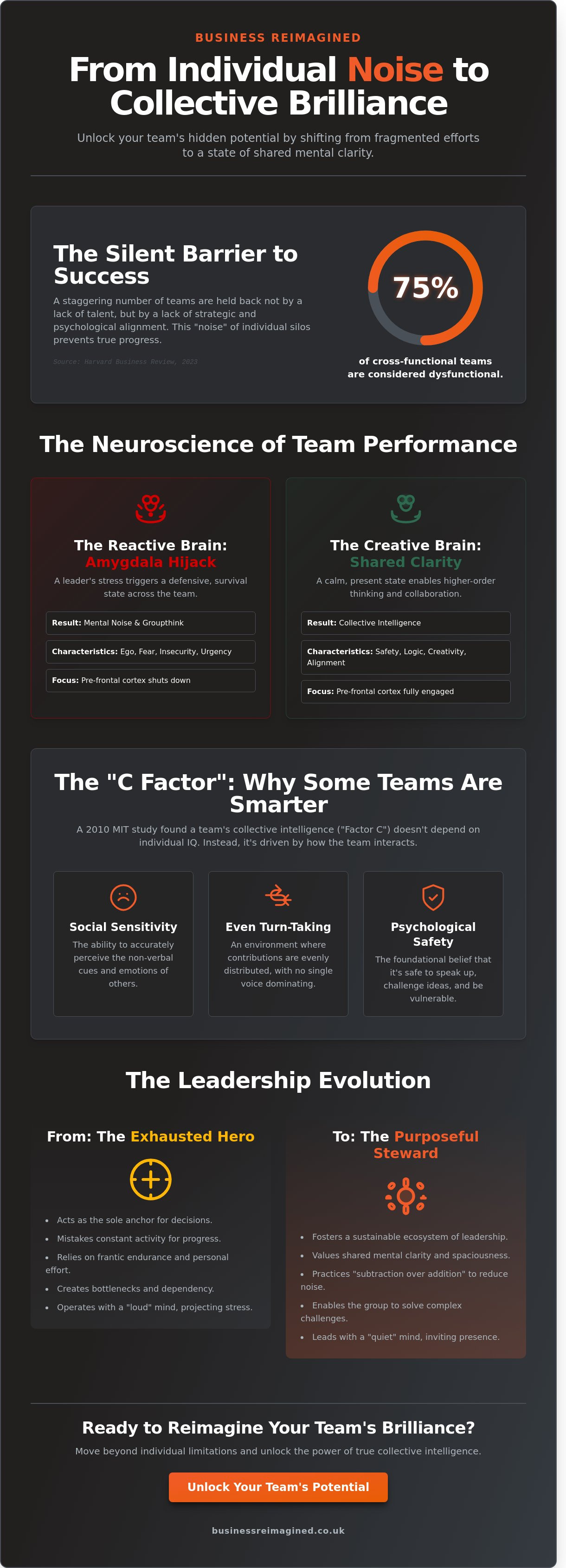
What if the greatest obstacle to your team's success isn't a lack of talent, but the very noise created by individual brilliance? A 2023 study by the Harvard Business Review found that 75% of cross-functional teams are dysfunctional because they lack the strategic alignment needed to move beyond individual silos. You likely feel this friction daily. It's the quiet frustration of watching brilliant minds stall in the face of groupthink, or the exhaustion of being the sole anchor for every decision. We often mistake activity for progress, yet true collective intelligence only emerges when we clear the mental noise that clouds our shared vision.
This article shows you how to transcend these individual limitations and harness the quiet brilliance of your organization. By prioritizing mental clarity and intentional alignment, you can foster a culture where decision-making becomes faster and more intuitive. We'll explore the specific shifts needed to reduce your team's reliance on a single leader and create a sustainable ecosystem where every voice contributes to a deeper, more powerful whole.
Key Takeaways
- Understand how to prevent the "amygdala hijack" from disrupting your team’s alignment, replacing defensive states with shared mental clarity.
- Explore the three components of Factor C to cultivate a leadership ecosystem rooted in social sensitivity and intentional turn-taking.
- Learn to transcend individual limitations by unlocking collective intelligence, allowing your team to solve complex challenges with ease.
- Master the art of "subtraction over addition" to clear the mental noise from your meetings and invite radical presence.
- Transition from the exhausted "hero leader" to a purposeful steward who values sustainable brilliance over frantic endurance.
What is Collective Intelligence in a Modern Business Context?
True collective intelligence is the emergent capacity of a group to solve complex problems more effectively than any individual member could alone. It isn't just about gathering opinions; it's about creating a cognitive ecosystem where the whole becomes significantly more capable than the sum of its parts. While the "Wisdom of Crowds" often relies on large-scale statistical averages to guess a value or a date, a high-performing leadership team requires a more intentional synthesis of deep expertise and emotional resonance.
We often mistake speed for effectiveness. Traditional hustle culture, which prizes rapid-fire responses and constant availability, actually suppresses the very intelligence it tries to exploit. When a team operates in a state of perpetual urgency, the prefrontal cortex narrows its focus, limiting the ability to see systemic connections. By contrast, this synergy flourishes when there's enough mental spaciousness to move beyond reactive habits and into creative alignment.
To better understand this concept, watch this helpful video:
This capacity isn't something you can force through a weekend retreat or a new software tool. It's a byproduct of a healthy, sustainable leadership culture. When a team feels safe enough to be honest and calm enough to be present, this shared wisdom becomes an enduring asset rather than a fleeting moment of brilliance.
The Difference Between Groupthink and Collective Intelligence
Groupthink, a term coined by psychologist Irving Janis in 1972, is a psychological phenomenon where the desire for harmony overrides a realistic appraisal of alternatives. It creates a "noisy" meeting room where dissent is stifled. True group wisdom requires the opposite: a "clear" collaborative space where diversity of thought is welcomed. It thrives on the quiet rebellion of individual perspective within a shared, spacious environment.
Why Individual IQ is Not Enough
It's a common misconception that putting the smartest people in one room creates the smartest team. A 2010 study by the MIT Center for Collective Intelligence demonstrated that a group’s performance isn't correlated with the average or maximum IQ of its members. Instead, the researchers found that "social sensitivity", the ability to perceive and respond to the emotions of others, was a primary driver of success. High-performing teams don't just think better; they feel and listen better, ensuring every voice contributes to the shared ecosystem of clarity.
The Neuroscience of Shared Thinking: Why Clarity Matters
When a leader walks into a room gripped by an "amygdala hijack," the atmosphere shifts instantly. This isn't just a mood; it's a biological event. Neuroscientific research shows that when a person in a position of authority enters a high-stress, defensive state, it triggers a similar "threat" response in their colleagues. The brain shifts resources away from the prefrontal cortex, which handles logic and creativity, toward the survival centers. Mirror neurons ensure that your internal state becomes the team's shared reality. If you're frantic, they're frantic. If you're guarded, they're guarded.
True collective intelligence isn't simply the sum of individual IQs. It's defined by "Factor C," a metric identified in a 2010 study by researchers from MIT and Carnegie Mellon. They discovered that group performance is driven by social sensitivity and the evenness of conversational turn-taking rather than the intelligence of the smartest member. From a neurological perspective, this requires a brain calm enough to process subtle social cues. This concept is supported by the science of collective intelligence, which frames teams as complex, multi-agent systems where the quality of interaction determines the total output. Mental clarity isn't a luxury. It's the foundational operating system for group brilliance.
The Impact of Mental Noise on Collaboration
Mental noise is the internal chatter of stress, ego, and insecurity. It functions like static on a radio. When a leader's mind is loud, they can't hear the intelligence already present in the room. We practice a subtractive psychology approach. Instead of adding more tools, we focus on removing the psychological barriers that block insight. A 2017 Gallup report found that teams with high psychological safety see a 27% reduction in turnover. When the noise of fear drops, the natural wisdom of the ecosystem emerges. You don't need to teach people to be smart; you just need to stop the noise that makes them feel stupid.
Creating a Leadership Environment That Supports Long-Term Success
Sustainable innovation requires "spaciousness" in strategic discussions. This isn't about taking more breaks; it's about the quality of the space between the thoughts. In a 2023 analysis of executive performance, groups that prioritized reflection over rapid-fire response were 40% more likely to reach breakthrough insights. This spaciousness starts with leader wellbeing. You can't lead a team to a place of calm clarity if you're drowning in hustle culture. We believe in reimagining these dynamics through intentional leadership development that prioritizes internal alignment. When the leader is grounded, the team finds its flow naturally.
Factor C: Why Some Teams Are Smarter Than Others
We often assume that a team's brilliance is simply the sum of its individual IQs. This is a common misconception. Research published in 2010 by Anita Williams Woolley and her colleagues revealed a different reality. They discovered "Factor C," a metric that explains why some groups consistently outperform others, regardless of the intelligence of individual members. According to a study on collective intelligence, the most successful teams aren't necessarily those with the highest average IQ. Instead, three specific social factors determine a group's potential: average social sensitivity, the equality of conversational turn-taking, and the proportion of women in the group.
The traditional leader feels pressured to be the smartest person in the room. This "hustle" mentality actually stifles the ecosystem. In a reimagined business, the leader adopts the role of a Quiet Rebel. By stepping back, you create the spaciousness required for others to contribute. Turn-taking isn't just a polite habit; it's a strategic tool. When one or two people dominate 80% of the conversation, the group's collective intelligence plateaus. Leaders who intentionally pause allow the team's hidden wisdom to surface, ensuring that no single voice drowns out the potential of the whole.
Social Sensitivity: The Secret Ingredient
Social sensitivity is the ability to read the unspoken. It involves perceiving and responding to the subtle emotional states of colleagues. This isn't a "soft skill" but a vital business metric. You can enhance this capacity through the Clarity Wellbeing Programme, which focuses on human-centric leadership and emotional alignment. For deeper insights into leading with empathy, you can connect with Kay Tear. Psychological safety acts as the soil here. Without it, social sensitivity cannot take root; the team remains a collection of individuals rather than a cohesive unit.
The Role of Diversity in Problem Solving
Cognitive diversity prevents habituation. In psychology, habituation occurs when a team becomes so familiar with a process that they stop noticing obvious flaws. Bringing in varied perspectives breaks this cycle. To invite "quiet" voices into the conversation, try using structured silence or written contributions before speaking. This approach helps team members Overcome Imposter Syndrome by providing a safe, intentional space to share their unique insights. When a team is diverse, they don't just work harder; they think more clearly and see what others miss.
How to Unlock Collective Intelligence in Your Team: A 5-Step Guide
Unlocking the potential of a group isn't about adding more pressure. It's about creating space. Most leaders try to solve friction by adding more meetings or new software. Real growth happens when we do the opposite. To harness collective intelligence, we must shift our focus from individual output to the health of the entire ecosystem.
- Step 1: Subtraction over Addition. Identify and remove the "mental noise" in your meeting structures. A 2021 study published in Nature found that people naturally gravitate towards additive solutions even when subtraction is more effective. Removing a redundant weekly report often yields more clarity than adding a new strategy session.
- Step 2: Foster Radical Presence. Encourage a state where team members are fully present. This means listening without the intent to immediately reply. When people feel heard, they contribute more authentically.
- Step 3: Establish "Turn-Taking" Norms. Ensure no single ego dominates the intellectual landscape. Google’s 2012 Project Aristotle research highlighted that the highest-performing teams practiced "equality in distribution of conversational turn-taking," ensuring every voice had space to breathe.
- Step 4: Align on Purpose, Not Just Process. Create a shared vision that resonates at a human level. When the purpose is clear, the process becomes an organic byproduct of the group's wisdom.
- Step 5: Reflect and Revisit. Use regular intervals to check the health of your leadership culture. This isn't a one-time fix but a gentle, ongoing practice of refinement.
Practising Subtractive Leadership
Start by auditing your current collaboration tools. If a platform causes more friction than flow, it's time to let it go. Strategic silence in executive meetings allows the loudest voices to settle, giving quieter, more analytical insights the room they need to surface. Subtractive leadership is the art of removing psychological barriers to allow natural insight to emerge.
Leveraging Professional Support
Sometimes, the internal ecosystem needs an external perspective to shift. You might bring in a specialist for Team Development Workshops when dynamics feel stagnant or communication feels forced. A transformation accelerator acts as a catalyst, shifting team habits quickly by highlighting blind spots the group can't see from within. This outside perspective helps restore the collective intelligence that often gets buried under daily operational stress. To explore how to find this level of focus, you can watch for a deeper understanding of the process.
Reimagining Success: From Individual Performance to Collective Brilliance
The traditional image of the "hero leader" is a heavy mantle to carry. It's a relic of an era that valued individual output over the health of the whole. We're witnessing a necessary shift toward the leader as a steward of collective intelligence. This isn't about being the smartest person in the room or having every answer. It's about creating a gentle, intentional environment where every voice contributes to a larger, more resilient wisdom. A leadership culture that actually endures isn't built on the grit of endurance; it's built on the spaciousness of mental clarity.
Business Reimagined helps leaders make this vital transition through bespoke programmes designed to quiet the noise. We move away from the frantic pace of hustle culture and toward a more grounded way of operating. By focusing on alignment rather than just activity, you allow your team to breathe. This "Quiet Rebel" approach to growth doesn't demand you do more. Instead, it asks you to lead with more purpose, ensuring your business is a living part of your life rather than a separate entity that consumes it.
The Long-Term Impact of Collective Intelligence
A team that thinks together is an ecosystem that survives together. When a business relies on a single leader for every decision, it creates a fragile bottleneck. This high cognitive load is a primary driver of executive burnout. A 2023 Deloitte study found that 77% of professionals have experienced burnout in their current roles, a statistic that underscores the unsustainability of the "hero" model. By distributing this load through collective intelligence, you ensure the business remains healthy even when you step back. For those looking to lead more authentically and move past the masks of perfectionism, Kay Tear’s book serves as a thoughtful resource for navigating these internal shifts.
Your Next Steps Toward Clarity
Take a moment to listen to the current noise level within your team. Is it the sound of frantic, disjointed activity, or the steady hum of a group in flow? If the noise is overwhelming, it's a sign that your ecosystem needs recalibration. You can explore how we support these transitions by visiting our Business Reimagined services page. We invite you to step out of the rush and into a conversation about what's truly possible.
If you feel ready to find more spaciousness in your professional life, you're welcome to book a discovery call. Let's explore how to build a business that supports your life, with purpose and clarity. Success doesn't have to be loud to be significant. It just needs to be yours.
Cultivate Your Team's Shared Brilliance
The shift from isolated performance to shared brilliance isn't just a management trend; it's a neurological necessity for the modern workplace ecosystem. We've explored how Factor C, a metric identified by researchers at MIT and Carnegie Mellon, proves that a team's social sensitivity outweighs the average IQ of its individual members. By prioritizing clarity and intentional alignment, you move beyond the exhausting cycles of hustle culture toward a more sustainable way of working. True collective intelligence emerges when we stop competing for the loudest voice and start cultivating a space where every contribution is heard and valued.
Business Reimagined, led by international speaker and leadership consultant Kay Tear, operates on a "Quiet Rebel" philosophy that rejects the frantic pace of traditional business. Our neuroscience-backed approach provides the strategic tools needed for sustainable leadership performance that lasts. You don't have to choose between success and sanity. When you align your team's natural strengths with intentional systems, you create a resilient environment that thrives on its own terms.
Explore our bespoke Team Development Workshops to start your transition toward a more spacious, impactful way of leading. Your team's potential is waiting to be reimagined.
Frequently Asked Questions
How is collective intelligence different from simple teamwork?
Collective intelligence is the emergence of a group mind that exceeds the sum of its parts, while teamwork is often just the coordination of individual tasks. Research from MIT’s Center for Collective Intelligence shows that group performance isn't tied to individual IQ but to social sensitivity. It’s about how the ecosystem breathes together. In 2010, researchers found that teams with high social perceptiveness consistently outperformed those with higher individual intelligence.
Can collective intelligence be measured in a corporate setting?
You can measure collective intelligence through the "c-factor," a metric developed by researchers at Carnegie Mellon and MIT in 2010. This score tracks social sensitivity, conversational turn-taking, and the proportion of women in a group. Instead of tracking raw output, look at the 80 percent of communication that happens through informal channels. High-performing teams show a 35 percent increase in problem-solving speed when these relational metrics are prioritized over individual KPIs.
What is the biggest barrier to collective intelligence in leadership teams?
The primary barrier is "cognitive entrenchment," where leaders rely on 10 or 20 years of rigid expertise rather than staying open to new signals. A 2019 study in the Harvard Business Review identified that 75 percent of cross-functional teams are actually dysfunctional because of siloed thinking. When a leader prioritizes being the smartest person in the room, the group's shared capacity shrinks. Silence becomes a metric of fear rather than a space for reflection.
Does a team need a high average IQ to have high collective intelligence?
No, a high average IQ isn't a prerequisite for collective intelligence; in fact, MIT studies confirm that group success correlates more with social awareness than individual intelligence. In tests of 699 people working in small groups, the teams with the highest IQs didn't consistently win. Instead, the groups that practiced equal turn-taking in conversation showed the most sustainable growth. It's about the quality of the connection, not the brilliance of the individuals.
How does a leader’s state of mind affect the team’s collective intelligence?
A leader’s nervous system acts as the "regulatory pace car" for the entire team, directly impacting their ability to think creatively. According to the HeartMath Institute, 100 percent of a group's emotional state is influenced by the physiological coherence of its leader. When you lead from a place of spaciousness rather than frantic urgency, you invite the team into a state of psychological safety. This alignment allows the ecosystem to function without the friction of cortisol.
Can technology like AI enhance our team’s collective intelligence?
AI can act as a "collaborative partner" by processing 1,000 times more data than a human, yet it requires human intentionality to create true collective intelligence. Tools like swarm AI, used in 2016 to predict the Kentucky Derby with 540 to 1 odds, show how algorithms can aggregate human intuition. Technology shouldn't replace the soul of the team. Use it to handle the noise so your people have the clarity to focus on high-level strategy.
How long does it take to build a culture of collective intelligence?
Building this culture is a journey that typically takes 6 to 18 months of intentional practice to become the team’s natural rhythm. A 2021 report by Gallup suggests that cultural shifts require at least 12 months of consistent leadership alignment to stick. It isn't a quick fix or a weekend retreat. It’s a slow, sustainable process of unlearning the hustle and moving toward a more integrated way of working together.
What is the first step a leader should take to unlock collective brilliance?
The first step is to implement "equitable turn-taking" in every meeting, ensuring no single voice dominates the conversation. Research by Anita Williams Woolley in 2010 found that teams with high social sensitivity always share the floor. Start by observing the silence. Give your team the gift of 5 minutes of quiet reflection before starting a discussion. This small act of spaciousness allows quieter voices to bring their unique clarity to the ecosystem.