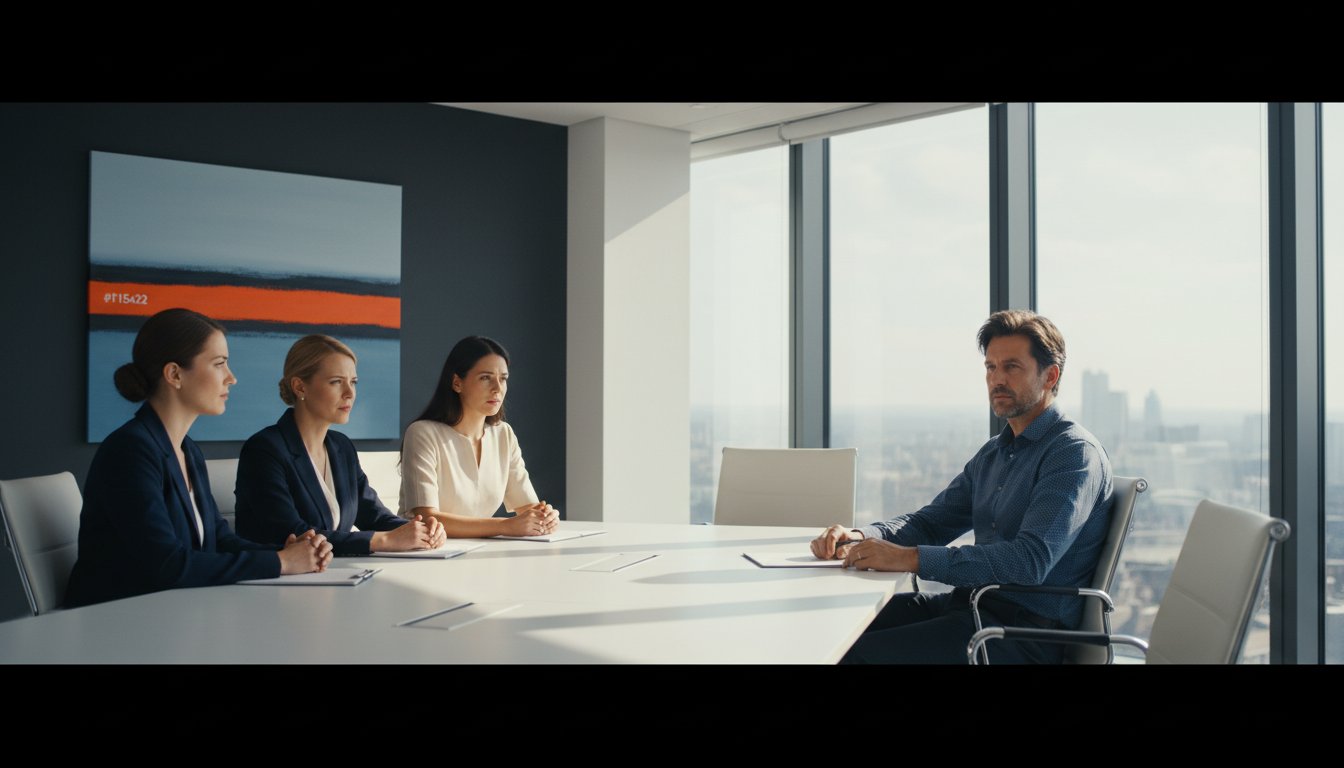
When a Person Is Not Present: The Hidden Cost of Absentee Leadership
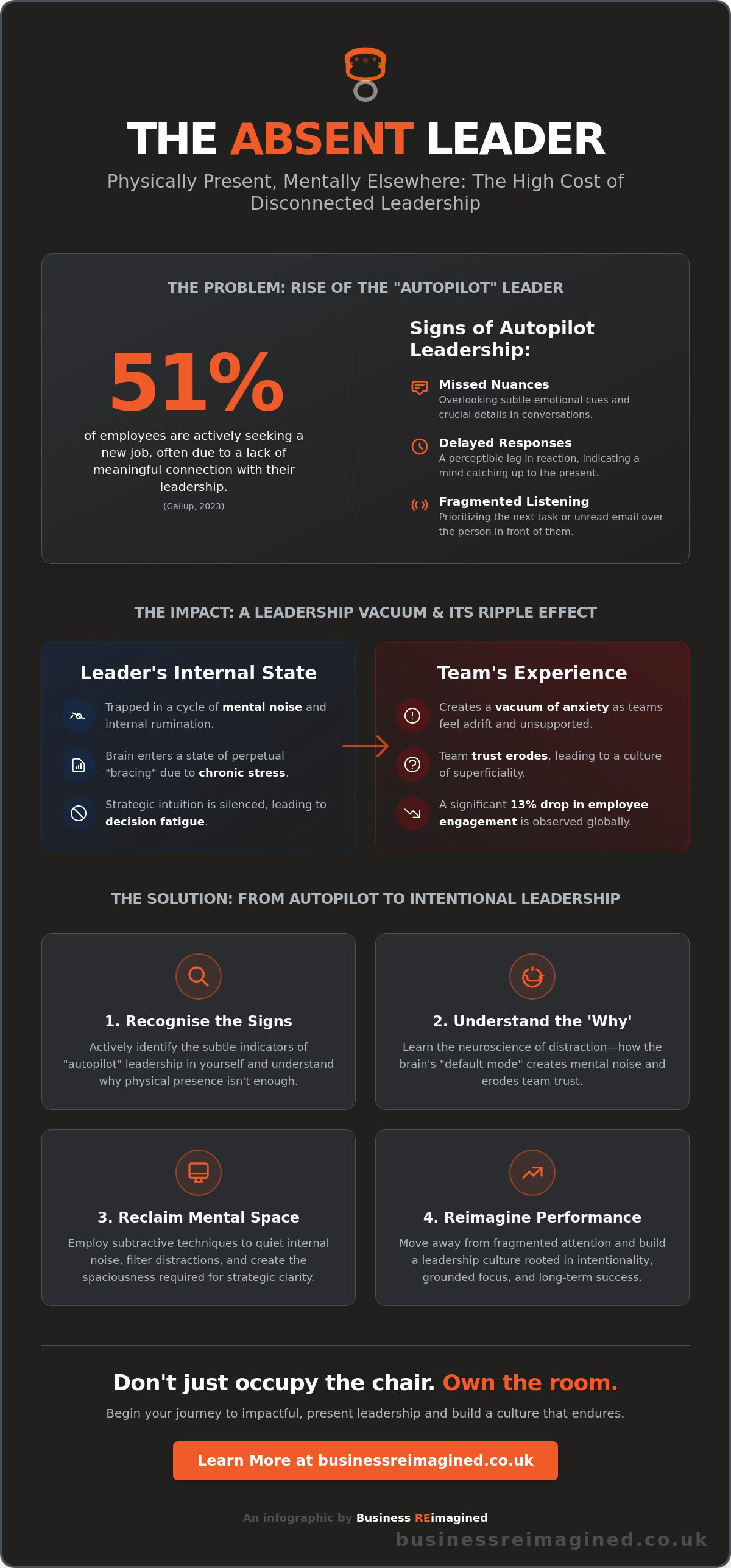
A leader can occupy a seat at the boardroom table for eight hours a day and still be entirely absent. We often mistake physical attendance for true engagement; however, when a person is not present mentally, the impact on a team is as damaging as a vacant office. A 2023 study by Gallup found that 51% of currently employed workers are watching for or actively seeking a new job, often due to a lack of meaningful connection with their leadership. You might find yourself nodding through meetings while your mind cycles through a loop of unread emails and unfinished tasks.
It's exhausting to feel like a mere observer in your own business, watching the days blur into a haze of decision fatigue and chronic mental noise. You likely recognise that your team needs more than just your physical signature on a document. This article promises to show you why physical presence is no longer the benchmark for modern leadership and how to reclaim the mental clarity required to lead with genuine impact. We will explore the steps to restore team trust and transition towards a leadership culture that can actually endure without sacrificing your well-being.
Key Takeaways
- Recognise the subtle signs of the "autopilot" leader and understand why physical attendance is no longer the benchmark for soulful, effective engagement.
- Uncover the neuroscience of distraction to understand why team trust erodes when a person is not present mentally, despite being physically in the room.
- Learn how to fill the vacuum of anxiety created by mental absence with a healthy leadership culture rooted in intentionality and grounded focus.
- Employ subtractive techniques to quieten internal noise, allowing you to reclaim the mental spaciousness required for true strategic clarity.
- Discover the path to reimagining performance by moving away from fragmented attention toward a leadership environment that supports long-term success.
Recognising the Signs: When a Person Is Not Present in the Room
Leadership is frequently equated with visibility. We assume that if a leader is sitting at the head of the table, they are leading. However, a profound disconnect occurs when a person is not present in the moments that matter most. This isn't about clinical dissociation or a habitual pattern of absence from the office; it's a subtle, pervasive withdrawal of attention that leaves teams feeling adrift. It's the difference between being a physical occupant of a space and a conscious participant in a conversation.
To better understand how this dynamic manifests in professional settings, watch this helpful video:
The "Autopilot" leader is a familiar figure in many offices. They attend every meeting, respond to every email, and meet every deadline, yet they remain fundamentally unreachable. Their physical presence acts as a mask for a lack of mental engagement. You can see it in the missed nuances of a conversation, the slightly delayed responses to emotional cues, and a style of fragmented listening that prioritises the next task over the person standing in front of them. When this happens, the leader isn't guiding the ship; they're simply drifting with the current.
The Boardroom Autopilot: A Common Executive Trap
High-stakes environments often pull the mind toward future anxieties or past failures. This creates a layer of mental noise that drowns out the actual dialogue happening in the room. Leaders find themselves planning their next move instead of hearing the current concern. True executive presence is the quiet alignment of thought and action in the now. Without this alignment, decisions are made based on assumptions rather than the reality of the situation.
Why Physical Attendance Does Not Equal Leadership
There is a stark difference between being a present-in-body figurehead and a present-in-mind strategic partner. While "busy-ness" is often worn as a badge of honour, it frequently serves as a distraction from the depth required for real impact. The emotional toll is significant; leading while mentally elsewhere creates a culture of superficiality and exhaustion. Achieving success requires shifting from frantic activity to mental clarity, a concept explored deeply in the Psychology of Performance. We must build a healthy leadership culture that can actually endure, rather than one that burns out through lack of connection. When a person is not present, the human element of the business begins to erode, often leading to a 13% drop in employee engagement as seen in recent global workplace studies.
The Psychology of Absence: Why Leaders Drift into Mental Noise
Presence is a cognitive resource, yet it's often the first thing a leader loses under pressure. The brain's architecture includes a "default mode network," which activates when we aren't focused on the outside world. While this network helps with self-reflection, it also fuels the mental noise that pulls a leader away from the room. When a person is not present, they aren't just distracted; they're trapped in a cycle of internal rumination that silences their strategic intuition. This isn't a character flaw; it's a neurological drift that happens when the mind prioritises safety over engagement.
This mental withdrawal is frequently a defensive response to high-stakes environments. Research suggests that the most common type of incompetent leader isn't the aggressive tyrant, but the one who is psychologically absent. They may be physically in the chair, but their focus is elsewhere, often due to habituation. When stress becomes a constant, the brain stops noticing the present moment and enters a state of perpetual "bracing." This prevents the formation of a healthy leadership culture because the leader is too busy surviving their own thoughts to guide others. We become used to the high-cortisol state, eventually failing to recognise when our attention has drifted entirely.
The Mechanics of Mental Noise
Mental noise acts as a barrier to professional impact. The brain naturally prioritises perceived threats, such as a drop in quarterly figures or a difficult board meeting, over current strategic opportunities. This often leads to a subtle form of Understanding Escapism where leaders hide in administrative busywork to avoid the discomfort of real presence. In her book, Overcome Imposter Syndrome, Kay Tear explains how deep-seated self-doubt leads to mental withdrawal. When you fear being "found out," your mind builds a defensive wall, making true presence feel too vulnerable to sustain. When a person is not present in their own confidence, they cannot lead with clarity.
Subtractive Psychology: Clearing the Internal Clutter
Clarity isn't found by adding more tools or productivity frameworks. It comes from subtractive psychology, which focuses on removing the internal dialogue that creates friction. One director I advised found clarity simply by stopping her habit of rehearsing responses while others spoke. By removing that mental layer, she returned to the present and fostered a leadership environment that supports long-term success. This shift allows for a more intentional, grounded way of working. If you're feeling the weight of mental noise, reach out to explore your alignment.
The Impact on Team Dynamics and Leadership Culture
Leadership is never a passive state. It's an active, energetic exchange between people. When a person is not present, even if they're physically sitting in a boardroom, they create a psychological vacuum. Human beings are naturally wired to seek patterns and reassurance from those in charge. In the absence of clear, attentive signals from a leader, teams don't simply wait in a state of neutral calm. They fill the void with assumptions, collective anxiety, and whispered concerns. This isn't a sign of a weak team; it's a natural response to a lack of alignment at the top.
This creates a ripple effect that spreads through the entire organisation. If a leader prioritises their smartphone or a distant deadline over the human being speaking to them, they're inadvertently giving the team permission to do the same. This fosters a leadership culture of fragmented attention. It's a quiet, slow-moving erosion of focus that can be felt in every meeting. Research from Gallup in 2023 indicates that only 23% of employees feel truly engaged at work. This lack of engagement often stems from a lack of authentic connection. Presence is the bedrock of psychological safety. Without it, team members stop taking risks because they don't feel seen or supported by their mentors.
The Double Bind of the Distracted Leader
An absentee leader often places their subordinates in a double bind. If an employee takes initiative while the leader is mentally elsewhere, they risk being reprimanded for overstepping. If they wait for guidance that never arrives, they're criticised for stagnation. This paralysis kills innovation. According to a 2021 study by the Workforce Institute, 63% of employees feel their voice has been ignored by their employer. When people feel their contributions aren't being witnessed, they stop bringing their best ideas to the table. Trust erodes quickly when a person is not present to acknowledge the daily efforts of their team.
Creating a Healthy Leadership Culture
We must move away from the frantic, breathless energy of hustle culture. A leadership culture that can actually endure is one where presence is treated as a shared value rather than a luxury. A healthy leadership culture provides the spaciousness needed for strategic thinking and deep reflection. It acts as a vital stabiliser during periods of organisational transformation. When a leader is grounded and intentional, the team feels anchored despite external pressures. This isn't about being available every hour of the day. It's about being fully there when you're there. This intentionality creates a leadership environment that supports long-term success, ensuring the business remains a living, breathing part of a well-lived life.
Subtractive Leadership: How to Reclaim Presence and Strategic Clarity
Leadership isn't about adding more "presence" hacks to an already overflowing plate. It is about subtraction. When a person is not present, the team feels a vacuum, but the solution isn't to work harder at being there. Instead, it is about removing the internal and external clutter that creates the distance. Reclaiming your presence requires a deliberate move away from the "hustle" and toward a leadership culture that can actually endure.
To move from absence to intentionality, follow these five steps:
- Step 1: Recognise the "drift." Notice when your mind has wandered into mental noise. Do this without judgment. Awareness is the only tool needed to begin the return to the now.
- Step 2: Employ subtractive techniques. Instead of trying to "think" your way into a solution, consciously lower the volume of your internal dialogue. Recognise that your thoughts are just thoughts, not fixed reality.
- Step 3: Practice "Deep Listening." Remove the pressure to formulate an immediate response while someone else is speaking. When you stop preparing your rebuttal, you actually hear what is being said.
- Step 4: Audit your environment. A 2001 study by the American Psychological Association found that brief mental blocks created by shifting between tasks can cost as much as 40% of someone's productive time. Reduce external stimuli that fragment your attention.
- Step 5: Re-engage with the 3 Principles. Ground yourself in the understanding of Mind, Consciousness, and Thought. This framework reminds us that our experience is created from the inside out, not by the external pressures of the boardroom.
Practical Tools for the Time-Poor Executive
Traditional mindfulness often fails busy leaders because it feels like another chore on a long list. It feels forced. Instead, try the "Check-In" technique. This involves 30 seconds of grounding before any high-stakes meeting. Simply feel your feet on the floor and notice your breath. This small act of intentionality shifts you from a state of frantic doing to one of grounded being. For those looking to embed these habits deeper, we offer tailored workshops designed for high-pressure leadership environment that supports long-term success.
Strategic Clarity through Mental Spaciousness
A quiet mind leads to better, faster decision-making. It's that simple. When the mental noise subsides, you gain the ability to distinguish between "urgent noise" and "strategic signal." Chantal Burns, in her work on mental clarity, suggests that our performance is always a reflection of our state of mind. When a person is not present, they are reacting to the noise. When they are present, they are responding to the signal. This spaciousness allows for a healthy leadership culture where strategy is born from insight rather than impulse. Clarity isn't something you find; it is what remains when the confusion is stripped away.
Ready to lead with more intention? Explore our leadership development services to help your team find clarity in the noise.
Reimagining Performance: Moving from Autopilot to Intentional Leadership
The journey from being a "ghost in the machine" to an intentional leader requires a conscious decision to step off the treadmill of frantic activity. We have seen how organisational performance suffers when a person is not present, creating a vacuum that is often filled by anxiety and confusion. According to the 2023 Gallup State of the Global Workplace report, disengaged employees cost the global economy approximately $8.8 trillion in lost productivity. This disconnection often starts at the top. By reimagining performance as a byproduct of presence rather than a result of constant grinding, you create a leadership culture that can actually endure. This transition protects your own health, reducing the risk of burnout, while simultaneously lifting the collective spirit of your organisation. It is an invitation to lead with soul rather than just strategy.
Moving from autopilot to intention is a quiet rebellion against a world that demands your attention be everywhere at once. It's about reclaiming the "now" to ensure your team feels seen, heard, and supported. When you trade the frantic pace for a grounded approach, you don't just improve the bottom line; you foster a leadership environment that supports long-term success. This shift creates a ripple effect, allowing your staff to breathe, innovate, and contribute from a place of security rather than fear.
The Clarity Wellbeing Programme: A Path to Insight
Our programme moves away from the traditional focus on external KPIs to prioritise your internal alignment. Through executive coaching, we identify the specific blind spots that cause you to retreat from your team. These are often the moments where you are physically in the room but mentally miles away. The hidden costs are steep when a person is not present, as it erodes the trust that took years to build. To see how others have successfully navigated this shift, explore the Business Reimagined YouTube channel. Here, we discuss the philosophy of slow business and the practical steps needed to foster a healthy leadership culture that values well-being as much as profit.
Next Steps: Honouring the Present Moment
The most effective leaders don't just manage; they exist with intention. This is the ultimate quiet rebellion: refusing to be hurried by a culture that values speed over depth. If you feel the call to move from autopilot to a more grounded way of working, I invite you to book a clarity call. We can explore how to bring you back to the centre of your leadership. Success is not found in the next frantic task; it is found in the quality of your presence in this very moment. In a complex business world, a present mind is your most strategic asset.
Reclaiming the Space for Intentional Leadership
True leadership requires more than a physical seat at the table. It demands a level of mental availability that many modern environments actively dismantle. You've seen the subtle erosion that occurs when a person is not present; the silence where there should be guidance, and the confusion that replaces clarity. By choosing to step off the autopilot treadmill, you begin to foster a leadership culture that can actually endure. This shift isn't achieved through adding more tasks, but through the subtractive psychology needed to quiet the noise and reclaim your focus.
Kay Tear brings over 15 years of experience in executive coaching and leadership development to help you navigate this transition. By grounding her approach in neuroscience, she helps leaders move away from the exhaustion of hustle culture and toward a state of grounded authority. Results from The Clarity Wellbeing Programme show that when leaders reclaim their presence, their teams regain their sense of purpose. It's time to trade the frantic pace for a more intentional, sustainable way of leading that values human connection over constant output.
Begin your journey toward strategic clarity; book a discovery call with Kay Tear
Your path to a more spacious and impactful professional life starts with a single, quiet choice to be here now.
Frequently Asked Questions
Is being "not present" the same as professional burnout?
Being "not present" isn't the same as burnout. Burnout is a chronic state of emotional and physical exhaustion caused by unmanaged workplace stress, affecting 23% of the global workforce according to Gallup's 2023 State of the Global Workplace report. Mental absence is often a temporary drift of attention or a habit of overthinking. You can be high-energy and still find your mind wandering far from the conversation at hand.
How can I tell if my team feels I am not present during meetings?
You can tell your team feels your absence when they stop offering spontaneous ideas or look for cues from others instead of you. The 2022 Microsoft Work Trend Index found that 38% of hybrid employees say their biggest challenge is knowing why and when to come into the office. If your team seems hesitant to share risks or remains unusually silent, they've likely noticed your attention is fractured. They need your grounded presence to feel safe enough to innovate.
Can a leader be present while managing a remote or hybrid team?
Presence is entirely possible in a digital space if you prioritise quality over constant availability. When a person is not present in a physical office, they must use intentional signals like active listening and video engagement to bridge the gap. A 2021 study by Buffer showed that 16% of remote workers struggle with loneliness. Your presence acts as the anchor for a healthy leadership culture that can actually endure, even across different time zones.
What is the quickest way to return to the present moment when I feel overwhelmed?
The quickest way to return to the now is to engage your physical senses. Try the "5-4-3-2-1" technique where you name five things you see, four you can touch, three you hear, two you smell, and one you taste. This simple shift moves your focus from the abstract chaos of your thoughts back to your immediate surroundings. It's a practical tool for any leader who feels the weight of a busy day pulling them away from their team's needs.
Does being present mean I have to stop planning for the future?
Presence doesn't mean you ignore the future; it means you plan from a place of clarity rather than anxiety. You can't steer a ship effectively if you're only looking at the horizon and ignoring the deck beneath your feet. In her book, "Overcome Imposter Syndrome: Understand your Mind to Break Free from Self-Doubt, Lead Authentically, and Accelerate Your Career", Kay Tear explains how staying grounded allows you to lead with authenticity. This clarity ensures your future strategies are built on a solid, realistic foundation.
What happens to organisational effectiveness when a CEO is mentally absent?
Organisational effectiveness drops sharply when a CEO is mentally absent because it creates a vacuum of direction. Research published in the Journal of Management indicates that absentee leadership is a significant predictor of workplace bullying and role ambiguity. Without a steady hand at the helm, the leadership environment that supports long-term success begins to crumble. Decisions stall, and the strategic rhythm of the business loses its pulse.
How does subtractive psychology differ from traditional executive coaching?
Subtractive psychology differs from traditional coaching by focusing on what you can let go of rather than what you need to add. Most executive programmes try to "bolt on" new skills or habits, which often leads to more mental noise and exhaustion. Subtractive psychology helps you strip away the layers of overthinking and conditioned stress. It reveals the innate clarity that's already there, allowing you to lead from a place of quiet authority and genuine connection.
Is "not being present" a sign of a more serious psychological condition?
While mental drifting is common, when a person is not present consistently, it can sometimes point toward underlying issues like chronic anxiety. However, for most leaders, it's a symptom of a cluttered mind rather than a clinical diagnosis. If you find yourself unable to focus for more than 47% of your waking hours, a figure cited by Harvard researchers, it's time to look at your mental load. Focus on creating spaciousness in your schedule to allow your mind to settle naturally.