
The Psychology of Performance: Reimagining Success Through Mental Clarity
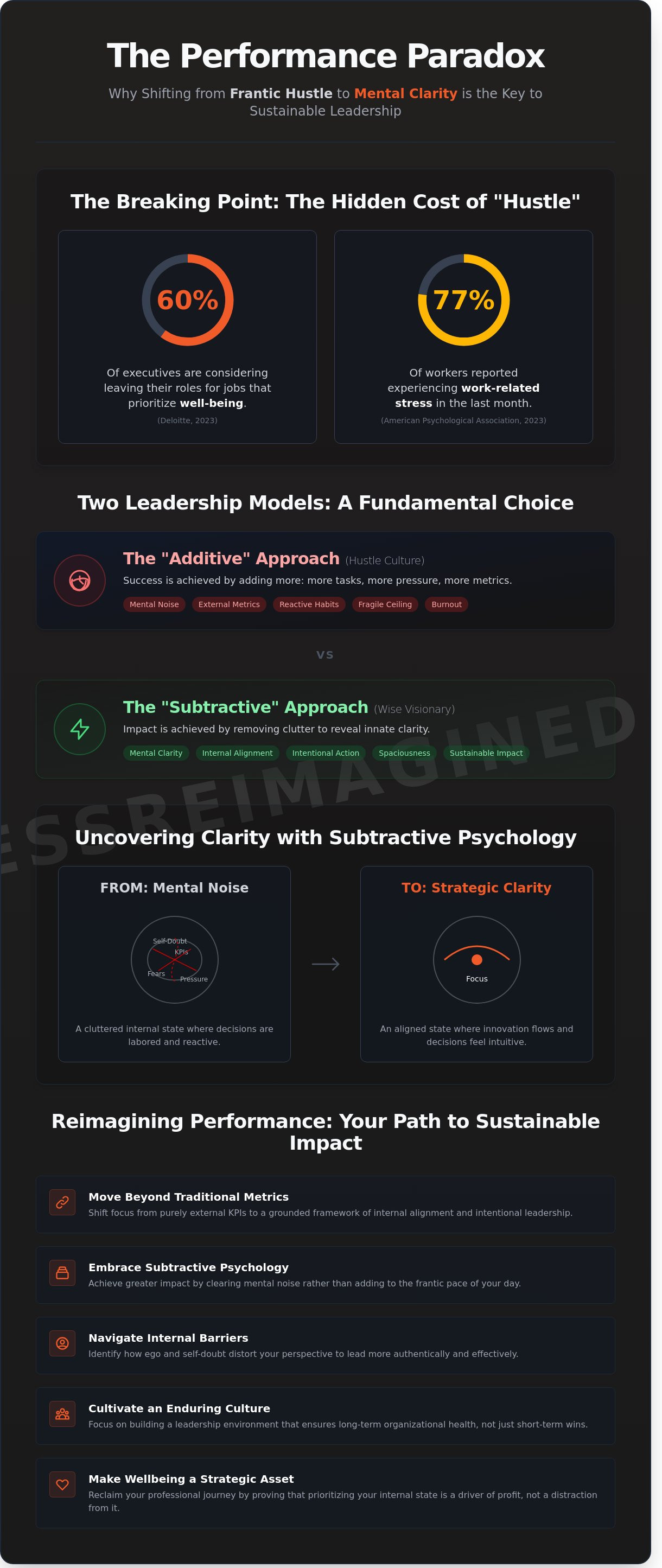
What if the frantic hustle we associate with high achievement is actually the greatest barrier to your potential? It's a quiet truth that many leaders ignore until the weight of decision fatigue becomes too heavy to carry. When we examine the psychology of performance, it becomes clear that sustainable impact stems from mental clarity rather than a crowded calendar. A 2023 Deloitte survey revealed that 60% of executives are considering leaving their roles for jobs that prioritize well-being, proving that the traditional model of success is fracturing.
You've likely felt the exhaustion of maintaining a high-performance facade while battling the internal fear that your success is a fluke. This disconnect is a core theme in Kay Tear's book, "Overcome Imposter Syndrome," which highlights how self-doubt can quietly erode even the most brilliant careers. I promise that by shifting your focus inward, you can transform your leadership from a frantic race into a grounded, intentional practice. We'll explore how to reclaim a sense of spaciousness in your decision-making and build a leadership culture that can actually endure.
Key Takeaways
- Move beyond the traditional sports-centric view to discover how the psychology of performance provides a grounded framework for high-impact, intentional leadership.
- Explore the power of subtractive psychology—a method for achieving greater impact by clearing mental noise rather than adding to the frantic pace of your day.
- Identify how the ego distorts your perspective and learn to navigate internal barriers using insights from Kay Tear’s Overcome Imposter Syndrome.
- Shift your focus from individual metrics to cultivating a leadership culture that can actually endure, ensuring long-term health for the entire organization.
- Reclaim your professional journey by prioritizing internal alignment, proving that wellbeing is a strategic asset rather than a distraction from profit.
What is the Psychology of Performance in a Leadership Context?
Performance psychology is the study of the mental factors that influence peak execution. While many associate this field with elite athletes, the psychology of performance in a leadership context is far more nuanced. It isn't just about physical output or speed. Instead, it focuses on the cognitive clarity and emotional resonance required to lead others with intention. While Performance Science often examines the mechanics of physical excellence, corporate leadership demands a focus on mental endurance and the ability to remain grounded under pressure.
Traditional hustle culture suggests that success is a product of constant motion. We're told to grind, to push, and to sacrifice well-being for the sake of growth. This approach creates a fragile ceiling. It leads to a state of perpetual "mental noise," which acts as the primary barrier to strategic clarity. This noise is the internal static of unexamined fears, reactive habits, and the pressure to perform for external validation. When a leader's mind is cluttered, their ability to make wise, long-term decisions diminishes. True success requires a shift away from this frantic pace toward a more sustainable, intentional way of working.
To better understand this concept, watch this helpful video:
Moving Beyond Traditional Performance Metrics
Key Performance Indicators (KPIs) offer a snapshot of progress, but they rarely capture the full health of a leader's impact. A leader might hit every financial target while inadvertently damaging the team's morale or their own mental health. We must shift our focus from external benchmarks to internal alignment. This means asking whether our professional actions reflect our personal values. When you prioritize internal clarity, you build a leadership culture that can actually endure. This process of finding authentic alignment is a core theme in Kay Tear's book, Overcome Imposter Syndrome, which explores how understanding your mind can accelerate your career without compromising your soul.
The Quiet Rebellion Against Hustle
The "Wise Visionary" approach is a quiet rebellion against the noise of modern business. It replaces frantic activity with intentionality. High-performing leaders recognize that "busy" is often just a mask for lack of direction. By intentionally creating spaciousness, they allow room for innovation and deep reflection. According to a 2023 study by the American Psychological Association, 77% of workers reported experiencing work-related stress in the previous month, a factor that significantly impairs cognitive function. Choosing a slower rhythm isn't about doing less; it's about doing what matters with greater presence. This commitment to professional health ensures that success is not just achieved, but sustained over a lifetime.
The Mechanics of Clarity: How State of Mind Drives Results
Performance doesn't begin in the boardroom or on a spreadsheet. It begins in the quiet spaces of the mind. We've been taught that high performance requires adding more: more skills, more hacks, and more pressure. This additive approach often leads to the very burnout it tries to solve. When we look at the psychology of performance, we see that results are a downstream effect of our internal state. Our feelings don't come from our circumstances; they come from our thoughts in the moment. This realization changes everything. It means that a stressful meeting isn't inherently stressful. The stress is a reflection of the mental noise we're carrying into the room. When we clear that noise, we don't just feel better; we perform with a precision that was previously unreachable.
Understanding Subtractive Psychology
Most professional development focuses on acquisition. We collect frameworks like badges of honor, yet our mental load only increases. Subtractive psychology suggests a different path. It's about uncovering the innate clarity that's already there once the static settles. In a business setting, this leads to a state of flow where decisions feel obvious rather than labored. Subtractive psychology is the removal of conceptual clutter to reveal natural wisdom. By letting go of the need to manage every stray thought, we find a more resilient way to lead. This is a core theme in Kay Tear's book, Overcome Imposter Syndrome, which highlights how clearing self-doubt allows authentic leadership to surface. When we stop over-thinking, we start performing.
The Neuroscience of Strategic Decision-Making
The brain doesn't function well under siege. Chronic stress, which affects roughly 33% of the global workforce according to 2023 Gallup data, triggers the amygdala and impairs the prefrontal cortex. This is the area responsible for executive function and strategic thinking. When the nervous system stays in a state of high alert, we lose the ability to see the "big picture." A calm nervous system is a strategic advantage. It allows for a leadership culture that can actually endure. If you find yourself reacting rather than responding, your mental deck is likely over-crowded. Understanding the psychology of performance helps us recognize that a quiet mind is the most powerful tool in a leader's arsenal.
How do you know when your judgment is clouded by mental noise? Look for these signals:
- A sense of urgent pressure that doesn't match the actual deadline.
- Repetitive, circular thinking about a single problem.
- Physical tension in the shoulders or chest during routine tasks.
- A feeling of being "stuck" despite having all the necessary data.
Recognizing these signs is the first step toward reclaiming your clarity. It's not about working harder; it's about working from a cleaner state of mind. If you're ready to explore how this shift can transform your team, you might consider looking into our bespoke leadership services.
Internal Barriers: Addressing the Ego and Self-Doubt
The internal landscape of a leader often dictates the external health of their organization. When we examine the psychology of performance, we find that the ego is frequently the silent architect of performance anxiety. It operates on a binary of success or catastrophe; this leaves little room for the nuance required in complex decision-making. This rigid mindset leads to self-projecting, a process where leaders unknowingly cast their own insecurities onto their teams. A 2023 survey by the American Psychological Association found that 71% of employees feel stressed during the workday, often due to a perceived lack of support. When a leader views their team through a lens of distortion, they create a leadership environment that is brittle rather than a leadership culture that can actually endure.
The friction often labeled as a "problem with authority" usually stems from these same internal distortions. It isn't always about a lack of respect for hierarchy; instead, it's often a defensive response to feeling controlled or undervalued. Leading authentically serves as the primary antidote to the burnout that follows these power struggles. By stripping away the need to maintain a perfect facade, leaders create a sense of spaciousness. This shift allows for a more intentional way of working, where energy is spent on strategic alignment rather than maintaining an image of invulnerability.
Overcoming the Shadow of Imposter Syndrome
High achievers often possess a complicated relationship with self-doubt. They use it as a jagged fuel, pushing harder to outrun the fear of being found out. While this might yield short-term results, it's a primary driver of chronic exhaustion. In her book, Overcome Imposter Syndrome, Kay Tear explains that understanding the mechanics of the mind is the only way to break this cycle. By moving away from fear-based motivation, leaders can finally begin to lead with clarity. This transition is essential for anyone looking to master the psychology of performance and find a more grounded path to success.
The Ego in the Boardroom
The boardroom is often a theater for the ego. The desperate need to be right can silence collective intelligence and halt innovation. A 2022 study published in the Harvard Business Review indicated that teams with high psychological safety are 40% more likely to implement creative ideas. To achieve this, leaders must transition from ego-driven agendas to purpose-driven leadership. This requires a commitment to being present. Many leaders use work as a form of escapism, burying themselves in tasks to avoid internal quiet. True performance comes from a place of presence, creating a healthy leadership culture where people feel seen rather than just managed.
Cultivating a Leadership Culture That Can Actually Endure
Performance is rarely a solo endeavor. While many corporate environments obsess over the individual psychology of performance, true longevity requires a shift in perspective toward the collective. A leader doesn't just manage a list of tasks; they curate the emotional climate of the entire room. When a leader operates from a place of frantic urgency, that vibration ripples outward, creating a culture of reactive firefighting. Conversely, a leader who prioritizes mental clarity provides the spaciousness necessary for others to do their best work.
A leader’s state of mind acts as a silent blueprint for the entire organization. If you're constantly rushed, your team will feel they don't have permission to pause or think deeply. This "emotional contagion" is a documented psychological phenomenon where a group's mood converges with that of its leader. To build a leadership culture that can actually endure, you must first address your own internal alignment. When you lead from a grounded, intentional place, you give your team the permission to do the same. This isn't just a soft skill; it's a strategic choice to optimize the psychology of performance across the whole team.
Avoiding the Double Bind
The double bind is a psychological trap first identified by Gregory Bateson in 1956. It occurs when a leader gives two conflicting commands that trap the employee in a no-win situation. For example, telling a team to "be bold and innovative" while simultaneously punishing every minor mistake. This creates a state of total paralysis. Employees stop taking initiative because every path leads to a perceived failure. In her book, "Overcome Imposter Syndrome", Kay Tear explores how these external pressures can fuel internal self-doubt, further hindering authentic leadership. Clarity of intent is the only way to break this cycle and free your team to act with confidence.
Building Sustainable Team Dynamics
Google's 2015 study, known as Project Aristotle, analyzed 180 teams to find the secret of high performance. They discovered that psychological safety was the most critical factor. It's the belief that you won't be punished for making a mistake or asking a clarifying question. Moving from reactive management to intentional leadership means building this safety into the daily rhythm of your work. Our Team Development Workshops help leaders facilitate this cultural shift by aligning team values with operational goals, ensuring the environment supports long-term success rather than short-term burnout.
Ready to evolve your leadership approach and find more spaciousness in your day? Book a clarity call to discuss how we can support your team's development.
Reimagining Your Performance: The Path to Sustainable Impact
True success isn't a destination reached through exhaustion. It's the result of a quiet, intentional alignment between your internal state and your external actions. The psychology of performance teaches us that when we lower the mental noise, our natural capability rises to the surface. It's about moving away from the frantic pursuit of "more" and toward a leadership culture that can actually endure.
Leadership that values wellbeing alongside profit isn't just a moral choice; it's a strategic one. Research by Gallup indicates that 76% of employees experience burnout at least sometimes, a statistic that highlights the fragility of traditional hustle culture (Gallup, 2020). By prioritizing mental clarity, you create a healthy leadership culture where high impact becomes a sustainable byproduct rather than a fleeting win. This shift requires us to understand the mind deeply, a theme explored in Kay Tear’s book, Overcome Imposter Syndrome, which helps leaders lead authentically by breaking free from self-doubt.
The Clarity Wellbeing Programme
The Clarity Wellbeing Programme treats leader health as a primary performance metric. We don't view rest as a reward for hard work. Instead, we see mental spaciousness as the fuel for strategic thinking. Maintaining this spaciousness allows you to make decisions from a place of calm rather than reactively. You can see this philosophy in practice by exploring Kay Tear's insights on YouTube to see how this approach transforms professional excellence.
- Focus on long-term vitality over short-term gains.
- Cultivate a leadership environment that supports long-term success.
- Reduce cognitive load to sharpen decision-making.
- Prioritize intentional rest to sustain high-level output.
Your First Step Toward Reimagining Success
Take a moment to reflect on your current mental noise levels. Is your mind a crowded room or a quiet sanctuary? Transformation begins with this simple, honest awareness. Executive coaching provides the partnership needed for this strategic shift, turning the psychology of performance from a concept into a lived reality. It's time to stop grinding and start flowing. If you're ready to lower the noise and raise your impact, book a clarity call to discuss your leadership journey. Let's reimagine what your success could look like when it's built on a foundation of clarity and purpose.
The Path to Sustainable Impact
True success doesn't emerge from the frantic pursuit of more. It's found in the quiet space where mental clarity meets intentional action. By mastering the psychology of performance, you shift from a state of constant reaction to one of grounded influence. This evolution requires you to dismantle the internal barriers that often thrive in high-pressure environments. In her book, "Overcome Imposter Syndrome: Understand your Mind to Break Free from Self-Doubt, Lead Authentically, and Accelerate Your Career," Kay Tear highlights how self-doubt can quietly erode even the most brilliant strategies. Addressing these shadows is the first step toward building a leadership culture that can actually endure.
Since 2011, Business Reimagined has delivered over a decade of executive impact through a neuroscience-backed approach. We don't believe in the traditional hustle; we believe in results that don't cost you your well-being. It's time to trade the exhaustion of the "grind" for a strategic partnership that values your humanity. You've spent years building your career; now it's time to ensure your leadership environment supports long-term success without the burnout. You deserve a professional life that feels as good on the inside as it looks on the outside.
Reimagine your leadership: Explore our bespoke programmes
Your future self will thank you for choosing clarity over chaos today.
Frequently Asked Questions
What is the difference between sports psychology and the psychology of performance in business?
While sports psychology targets high-intensity bursts of physical output, the psychology of performance in business focuses on maintaining mental clarity over a 40 year career. Athletes often train for a single gold medal moment. In contrast, a leader must navigate 2,000 or more decisions annually while maintaining a healthy leadership culture. It's the difference between a sprint and an intentional, lifelong marathon that requires a grounded sense of presence.
How can understanding the mind help reduce executive burnout?
Understanding the mind helps leaders realize that stress is created by thought rather than external pressure. A 2023 Deloitte study found that 77% of professionals have experienced burnout at their current job. By understanding the mind, executives learn that pressure is an internal construct. This shift allows for a more spacious way of working. It replaces the frantic hustle with a grounded sense of presence that naturally preserves energy.
Can the psychology of performance actually improve my company's bottom line?
The psychology of performance directly impacts profitability by reducing the cost of poor decision-making and high employee turnover. Gallup reported in 2023 that disengaged employees cost the global economy $8.8 trillion. When leaders operate from a place of clarity, they make fewer expensive errors. A leadership culture that can actually endure creates a stable environment where productivity rises naturally without the need for forced pressure.
What are the common signs of 'mental noise' in a leadership team?
Common signs of mental noise include reactive decision-making and a lack of creative space. A 2021 study by Qatalog found that employees waste 59 minutes daily switching between tools, which fractures mental focus. When a team is noisy, they struggle to distinguish between a genuine crisis and a passing thought. You might notice that meetings run 20 minutes over schedule or that simple projects suddenly feel insurmountable. These signals indicate a cluttered collective mind.
How does imposter syndrome affect high-level decision-making?
Imposter syndrome creates a cycle of over-analysis that can delay critical business pivots by months. In her book, "Overcome Imposter Syndrome: Understand your Mind to Break Free from Self-Doubt, Lead Authentically, and Accelerate Your Career," Kay Tear explains how self-doubt masks a leader's natural wisdom. A 2020 study by KPMG found that 75% of female executives experience these feelings. This internal friction often results in slower decision-making as leaders seek external validation.
Is performance coaching different from traditional business consulting?
Business consulting typically focuses on external structures like spreadsheets or supply chains, whereas performance coaching addresses the internal state of the leader. A consultant might give you a new 10 step plan. A performance coach helps you access the mental spaciousness required to execute any plan without exhaustion. It's about refining the lens through which you see your business rather than just rearranging the furniture. You become a steady, strategic partner to your own ambitions.
What is subtractive psychology and how does it apply to leadership?
Subtractive psychology is the practice of removing mental clutter to reveal the innate wisdom that already exists within a leader. Most traditional training programs try to add more tools to an already full mind. The psychology of performance suggests that we don't need more information; we need less interference. By subtracting the "shoulds" and the "musts," we find a more intentional way to lead. This approach creates a leadership environment that supports long-term success.
How long does it take to see results from a performance psychology approach?
You can experience a shift in mental clarity in as little as one 60 minute session, though deep cultural change usually takes 90 to 180 days. Research from University College London in 2009 suggests it takes an average of 66 days to form new habits. As you consistently apply these principles, you'll notice a healthy leadership culture emerging. This timeline ensures that the changes are not just temporary fixes but part of a lasting transformation.