
What Is Transition Coaching? Navigating Professional Change with Clarity
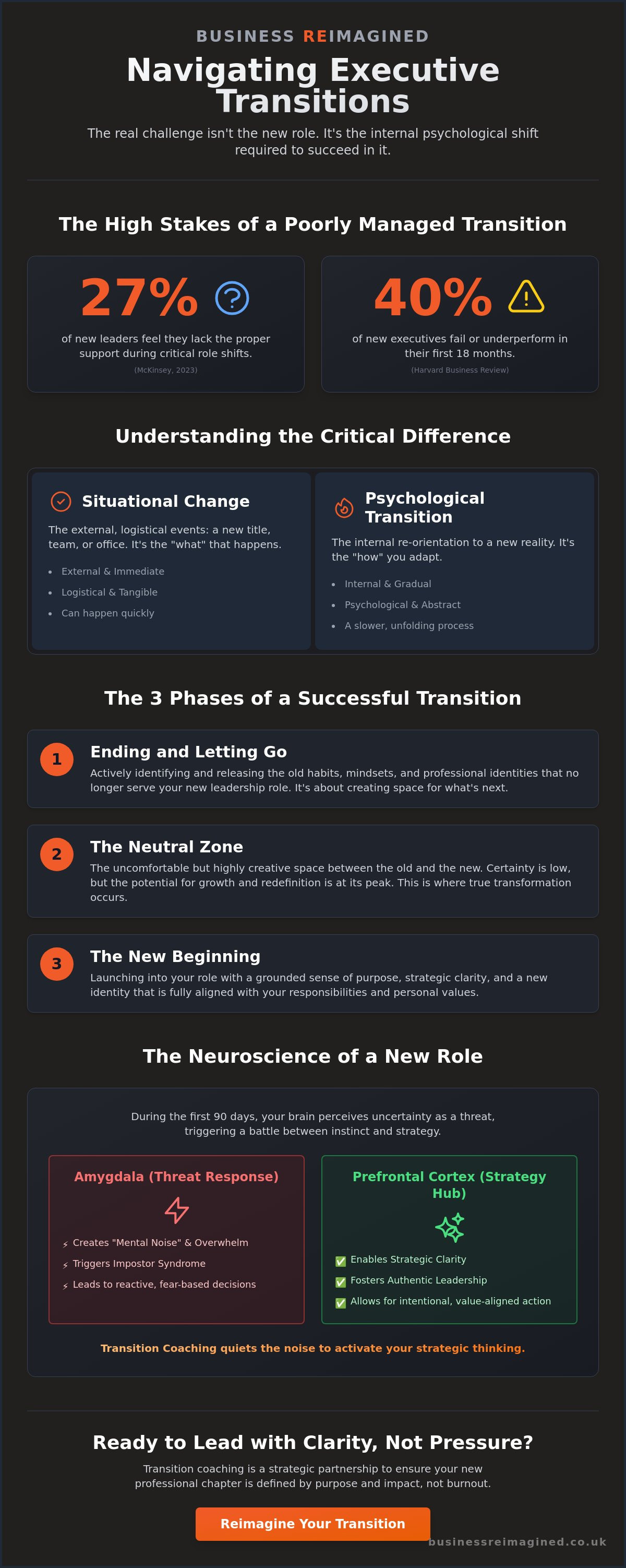
What if the most demanding part of your new executive role isn't the increased workload, but the version of yourself you're still trying to carry? You've reached the milestone you worked so hard for, yet the expected sense of triumph is often replaced by a quiet, persistent overwhelm. This is why transition coaching has become an essential practice for those entering high-stakes roles. It's natural to feel like an impostor when you're caught between new expectations and the old habits that no longer serve your growth. Research from McKinsey indicates that 27% of new leaders feel they lack the proper support during these critical shifts (McKinsey, 2023).
We'll explore how this intentional approach goes beyond simple change management to address the deeper psychological shifts required for true leadership. You'll discover a strategic framework for making a meaningful impact while maintaining your well-being, ensuring your new professional chapter is defined by mental clarity rather than burnout. By the end of this article, you'll understand how to foster a leadership culture that can actually endure, allowing your personal values to align perfectly with your new professional demands.
Key Takeaways
- Learn to distinguish between the external logistics of a new role and the internal psychological re-orientation required for a truly successful shift.
- Understand how your brain perceives professional uncertainty as a threat and how to quiet the "mental noise" that often disrupts decision-making during your first 90 days.
- Identify high-stakes scenarios where a leadership culture that can actually endure is most at risk and how to mitigate the hidden costs of a failed transition.
- Discover the power of "subtractive psychology" to clear away the clutter of traditional to-do lists and reclaim your mental spaciousness.
- Explore how transition coaching serves as a steady partnership to help you lead with clarity rather than reacting from a place of frantic pressure.
Understanding Transition Coaching: Beyond the Mechanics of Change
Change is often viewed as a logistical hurdle. A new office, a fresh title, or a restructured team are visible markers of progress. However, transition coaching focuses on what happens beneath the surface. While situational change is external and immediate, transition is the internal psychological re-orientation that follows. It's the process of coming to terms with a new reality. Without this internal alignment, even the most prestigious promotion can feel like a hollow victory.
The "Quiet Rebel" understands that rushing through this process is a mistake. In a culture that prizes speed above all else, taking the time to pause feels radical. Yet, research suggests that up to 40% of new leaders fail or underperform in their first 18 months (Source: Harvard Business Review). This often happens because they haven't properly navigated the psychological shift required by their new role. By embracing a slower, more intentional pace, leaders build a leadership culture that can actually endure.
The Three Phases of Transition
- Ending and Letting Go: This stage involves identifying the habits and identities that no longer serve your new role. It's about mourning the old way of working to make room for the new.
- The Neutral Zone: This is the uncomfortable but fertile ground between the old and the new. It's a liminal space where old certainties have gone, but new ones haven't yet taken root.
- The New Beginning: This is the final phase. It's where you launch with a grounded sense of purpose and strategic clarity, fully aligned with your new responsibilities.
Transition Coaching vs. Executive Coaching
Standard executive coaching usually focuses on ongoing performance and skill-building. It's about getting better at what you already do. In contrast, transition coaching is time-bound and focused specifically on the "liminal space" of professional shifts. It provides the spaciousness needed to redefine your leadership identity during a period of flux.
Choosing a transition-specific programme is vital when your leadership team faces significant upheaval. It ensures that the internal shift matches the external change. For those feeling the weight of self-doubt during these shifts, Kay Tear's book, Overcome Imposter Syndrome, offers valuable insights into leading authentically during times of uncertainty. By investing in this specialised partnership, you create a leadership environment that supports long-term success rather than temporary gains.
The Neuroscience of Navigating Professional Uncertainty
Our brains are wired for survival, not necessarily for the complexities of a boardroom promotion. When you step into a high-stakes new role, your prefrontal cortex often battles an overactive amygdala. This primitive part of the brain perceives a shift in status or a lack of certainty as a physical threat. Research suggests that the first 90 days are a period of peak "mental noise," where the volume of internal chatter can drown out strategic intuition. Transition coaching provides the quietness needed to filter this noise, allowing for better decision-making when the pressure is most intense.
Adapting to a new leadership culture requires neuroplasticity, the brain's remarkable ability to form new neural pathways. It isn't just about learning new names or processes; it's about rewiring how you respond to unfamiliar organisational dynamics. When you intentionally engage this plasticity, you move from a state of reactive survival to one of strategic presence. Mental clarity acts as a vital buffer, protecting your cognitive resources against the physiological toll of transition-induced stress.
Breaking the Cycle of Habituation
Under pressure, we instinctively retreat to what we know. This is why many leaders rely on "heroics" or micromanagement in a new role, even if those behaviours aren't appropriate for their new level of seniority. You can see these psychology habituation examples when a director continues to do the work of a manager because it feels safe. Transition coaching creates the intentional pause required for unlearning. By identifying these patterns early, you create the spaciousness needed to adopt new leadership capabilities that actually fit your current environment.
- Identify "safety behaviours" that no longer serve your new rank.
- Practice intentional unlearning to shed outdated operational habits.
- Build a leadership environment that supports long-term success rather than short-term fire-fighting.
Managing the "Imposter" Narrative
Transitions are fertile ground for self-doubt. Without immediate "proof" of success in a new environment, the mind often fills the void with a narrative of being "found out." In her book, Overcome Imposter Syndrome, Kay Tear explains how these professional shifts trigger deep-seated fears of inadequacy. A grounded state of mind allows you to lead with authenticity even before you've secured your first major win. Instead of seeking constant external validation, you can focus on creating a healthy leadership culture that can actually endure. If you're feeling the weight of these internal voices, you might find it helpful to connect for a deeper conversation about your specific challenges.
When Transition Coaching Becomes Essential: Common Scenarios
Leadership transitions are fragile moments. A leadership environment that supports long-term success is most vulnerable when roles shift or new faces arrive. Research from McKinsey indicates that 46% of leader transitions are considered unsuccessful or underperforming after two years. This failure isn't just a line item on a balance sheet. The cost includes fractured team morale, lost strategic momentum, and a culture of hesitation that can take years to repair. Transition coaching acts as a transformation accelerator, turning these high-stakes periods into opportunities for deep organisational renewal.
While performance coaching provides essential ongoing support for established roles, transition coaching is specifically designed to navigate the turbulence of the "in-between." It creates the mental clarity needed to lead with intention rather than reacting to pressure.
Step-Up Transitions: Moving into the C-Suite
Ascending to the C-Suite requires a fundamental shift from "doing" to "being." It's no longer about your technical output; it's about your presence and strategic influence. Many new executives fall into the "Double Bind," where they feel the weight of massive expectations but lack the historical context to act decisively. We focus on creating spaciousness, allowing you to lead from a place of internal alignment. This ensures your executive presence is grounded in who you are, not just a performance for the board.
Onboarding Transitions: The External Hire
Joining a new organisation as an external hire is a delicate balancing act. You're expected to bring fresh perspectives while integrating into a leadership culture that can actually endure. The challenge is mapping the unwritten rules of the office without succumbing to the mental noise of "proving yourself." Instead of chasing frantic quick wins that can alienate your new team, we focus on establishing trust and credibility through a calm, steady presence. This intentional approach ensures you don't lose your unique voice while becoming a vital part of the collective.
Legacy Transitions: Preparing for Exit
Stepping away from a role you've built is a profound psychological challenge. This is especially true in family business coaching scenarios, where identity and enterprise are often intertwined. Letting go requires more than just a succession plan; it requires a healthy leadership culture that can thrive in your absence. We work to ensure a sustainable transition where the leader finds purpose in their "next chapter" while the organisation maintains its integrity. It's about ensuring your legacy is a foundation, not a shadow.
The Clarity Framework: A Subtractive Approach to Transition
Traditional transition coaching often focuses on what a leader needs to add. New KPIs, fresh stakeholders, and expanded responsibilities usually lead to an ever-growing list of "to-dos." This additive mindset is a primary driver of burnout. Research by McKinsey in 2018 indicates that 46% of leaders fail in their new roles within the first 18 months; this is frequently due to the sheer volume of noise they attempt to manage. A more effective path involves subtractive psychology, which prioritises the removal of mental clutter over the acquisition of more tasks.
When you enter a new professional phase, your state of mind becomes your most valuable strategic asset. If your internal world is crowded, your external decisions will reflect that chaos. Transition coaching helps you find spaciousness in a schedule that feels increasingly tight. It isn't about working harder. It's about seeing more clearly. By reducing the pressure to perform through constant activity, you create room for grounded, intentional leadership. This shift is essential for those who want to lead authentically without losing themselves in the process.
Reducing Mental Noise
In a new environment, every piece of information feels like a priority. You need to distinguish the "signal" from the "noise." Noise is the frantic energy of office politics or the pressure of arbitrary deadlines. Signal is the strategic truth of the business. Mental clarity allows you to make high-stakes decisions even when data is incomplete. This subtractive shift moves you from a place of reactive "hustle" to a state of calm authority. Kay Tear explores these themes of internal alignment in her book, Overcome Imposter Syndrome, where she highlights how understanding the mind helps leaders lead with genuine confidence.
Creating a Leadership Environment That Supports Long-Term Success
The internal state of a leader acts as a blueprint for the entire team. If you are frantic, your team will be too. By embracing a "slow business" philosophy, you build a leadership culture that can actually endure. This isn't about moving slowly for the sake of it; it's about moving with purpose. Our Beyond Limits Programme is designed to help you sustain this clarity long-term, ensuring your professional change doesn't come at the cost of your well-being. You can begin this journey of alignment by booking a conversation to explore your path forward.
Ready to move beyond the hustle? Book a discovery call to discuss how transition coaching can bring clarity to your next move.
Reimagining Your Transition with Business Reimagined
Transitioning into a new leadership role or shifting your career path is rarely a simple logistical move. Traditional corporate consulting often ignores the human element, focusing instead on spreadsheets, KPIs, and structural charts. At Business Reimagined, we believe that professional evolution requires a leadership culture that can actually endure. We provide a partnership built on calm authority and soulful empathy. This approach replaces the frantic energy of hustle culture with a grounded, sustainable strategy. It moves you from a state of heavy overwhelm into a space of genuine possibility. Our transition coaching focuses on the leader as a whole person, ensuring you don't lose your sense of self in the process of change.
Research by McKinsey suggests that 70% of complex, large-scale change programmes fail to reach their goals, often due to a lack of focus on the human side of the transition. We bridge this gap by ensuring your internal clarity matches your external ambitions. By fostering a healthy leadership culture, we help you build a professional life that feels as good as it looks on paper. This is not about grinding harder; it is about moving with intention.
A Tailored Approach to Your Next Chapter
Every professional shift is unique. We don't believe in rigid, one-size-fits-all templates that treat leaders like components in a machine. Instead, we customise our transformation accelerators to align with your specific goals and values. A vital component of our work involves integrating "The Clarity Wellbeing Programme" into the transition process. This ensures that your mental health and internal alignment aren't sacrificed for the sake of a title change. We view your career as an intentional, living part of your life. You can explore our bespoke services to see how we shape programmes that value long-term health and spaciousness as much as strategic success.
Begin the Conversation
The most effective time to engage in transition coaching is often before the official change occurs. Preparing your internal landscape is just as important as updating your CV or announcing a new appointment. Take a moment to reflect on your current state of mind. Does the upcoming shift feel like a burden or an opportunity? Are you leading from a place of clarity or a place of reaction?
We invite you to step away from the noise and find a moment of stillness. When you're ready to explore how we can support your journey from where you are to where you want to be, you can book a clarity call to begin the conversation. Success is personal, and it starts with your decision to lead with intention and purpose.
Choosing a Path of Purpose and Clarity
Professional change doesn't have to be a period of frantic "doing." It's an invitation to embrace a subtractive approach, stripping away the noise of hustle culture to reveal your true alignment. By understanding the neuroscience of uncertainty, you can transform a period of flux into a strategic advantage. Business Reimagined was founded in 2011 to provide this exact level of intentional support. With over a decade of executive coaching experience, we help you cultivate a leadership environment that supports long-term success without the cost of your well-being.
Effective transition coaching is about more than just your next title; it's about the mental clarity required to lead with soul and strategy. You don't need to navigate this shift alone or under the weight of outdated expectations. It's time to rewrite the rules of your professional life and step into a role that feels both expansive and sustainable. Your next chapter is waiting to be written with intention and grace.
Book a Clarity Call with Kay Tear to discuss your transition
Frequently Asked Questions
What is the difference between transition coaching and outplacement services?
Outplacement focuses on the exit; transition coaching focuses on the internal psychological shift and long-term alignment. While outplacement helps 74% of displaced workers find new roles within six months according to Randstad RiseSmart, this coaching ensures the individual thrives once they arrive. It's a more intentional process that looks at your holistic well-being rather than just your CV or job search strategy. This ensures you don't just find a job, but find the right fit.
How long does a typical transition coaching programme last?
A typical programme lasts between three and six months. This timeframe allows for a rhythmic, reflective flow of sessions that don't feel rushed or frantic. Research by the International Coaching Federation (ICF) in 2023 suggests that most coaching engagements span at least six months to ensure behavioral changes truly take root in a leadership culture that can actually endure. We value this spaciousness to ensure your progress is sustainable and deeply grounded.
Is transition coaching only for senior executives and the C-suite?
No, it's a valuable tool for professionals at every level. A 2022 survey by the Chartered Management Institute (CMI) found that 82% of people entering management roles have had no formal training. Providing this support at all levels helps build a healthy leadership culture where every individual feels seen. It's about moving away from the hustle and ensuring every transition is handled with intentionality and care, regardless of your job title.
How do you measure the ROI of transition coaching for an organisation?
You measure ROI by looking at retention rates and the speed of integration into the new role. A study by Manchester Inc. found that coaching yielded an average ROI of 5.7 times the initial investment. In a practical sense, it reduces the productivity dip that occurs when a leader takes up to six months to become fully effective. This approach ensures the financial health of the business remains steady while supporting the person.
Can transition coaching help with imposter syndrome in a new role?
Transition coaching is highly effective for managing the self-doubt that arises during professional shifts. In her book, "Overcome Imposter Syndrome: Understand your Mind to Break Free from Self-Doubt, Lead Authentically, and Accelerate Your Career," Kay Tear explores how understanding your mind can help you lead with clarity. By focusing on internal alignment, you can navigate these feelings without the pressure of hustle culture. It's about finding a grounded, soulful way to lead authentically.
How does transition coaching integrate with a company's existing onboarding process?
It acts as a strategic partner to your existing process by focusing on the human element. While onboarding covers the what and how of a role, this support addresses the who. It ensures the new hire aligns their personal values with the company's vision. This creates a leadership environment that supports long-term success, helping the individual feel heard and understood from their very first day in the office.
What is the 'Neutral Zone' in transition coaching, and why does it matter?
The Neutral Zone is the psychological middle ground where the old way has ended but the new hasn't fully begun. William Bridges, who developed this model in his book Transitions, notes it's often a time of anxiety but also great creativity. Navigating this space with a coach allows for a more spacious, intentional transition. You can explore new possibilities here rather than making a frantic rush to find immediate, yet potentially misaligned, answers.
How can I tell if I need a transition coach or a regular business mentor?
A mentor offers advice based on their own path, whereas a coach facilitates your unique journey of discovery. If you need specific industry shortcuts or technical advice, find a mentor. If you want to build a sustainable way of working that aligns with your values, seeking professional support for your change is better. It's about reimagining your career on your own terms without the pressure to follow someone else's blueprint.