
What is 3P? The Definitive Guide to Process and Principles in Business
When leaders seek to improve performance, they often look outwards—at processes, systems, and methodologies. But what if the most significant leverage point for sustainable success lies within? The term "3P" often points to a manufacturing framework, but its most transformative meaning for modern leaders is a profound, yet simple, understanding of the human mind.
This guide explores the Three Principles of psychology—Mind, Consciousness, and Thought. It offers a path away from the complexity of external fixes and towards the innate clarity that drives exceptional leadership, innovation, and wellbeing.
What Does 3P Mean? Uncovering the Two Meanings in Business
In the business world, "3P" can refer to two very different concepts. Understanding the distinction is the first step toward reimagining what truly drives performance. One is a tool for machines and systems; the other is an understanding of the people who run them.
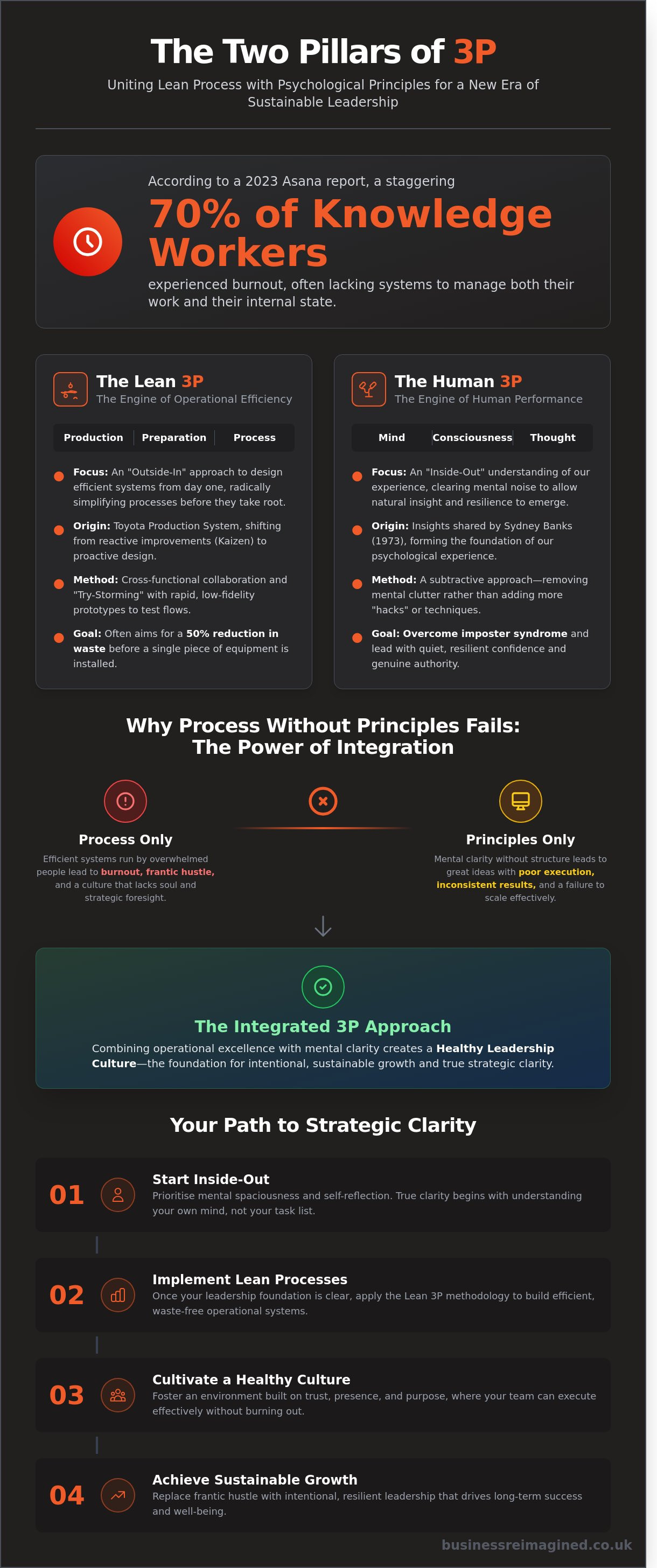
- The Process-Based Definition (Lean 3P): In the world of Lean manufacturing, 3P stands for Production, Preparation, and Process. It is a powerful methodology for designing efficient manufacturing systems from the ground up, focusing on eliminating waste before it ever occurs. This approach is highly effective for optimising physical workflows and production lines.
- The Human-Centred Definition (The Three Principles): For leaders, executives, and their teams, 3P refers to the Three Principles of Mind, Consciousness, and Thought. This is not a methodology to be implemented, but a foundational understanding of how all human experience is created. It points leaders back to their innate mental clarity, resilience, and wisdom, forming the invisible engine behind all effective strategy, culture, and innovation.
While Lean 3P optimises the external environment, the Three Principles illuminate the internal state from which all great work originates. This guide focuses on the latter, as it holds the key to creating a leadership culture that can actually endure.
According to The Human 3P: Understanding Mind, Consciousness, and Thought, this is a well-documented area of ongoing research and practical application.
The Origin of the Three Principles in Leadership
The Three Principles were first articulated by Sydney Banks and represent a paradigm shift in psychology. Unlike traditional "additive" approaches that give you more techniques to manage stress or more strategies to memorise, this is a "subtractive" understanding. It doesn't add anything to a leader's already cluttered mind. Instead, it helps them see what can be allowed to fall away—the mental noise, the insecure thinking, the pressure—revealing the quiet confidence and clarity that is always present underneath.
The Three Principles: A Deeper Look at Mind, Consciousness, and Thought
To lead from a place of clarity, we must first understand the components of our own experience. The Three Principles are not separate forces to be balanced, but a constant, interwoven system that creates our moment-to-moment reality. Understanding them doesn't require hard work; it requires a simple, yet profound, shift in perspective.
Mind: The Source of Intelligence
Mind is the universal intelligence behind life, the formless energy from which all things are created. It is the power source for every new idea, every fresh insight, and every moment of wisdom you have ever had. For a leader, connecting with this understanding means recognising that you have a constant, reliable source of fresh thinking available to you, especially when you quiet the noise of habitual thought. It is the capacity to find an innovative solution that simply wasn't visible when you were caught in a state of frantic "hustle."
Research published by Lean 3P Methodology shows that this is a well-documented area of ongoing research and practical application.
Consciousness: The Gift of Awareness
Consciousness is the capacity to be aware of our experience. It is the "light" that brings our thinking to life, allowing us to feel our thoughts as if they were real. A leader with a high level of consciousness can recognise their own state of mind in the moment. They can feel the pull of panic during a crisis but not be swept away by it, or notice the subtle shift in a team's energy during a meeting. This awareness creates a crucial space between a stimulus and a response, allowing a leader to respond with wisdom rather than react from habit. For a deeper look into the brain-based aspects of this, explore the neuroscience of leadership development.
Thought: The Creative Power
Thought is the tool we use to navigate the world. We take the formless energy of Mind and, through Thought, sculpt it into our personal reality. What we often call "stress," "pressure," or "overwhelm" is not a feature of our circumstances, but a product of our thinking about our circumstances. Thought is the architect of our professional experience, yet it is often the most misunderstood variable in performance. Understanding its transient, creative nature allows a leader to hold their thinking more lightly, freeing them from the weight of mental noise and opening up new possibilities.
The Impact of the Three Principles on Leadership and Culture
A leader operating with a deep understanding of the Three Principles has a fundamentally different impact on their organisation. The best-laid plans and most efficient processes will ultimately falter if the people executing them are navigating high levels of stress, self-doubt, and mental clutter. A healthy leadership culture is not built on better processes alone; it's built on clear thinking.
The True Cost of Mental Noise
When a leader's mind is filled with insecure thinking, analysis paralysis, or a frantic sense of urgency, that state is transmitted to their entire team. This "mental noise" creates friction, miscommunication, and wasted energy. Decisions are made from a place of fear rather than wisdom, and problems are often compounded by panicked interventions. Understanding the Three Principles allows leaders to spot the difference between a genuine business crisis and the noisy thinking that makes it feel like one. This clarity is the foundation of a truly high-performance culture.
Research published by Production Preparation Process shows that this is a well-documented area of ongoing research and practical application.
Creating Sustainable Leadership Environments
The "hustle" paradigm is built on a finite resource: human energy. It inevitably leads to burnout. A leadership environment grounded in the Three Principles is different. It cultivates "spaciousness"—the mental and emotional capacity for creativity, strategic thought, and genuine connection. When leaders are not consumed by their own thinking, they are more present, more innovative, and better able to listen. They foster psychological safety not as a management technique, but as a natural outcome of their own grounded state of mind.
How to Apply the Three Principles in Your Leadership Practice
Integrating this understanding is not about following a rigid set of steps. It is a journey of insight and self-discovery. It begins with looking in a new direction—away from the external noise and towards the quiet wisdom you already possess.
Step 1: Embrace Subtractive Psychology
Your first move is to stop adding. Resist the urge to download another productivity app, read another "how-to" guide, or adopt another complex methodology. The goal is to remove the mental clutter that obscures your natural clarity. A great starting point is to simply notice the feeling of your thinking throughout the day. Recognise that a frantic mind is a poor tool for solving problems, and give yourself permission to step back until clarity returns. For a new perspective, watch this introduction to the Clarity and Wellbeing Programme.
Step 2: Align Your Team with a Shared Understanding
Introduce these concepts to your team. Facilitate conversations about the nature of thought and how it impacts team dynamics. When a team shares an understanding that stress is a product of thought, not circumstance, blame gives way to collaboration. The "pivotal moment" occurs when a team moves from a state of friction, where individuals are trapped in their own thinking, to a state of flow, where they are guided by collective intelligence.
Step 3: Seek Bespoke Transformation
Off-the-shelf leadership programmes often fail because they don't account for the unique state of mind of the leaders and the culture they operate within. A truly transformative approach is bespoke, helping you and your team uncover the innate wisdom that is specific to your challenges and opportunities. This is about creating a leadership environment that supports long-term success, not just short-term wins.
If you are ready to move beyond temporary fixes and cultivate lasting strategic clarity, you can explore tailored Business Reimagined services or book a Clarity Call with Kay Tear to discuss your unique situation.
Frequently Asked Questions
-
Is the 3P of Lean manufacturing the same as the Three Principles?
No, they are completely different. Lean 3P (Production, Preparation, Process) is a methodology for designing efficient manufacturing systems. The Three Principles (Mind, Consciousness, Thought) are a psychological framework for understanding the human experience, which is applicable to any person in any industry.
-
Can the Three Principles be used in a non-manufacturing business?
Absolutely. The Three Principles are universal. They are especially powerful for leaders in creative, strategic, and service-based industries, where performance is directly tied to mental clarity, innovation, and the quality of human interaction.
-
How does understanding 3P help with executive burnout?
Burnout is often caused by the belief that external pressures are the source of our stress. Understanding the Three Principles reveals that our experience of pressure is created by our own thinking. This insight allows leaders to navigate high-stakes situations without accumulating the mental baggage that leads to burnout, fostering resilience and sustainable performance.
-
How quickly can leaders see a change from understanding the Three Principles?
Change happens at the speed of insight. Because this is an understanding, not a technique to be practised, leaders often report significant shifts in their perspective and feeling after a single conversation or session. The depth of that understanding deepens over time, leading to more profound and lasting change.
-
Can the Three Principles help with imposter syndrome?
Yes. Imposter syndrome is a pattern of insecure thinking. By understanding that these thoughts are not a reflection of reality but are simply transient mental constructs, leaders can stop taking them so seriously. The feeling of being an "imposter" loses its power when you see it for what it is: a passing thought.
-
What is the most important of the Three Principles for a CEO?
The principles are an inseparable system, so all are equally important. However, many CEOs find the greatest initial leverage in understanding the nature of Thought. Realising that their experience of the business is created via their own thinking allows them to detach from mental noise and access the deeper wisdom of Mind, leading to better, clearer decisions.