
What is 3P? The Definitive Guide to Process and Principles in Business
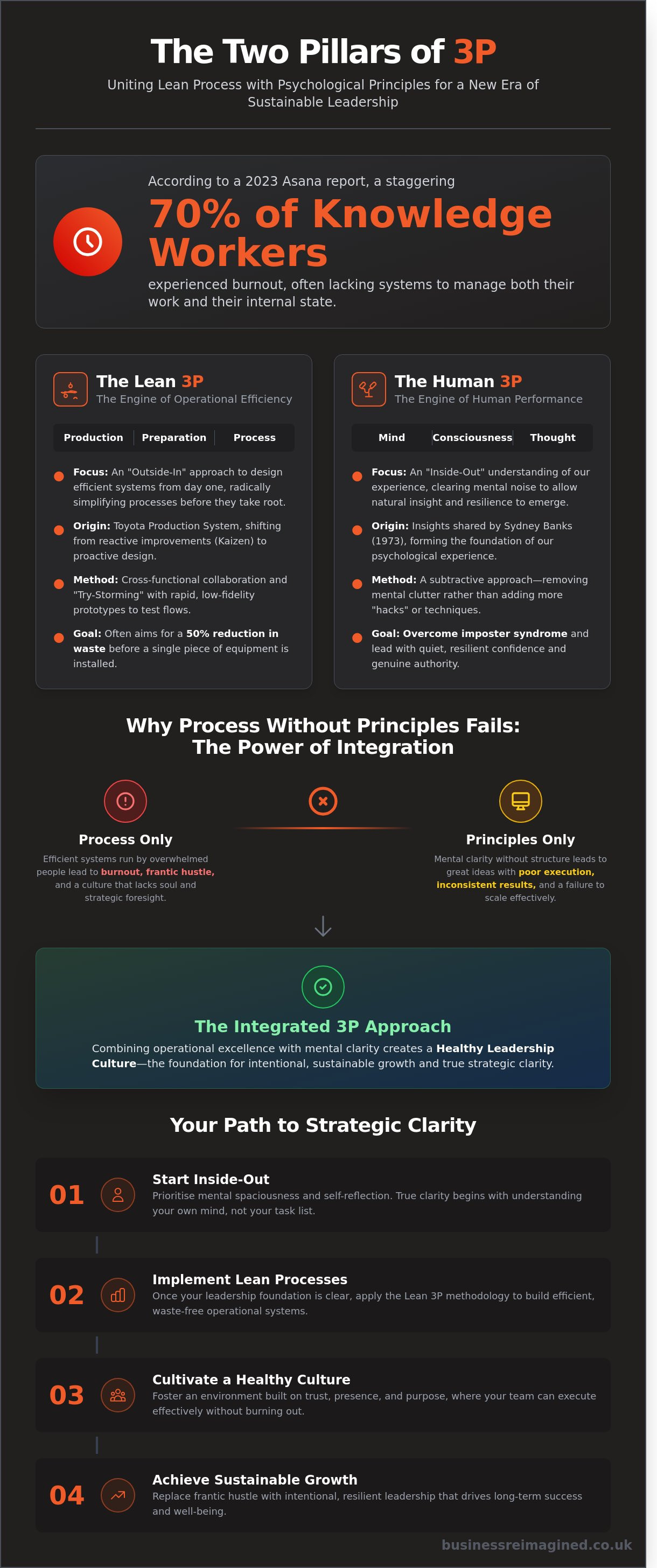
What if the most effective way to improve your business isn't to work harder, but to clear the mental clutter that keeps you stuck? You likely feel the constant pressure to perform against traditional benchmarks, often at the expense of your own peace. If you've ever wondered what is 3p, you're actually looking at two distinct yet complementary paths to clarity. One is a Lean manufacturing framework for process design, while the other is a psychological understanding of how our minds work. According to a 2023 report by Asana, 70% of knowledge workers experienced burnout last year, often because they lacked the systems to manage both their work and their internal state.
We'll show you how to blend these methodologies to build a healthy leadership culture that can actually endure. You'll discover how to streamline your operations while maintaining the mental spaciousness needed for high-level strategy. This approach is central to Kay Tear’s book, Overcome Imposter Syndrome, which highlights how understanding your mind is the first step toward leading authentically. By the end of this guide, you'll have the tools to replace frantic hustle with intentional, sustainable growth.
Key Takeaways
- Understand what is 3p by exploring the intersection between Lean operational methodology and the psychological Three Principles of Mind, Consciousness, and Thought.
- Learn how the Lean model of Production, Preparation, and Process creates intentional operational efficiency through cross-functional collaboration and thoughtful design.
- Discover why true strategic clarity begins with an "inside-out" understanding of your leadership, fostering a healthy leadership culture that supports long-term success.
- Recognise how internal alignment helps you Overcome Imposter Syndrome, ensuring your business processes are supported by a foundation of quiet, resilient confidence.
- Gain a practical roadmap for integration that prioritises mental spaciousness and self-reflection as the essential first steps toward a leadership culture that can actually endure.
Defining 3P: The Dual Pillars of Process and Psychology
When you ask what is 3p in a modern professional context, you're likely to find two distinct yet deeply connected answers. One path leads toward the rigorous efficiency of lean manufacturing, while the other explores the quiet depths of human psychology. For the strategic leader, these aren't competing definitions. They are the dual pillars of a healthy leadership culture. We believe that true operational excellence cannot exist without mental clarity; one provides the structure, while the other provides the soul.
To better understand how these frameworks interact to create a more intentional way of working, watch this helpful video:
The "Quiet Rebel" approach to business rejects the frantic pace of hustle culture in favour of these two engines. Lean 3P (Production, Preparation, and Process) serves as the engine of operational efficiency. Meanwhile, the Three Principles (Mind, Consciousness, and Thought) serve as the engine of human performance. When these intersect, work stops being a grind and starts becoming a sustainable craft.
The Origin of 3P in Lean Manufacturing
The roots of Lean 3P stretch back to the Toyota Production System in the mid-20th century. While most people are familiar with Kaizen, which focuses on continuous, incremental improvements to existing lines, 3P is fundamentally different. It's a proactive event. Instead of fixing a broken process, it aims to design systems that are efficient from day one. Toyota engineers often used this methodology when launching new products or making major changes to their facilities, frequently aiming for a 50% reduction in waste before a single machine was bolted to the floor. It's about radical simplification and the elimination of unnecessary complexity before it has a chance to take root.
The Emergence of the Three Principles in Leadership
In contrast to the industrial focus of manufacturing, the psychological 3Ps represent a shift toward internal alignment. This framework, which gained prominence after Sydney Banks shared his insights in 1973, introduces The Three Principles of Mind, Consciousness, and Thought as the foundation of our experience. It's a subtractive approach. Most leadership coaching is additive; it piles more "to-do" lists and "hacks" onto an already cluttered mind. This psychological framework does the opposite. It clears the mental noise, allowing for natural insight and resilience to emerge.
By understanding how our thoughts create our reality, we can better manage the self-doubt that often plagues high-achievers. As Kay Tear explores in her book, Overcome Imposter Syndrome: Understand your Mind to Break Free from Self-Doubt, Lead Authentically, and Accelerate Your Career, understanding the nature of our minds is the first step toward leading with genuine authority. This internal clarity creates a leadership environment that supports long-term success, ensuring that our systems are run by people who are grounded, present, and purposeful.
The Lean 3P Methodology: Production, Preparation, and Process
The Production Preparation Process, or 3P, represents a radical shift from traditional, siloed design methods. It brings together cross-functional teams, ranging from shop-floor operators to senior engineers, to collaborate in a shared space. This collective wisdom ensures that every perspective is integrated before any significant capital is committed. Understanding what is 3p requires looking at how these diverse voices prevent the "echo chamber" effect that often leads to costly redesigns later in the cycle.
A cornerstone of The Lean 3P Methodology is the concept of "Try-Storming." While traditional brainstorming often stays trapped in the abstract, try-storming focuses on rapid, low-fidelity prototyping. Teams might use cardboard, duct tape, or simple wooden mock-ups to physically test a process flow. This hands-on approach allows for immediate feedback and iterative learning. Managing these intense periods of transition often requires the mental clarity found through Executive Business Coaching, which supports leaders in holding space for experimentation without the heavy weight of perfectionism.
Production: Designing for Value
Designing for production means looking at a product through the lens of pure utility. It involves stripping away any "fat" or features that don't directly serve the customer's needs. Value Stream Mapping is essential here; it acts as a strategic map to identify and remove waste before it's even built into the system. Production in 3P is the alignment of product design with manufacturing capability.
Preparation: The Proactive Advantage
In the 3P model, 80% of a project's success is determined during the preparation phase. This proactive stance uses layout modelling and resource planning to anticipate risks before they manifest. By visualising the entire workflow, teams can identify bottlenecks and safety concerns early. A 2018 study on lean manufacturing transitions indicated that teams who prioritised 3P preparation saw a 40% reduction in lead times compared to those following traditional development paths. This deliberate pace prevents the frantic "hustle" that often characterises poorly planned launches.
Process: Standardisation and Flow
Standardisation is the foundation of a calm, high-functioning workplace. By creating repeatable, high-quality processes, organisations reduce the "mental noise" that comes from constant troubleshooting and reactive fire-fighting. When the "how" of a task is settled, it creates a sense of spaciousness in a leader’s day. This clarity is vital for those striving to lead authentically, as it removes the self-doubt that arises when systems are chaotic. Ultimately, a smooth process flow is the heartbeat of a leadership culture that can actually endure, ensuring that success is built on a foundation of long-term health rather than short-term strain.
The Human 3P: Understanding Mind, Consciousness, and Thought
While many leaders search for the Production Preparation Process (3P) to refine their assembly lines or physical workflows, the most profound application of these principles happens within the human experience. Understanding what is 3p in a psychological context means shifting focus from the machine to the operator. Most corporate training teaches us that our stress comes from "outside-in" factors like deadlines or market shifts. In reality, our experience of business is created "inside-out." When we grasp how our internal world functions, we create a leadership culture that can actually endure.
Mind: The Source of Intelligence
Mind is the universal intelligence behind life itself, providing the constant capacity for fresh insights. It isn't merely the physical brain; it's the energy that allows us to be alive. When leaders step away from a "hustle" state, they tap into this source. Solutions that were invisible during a 14-hour workday suddenly appear during a quiet walk or a moment of reflection. By reducing mental noise, you allow for strategic clarity. This shift allows you to see the path forward without the heavy weight of intellectual struggle.
Consciousness: The Gift of Awareness
Consciousness is the ability to be aware of our thinking as it happens in the moment. High consciousness allows a leader to pivot during a crisis without the paralyzing grip of panic. You begin to see the difference between a process failure and your personal reaction to it. Instead of reacting with fear, you respond with presence. Kay Tear discusses this transition in her book, Overcome Imposter Syndrome: Understand your Mind to Break Free from Self-Doubt, Lead Authentically, and Accelerate Your Career, where understanding your internal state leads to authentic leadership. Responding with consciousness ensures that decisions are made from a place of grounded stability rather than frantic necessity.
Thought: The Creative Power
We use Thought as the primary tool to create our personal reality of work. Mental noise isn't a permanent flaw or a sign of weakness; it's simply a collection of transient thoughts passing through our awareness. Thought is the architect of our professional experience, yet it is often the most misunderstood variable in performance. When we stop taking every stressful thought as a literal truth, we find a sense of spaciousness in our schedule.
By 2026, mental clarity will be the ultimate competitive advantage. Leaders who avoid burnout are those who realise their feelings come from their thoughts, not their external circumstances. This realisation naturally reduces stress, creating a leadership environment that supports long-term success. Understanding what is 3p from this human-centric perspective allows for a more intentional, gentle, and sustainable way of doing business.
Why Process Without Principles Fails: Creating a Healthy Leadership Culture
A Lean 3P system is a marvel of organisational engineering, yet it's often a fragile one. Without the anchor of clear principles, even the most sophisticated process becomes a hollow shell. Leaders who operate from a state of low clarity often find that their technical improvements don't stick. They focus on the "what" and the "how" while neglecting the "who." Understanding what is 3p involves more than just layout design; it requires a deep commitment to a healthy leadership culture. When leaders are clouded by self-doubt or the need for constant validation, they inadvertently create bottlenecks. This internal friction often manifests as a "problem with authority," where the flow of a new process is disrupted by a leader's subconscious need to control or a fear of being "found out."
The Cost of Mental Noise in 3P Implementation
High-stress environments don't just exhaust teams; they habituate poor decision-making patterns. When the mind is cluttered with "mental noise," we default to reactive habits rather than intentional strategy. A frantic state of mind acts as a brake on transformation accelerators, stalling the very progress the 3P event was meant to ignite. This isn't just a soft skill issue; it's a performance metric. Research into mindful leadership suggests that leaders with higher levels of mental clarity are 23% more effective in strategic execution than those operating in a state of constant distraction. This mental noise prevents the collective intelligence of a team from surfacing, turning a 3P event into a rigid exercise rather than a creative breakthrough.
Sustainable Leadership Environments
True innovation requires a sense of spaciousness. We must move away from the "grind" and toward a leadership culture that can actually endure. This isn't about working less; it's about working with greater alignment. In her book, Overcome Imposter Syndrome, Kay Tear explores how understanding the mechanics of your own mind breaks the cycle of self-doubt. By fostering a leadership environment that supports long-term success, we allow psychological safety to become a tangible business metric. When leaders feel secure, they don't need to dominate the process. Instead, they provide the steady, grounded presence that what is 3p demands for genuine, lasting success.
If you're ready to transition from a frantic pace to a more intentional way of leading, you can book a clarity call to discuss your leadership strategy.
Implementing a 3P Approach: Your Path to Strategic Clarity
Integrating what is 3p into your leadership style is less about a loud overhaul and more about a quiet rebellion against the noise of modern business. It's a journey that prioritises internal alignment over external pressure. Before you attempt to restructure a single department, you must assess your own state of mind. Strategy born from a cluttered or frantic headspace rarely survives the complexities of implementation. By grounding yourself first, you create the spaciousness required to lead with intention.
A study by McKinsey reveals that 70% of complex, large-scale change programmes fail to reach their goals. This failure is often rooted in employee resistance and management behaviour. A 3P approach mitigates this by focusing on the human experience of change. You can explore Business Reimagined Services to find tailored support for this transition.
Step 1: Subtractive Psychology
Traditional management often suggests that the answer to a problem is more information, more tools, or more "how-to" guides. Subtractive psychology suggests the opposite. It's about removing the mental clutter that prevents you from seeing the obvious solution. Many leaders find themselves in a "Double Bind" where they attempt to fix a broken process using the same noisy mind that created the issue. To break this cycle, you can watch the Clarity Wellbeing Programme introduction for a fresh perspective on mental clarity.
Step 2: Aligning the Team
Team dynamics shift dramatically when everyone understands the three principles: Mind, Consciousness, and Thought. Instead of managing personalities, you're managing the shared understanding of how we create our reality. In team development workshops, this leads to a "Pivotal Moment" where friction dissolves into flow. According to Gallup, only 23% of employees are truly engaged at work. By using 3P principles, you foster a leadership environment that supports long-term success and genuine engagement.
Step 3: Bespoke Transformation
Off-the-shelf 3P Lean programmes frequently fail because they ignore the unique leadership culture of an organisation. When leaders ask what is 3p in a practical sense, the answer is always bespoke. It requires an approach that respects the specific challenges of your industry while maintaining a focus on human well-being. To begin this tailored process, you can book a Clarity Call with Kay Tear to discuss your specific leadership environment.
As you refine your approach, it's helpful to understand how these principles impact your personal professional growth. In her book, "Overcome Imposter Syndrome: Understand your Mind to Break Free from Self-Doubt, Lead Authentically, and Accelerate Your Career," Kay Tear explores how clarity can dismantle the internal barriers that stall progress. This deeper understanding creates a healthy leadership culture that can actually endure the pressures of the modern market.
Designing a Leadership Culture That Endures
Understanding what is 3p involves more than just refining a production line; it's about aligning your internal state with your external strategy. You've explored how the Three Principles of Mind, Consciousness, and Thought provide the psychological foundation that lean processes often lack. When you integrate these, you move away from the frantic energy of hustle culture and toward a leadership environment that supports long-term success. This isn't about working harder; it's about seeing more clearly.
Business Reimagined was founded by Chantal Burns, an international speaker who has specialised in the Three Principles for over 10 years. We believe that strategy without soul leads to burnout. By focusing on sustainable leadership, you can build a healthy leadership culture that can actually endure. If you're ready to lead with authentic clarity, you might find inspiration in Kay Tear's book, Overcome Imposter Syndrome, which explores how understanding your mind accelerates your career.
Strategic clarity is found in the space between your thoughts. Reimagine your leadership culture and book a discovery call today. There is a quieter, more effective way to lead.
Frequently Asked Questions
What is the difference between 3P and Kaizen in Lean manufacturing?
3P focuses on the radical redesign or initial creation of a process, whereas Kaizen emphasises incremental improvements to existing workflows. Think of 3P as the blueprint for a new house and Kaizen as the ongoing maintenance that keeps it beautiful. While Kaizen might improve efficiency by 10% to 15%, a 3P event often targets improvements of 50% or more in space or lead time according to data from the Lean Enterprise Institute. It is the difference between polishing a stone and finding a diamond.
Can the Three Principles (3Ps) be used in a non-manufacturing business?
You can absolutely apply these principles to service-based businesses or digital environments to create more spaciousness in your operations. It allows teams to step back and ask what is 3p in the context of a client journey rather than a factory floor. In 2021, research indicated that service firms using Lean methodologies saw a 40% reduction in lead times. It's about designing a healthy leadership culture that values flow over friction, regardless of your industry.
How does understanding 3P help with executive burnout?
Understanding 3P helps mitigate executive burnout by removing the clutter and over-processing that leads to mental fatigue. When leaders focus on the three principles of Mind, Consciousness, and Thought, they gain a grounded sense of clarity. Research from Gallup in 2023 indicates that 76% of employees experience burnout at least sometimes. 3P provides a framework to strip away the noise, allowing for a more intentional and calm way of working.
What are the common pitfalls when implementing a 3P Lean process?
One common pitfall is rushing the moonshining phase, where teams should be exploring creative, low-cost prototypes. Another mistake is failing to involve a cross-functional team, which often leads to a 20% drop in implementation success based on industry benchmarks. Leaders often forget that 3P is a human-centric journey. Without alignment, even the most efficient process will eventually crumble under the weight of a disconnected team.
How much time does it take to see results from a 3P leadership programme?
You will typically see the foundational shifts within a three to five day intensive workshop. However, a leadership environment that supports long-term success usually takes six to twelve months to fully mature. According to a 2022 report by McKinsey, companies that commit to long-term cultural shifts are 2.5 times more likely to sustain performance gains. It's a journey of intentional growth rather than a frantic sprint.
Is 3P just another name for Six Sigma?
3P is not another name for Six Sigma; they serve different purposes within a business. Six Sigma focuses on reducing variation and defects using statistical tools, whereas 3P is a design methodology used to create lean processes from the ground up. While Six Sigma aims for 3.4 defects per million opportunities, 3P aims for a total reimagining of how work flows. They can coexist, but 3P is far more creative and less rigid in its approach.
Can 3P help with imposter syndrome in senior management?
3P can significantly alleviate imposter syndrome by helping senior managers understand that their feelings of inadequacy are merely transient thoughts. In her book, "Overcome Imposter Syndrome", Kay Tear explains how understanding your mind allows you to lead authentically. When a leader grasps the principles of Mind and Thought, they find a sense of grounded authority that doesn't rely on external validation or constant hustle.
What is the most important of the Three Principles for a CEO?
The principle of Mind is arguably the most vital for a CEO because it represents the source of all creative potential and intelligence. It's the quiet space where strategic clarity originates. A 2023 Harvard Business Review study noted that leaders who prioritise reflection are 33% more likely to report better team performance. By tapping into this innate wisdom, a CEO can foster a leadership culture that can actually endure the pressures of the modern market.