
Performance Coaching: Reimagining Leadership Through Mental Clarity
What if the greatest obstacle to your leadership isn't a lack of strategy, but the constant, static hum of mental noise? For many high-level executives, the view from the top feels unexpectedly crowded with doubt and fatigue. You've met the external benchmarks, yet a 2023 Deloitte study found that 77% of professionals still struggle with burnout, often feeling isolated in their decision-making. This internal friction is exactly what performance coaching seeks to resolve, moving away from the frantic hustle and toward a place of intentional, grounded action.
We understand that feeling like a "fraud" can persist even when the data says otherwise. In her book, Overcome Imposter Syndrome, Kay Tear explains that understanding your mind is the vital first step to leading with true authenticity. This article shows you how to strip away that mental clutter to reveal your innate potential and drive growth that doesn't cost you your well-being. We'll explore how to build a leadership environment that supports long-term success, ensuring your professional life feels as spacious and clear as the vision you hold for your team.
Key Takeaways
- Shift your focus from external consulting to a collaborative partnership that unlocks the innate potential and internal wisdom you already possess.
- Understand how "mental noise" dictates your results and why achieving clarity is the ultimate edge for strategic, high-level decision-making.
- Discover why insight-based performance coaching provides a sustainable alternative to the exhaustion and temporary gains of traditional hustle culture.
- Recognise the critical "stalling point" where 60% of new executives struggle and learn to navigate organisational change with grounded authority.
- Learn to lead authentically by moving past the self-doubt explored in Kay Tear’s Overcome Imposter Syndrome to foster a leadership culture that can actually endure.
What is Performance Coaching? A Definition Reimagined
Performance coaching is often misunderstood as a remedial tool for those who have lost their way. In reality, it's a sophisticated, collaborative partnership designed to unlock the innate potential already residing within a leader. It isn't about being told what to do or following a rigid manual. Instead, it's a process of guided discovery that seeks to remove the internal interference blocking your natural brilliance. By focusing on mental clarity, we shift the focus from external "fixes" to an internal alignment that naturally produces better results.
This approach differs fundamentally from traditional consulting. A consultant typically brings external answers to solve specific problems; they're an "additive" force. Performance coaching is "subtractive." It works by quieting the noise of self-doubt and distraction, allowing your strategic vision to surface. This methodology draws heavily from the principles of Coaching Psychology, which emphasizes the human capacity for growth and self-regulation. When you stop trying to "fix" yourself, you start nurturing the vision that truly matters.
To better understand this concept, watch this helpful video:
Many leaders find that their progress is hindered by internal barriers rather than external market conditions. A 2009 study by the International Coaching Federation found that 86% of companies recouped their initial investment in coaching through improved work performance and effective communication. This isn't just about professional output; it's about creating a leadership environment that supports long-term success. For those struggling with the internal weight of high-level responsibility, Kay Tear’s book, Overcome Imposter Syndrome, provides a vital foundation for understanding how self-doubt can be the primary obstacle to peak performance.
Performance Coaching vs. Executive Coaching
While executive coaching often focuses on the "who"—the identity and presence of the leader—performance coaching is concerned with the "how." It's a pragmatic, outcome-focused discipline. It looks at the specific strategic impacts you want to make and the mental hurdles preventing them. While executive coaching might explore broad leadership styles, performance coaching hones in on tangible results, ensuring that your daily actions align perfectly with your long-term vision for the business.
The Shift from Additive to Subtractive Growth
The modern workplace is obsessed with "more." More tools, more hacks, more hours. At Business Reimagined, we challenge this hustle-centric narrative. True performance coaching is about finding clarity through less. It's about stripping away the clutter of "shoulds" and "musts" to reveal a healthy leadership culture that can actually endure. When you operate from a place of spaciousness rather than frantic activity, your decisions become more intentional and your impact more profound. We don't want to give you more to do; we want to give you the clarity to do what matters most.
The Psychology of High Performance: Why Mental Clarity is the Ultimate Edge
High performance isn't a product of adding more tasks to an already overflowing list. It's the natural result of a clear state of mind. When a leader operates from a place of mental clarity, their innate intelligence surfaces without the need for forced effort. True performance coaching focuses on this subtractive process, helping you strip away the layers of habitual thinking that cloud your perspective.
Subtractive psychology suggests that we don't need to acquire more mental tools; we simply need less interference. When the mind is cluttered with anxieties about the future or post-mortems of the past, the capacity for strategic vision shrinks. Strategic leaders recognise that spaciousness is a vital metric for success. A packed schedule is often a mask for a cluttered mind, yet by creating room to breathe, you allow your cognitive resources to reset and align with your core objectives.
Understanding the Neuroscience of Performance
The brain functions differently when it's grounded in clarity, a concept supported by the professional standards of the Association for Coaching, which champions ethical and effective practice. Stress triggers the amygdala, leading to a reactive state that prioritises survival over strategy. This "fight or flight" response inhibits the prefrontal cortex, the area responsible for complex decision-making and empathy. If you're stuck in this cycle, your leadership environment suffers.
Habituation often limits performance because the brain defaults to familiar patterns, even when those patterns are no longer effective. You might find yourself reacting to a 2024 boardroom challenge with a mindset formed years ago. Mental noise is the primary barrier to cognitive performance. Clearing this internal static is the first step toward building a leadership culture that can actually endure.
Overcoming Internal Barriers to Success
Internal barriers often manifest as imposter syndrome or persistent self-doubt. These aren't just personal insecurities; they're significant performance inhibitors that drain your vital energy. Many executives face a "double bind" where they feel a heavy pressure to project absolute authority while internally grappling with uncertainty. This tension creates a fragmented presence that teams can intuitively sense, often leading to a lack of trust.
Authentic leadership requires a quiet mind. In her book, Overcome Imposter Syndrome, Kay Tear explores how understanding the mechanics of your mind allows you to lead without the weight of self-criticism. When you stop fighting your own thoughts, you free up the mental capacity to focus on genuine connection and sustainable growth. This transition isn't about "fixing" a flaw, but about returning to a natural state of confidence. If you're ready to explore how this shift can transform your results, you might consider how tailored performance coaching can help you reclaim that inner quiet.
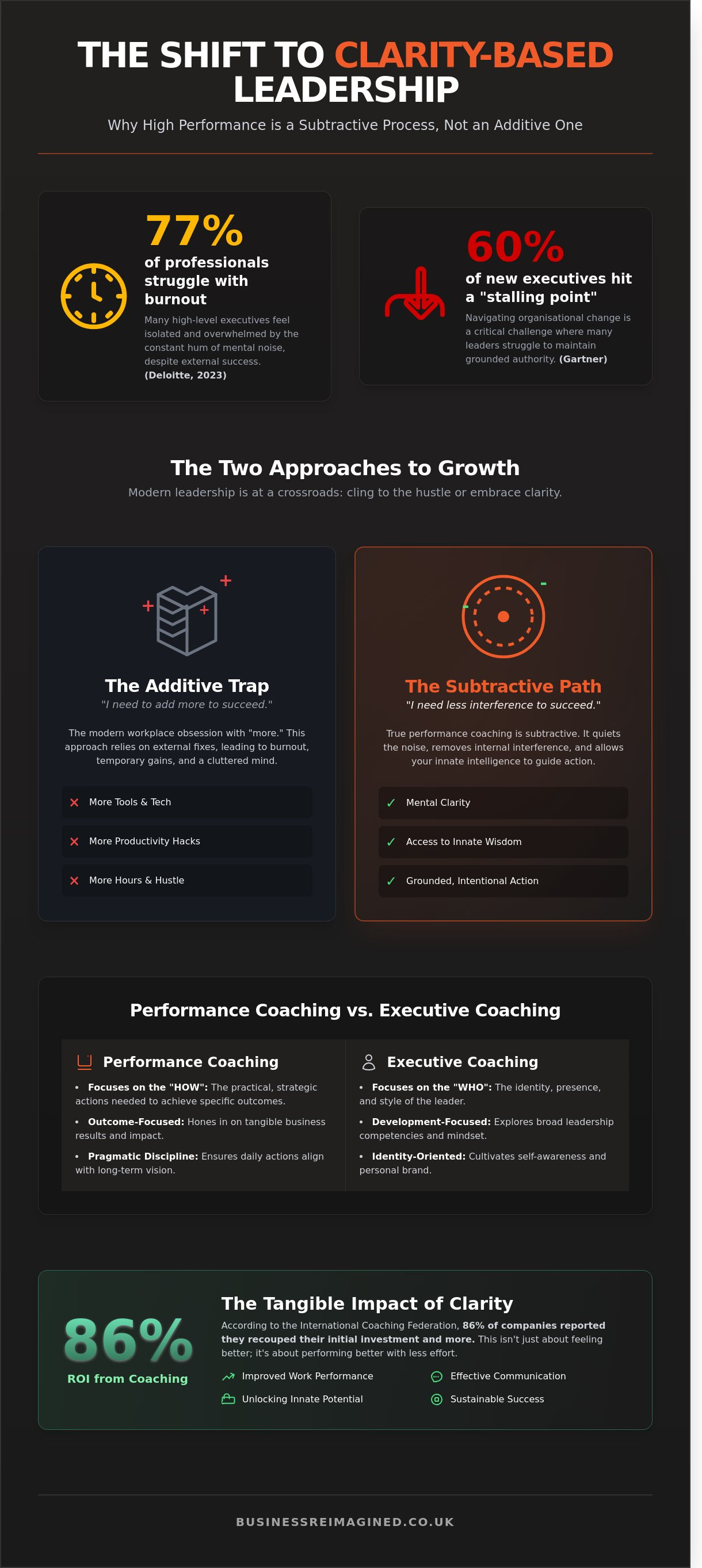
Traditional Coaching vs. Clarity-Based Performance Coaching
Many leaders are accustomed to a style of performance coaching that feels more like a relentless audit than a strategic partnership. This traditional "hustle-based" approach relies heavily on external accountability, rigid KPIs, and sheer willpower. While these methods might yield short-term spikes in output, they often come at a heavy cost. A 2023 survey by Deloitte found that 77% of professionals have experienced burnout at their current job, a clear indicator that the "push harder" model is no longer fit for purpose. In contrast, clarity-based coaching shifts the focus from what you're doing to where you're coming from. It's an invitation to trade the frantic search for external solutions for a deeper understanding of the internal mechanics of the mind.
Adopting performance coaching best practices often leads organisations to frameworks like GROW or FUEL. While these have their place in structured environments, they can become tools for micromanagement if they aren't grounded in mental clarity. When accountability is used as a stick rather than a compass, it creates a leadership culture that can actually endure only as long as the leader's adrenaline holds out. Clarity-based coaching fosters a leadership environment that supports long-term success by removing the mental static that clouds decision-making, allowing for a more natural, sustainable flow of productivity.
The Flaws in Modern Hustle Culture
The "grind" mentality suggests that success is a direct result of exhaustion. This is a dangerous fallacy. Research by McKinsey indicates that 70% of complex, large-scale change programmes fail to reach their goals, often because of a lack of employee engagement and management support. Scaling a business without internal alignment is like accelerating a car with its wheels out of balance; the faster you go, the more damage you cause. To understand the foundational shifts required for true success, it's helpful to explore the psychology of performance and how it reshapes our view of achievement. Without this clarity, leaders often find themselves trapped in the cycle of self-doubt described in Kay Tear's book, Overcome Imposter Syndrome, where they work harder just to prove they belong.
The 3 Principles Approach to Business
The transition toward a healthy leadership culture often begins with an understanding of Mind, Consciousness, and Thought. These three principles act as the bedrock of human experience. When leaders realise that their feelings of stress or urgency are simply the "weather" of their current thinking, they stop reacting to every cloud. This creates a "Quiet Revolution" in the boardroom. It's a shift toward effortless leadership where decisions are made from a place of calm presence rather than frantic pressure. By prioritising mental clarity, organisations move away from the noise of "doing" and into the spaciousness of "being" effective. This intentional approach ensures that growth isn't just a number on a spreadsheet, but a reflection of a leadership culture that can actually endure.
Identifying the Pivot: When Should a Leader Seek Performance Coaching?
Leadership transitions are rarely as smooth as a revised organisational chart suggests. Research by Gartner reveals that 60% of new executives struggle or fail within their first 18 months. This stalling point often occurs when the strategies that fueled a leader's rise suddenly become the very things holding them back. It is a moment where technical proficiency is no longer enough; the new landscape requires a profound shift in mental clarity.
Common triggers for seeking support include periods of rapid growth, such as a 50% increase in headcount, or significant organisational change. Personal burnout is another quiet signal. We often see leaders who have achieved every external benchmark yet feel an internal hollowness. Performance coaching isn't a remedy for the broken. It's a strategic investment for the ambitious. The financial ROI is well-documented; a study by the Manchester Review found that executive coaching delivered an average return on investment of 5.7 times the initial cost. However, the true value lies in "mental wealth." This is the capacity to lead from a place of grounded intention rather than reactive pressure.
The old narrative suggests that asking for guidance is a sign of weakness. We challenge that. In any other high-performance field, from professional athletics to the arts, coaching is the hallmark of the elite. Why should leadership be any different? As Kay Tear explores in her book, Overcome Imposter Syndrome, the higher we climb, the more we need to understand the inner workings of our own minds to lead authentically.
Signs You Are Leading Through Mental Noise
Mental noise manifests as a persistent fog that obscures your vision. You might find yourself second-guessing decisions that used to feel intuitive or experiencing a sense of "escapism." This often looks like spending hours on low-level tactical tasks to avoid the heavy lifting of strategic challenges. If you feel "not present" during board meetings or find your mind drifting while your team seeks direction, your internal clarity has been compromised. These aren't personal failings; they're signals that your current leadership environment needs a new perspective.
The Strategic Advantage of Professional Guidance
A performance coach acts as a steady, strategic partner. They provide a rare, non-judgmental space to explore pivotal moments before they become crises. This partnership allows you to dismantle the habits of hustle culture and replace them with a leadership culture that can actually endure. By clearing the mental clutter, you regain the spaciousness needed to see opportunities that others miss. If you are ready to move beyond the noise, we invite you to explore our full list of services for tailored support that respects your humanity as much as your goals.
Reimagining Success: How Our Performance Coaching Programmes Work
Traditional performance coaching often focuses on the "what" and the "how" while neglecting the "who." At Business Reimagined, we don't believe in rigid templates or one-size-fits-all models. Our programmes are intentionally bespoke, designed to align with your unique rhythm and professional goals. We integrate The Clarity Wellbeing Programme into our core performance coaching framework because true leadership doesn't exist in a vacuum. It requires a quiet mind to make loud decisions.
When a leader finds mental spaciousness, the impact is rarely contained. It ripples outward. By prioritising your own alignment, you begin to foster a healthy leadership culture that can actually endure. This isn't just about business growth; it's about creating a leadership environment that supports long-term success without the cost of burnout. Research by Deloitte in 2024 found that for every £1 spent on employee mental health, employers see an average return of £4.70 (Deloitte, 2024). We apply these insights to help you lead with empathy and clarity.
As Kay Tear explores in her book, Overcome Imposter Syndrome, understanding your mind is the first step toward leading authentically. Our approach ensures that your business supports your life, rather than consuming it.
The Journey from Noise to Clarity
The shift from overwhelm to strategic execution follows a deliberate path. We begin by stripping away the noise of hustle culture, allowing genuine insights to surface. Once clarity is established, we use specific transformation accelerators to implement change quickly and effectively. This ensures that organisational shifts don't drag on for years but happen with intentional speed. You can explore video insights into our methodology on our YouTube channel.
Taking the Next Step Toward Sustainable Leadership
What are your current mental metrics for success? If you're measuring your worth by the length of your to-do list, it's time to recalibrate. Success is personal. It should feel spacious and purposeful. We invite you to step away from the grind and consider what a leadership culture that can actually endure would look like for you. If you're ready to move toward a more intentional way of working, you can book a clarity call via Calendly to discuss how we can partner with you.
Step into Your Next Chapter of Clarity
True leadership isn't found in the frantic pursuit of more; it's discovered in the quiet space of mental clarity. By moving beyond the noise of traditional hustle culture, you can cultivate a leadership environment that supports long-term success and allows your team to thrive without the heavy weight of burnout. Business Reimagined, founded by international speaker Chantal Burns, has spent over 15 years guiding executive transformations through our unique, neuroscience-backed "Clarity" methodology. We believe that when you understand the mechanics of your mind, your capacity for authentic impact grows naturally.
If self-doubt has occasionally clouded your vision, Kay Tear’s book, Overcome Imposter Syndrome, offers valuable insights into leading with genuine confidence. Our approach to performance coaching is designed to be a steady partnership that prioritises your well-being as much as your professional outcomes. It's about intentional alignment rather than forced growth. You don't have to navigate this transition alone. Book a Clarity Call to reimagine your leadership performance and begin crafting a professional life that feels as good on the inside as it looks on the outside. Your most impactful work is waiting for you in the stillness.
Frequently Asked Questions
What is the difference between performance coaching and a standard business consultant?
A performance coach focuses on the internal state of the leader, while a consultant typically provides external solutions for business processes. While a consultant might hand you a 50 page strategy document, a coach helps you clear the mental clutter that prevents you from executing that strategy. This approach creates a leadership culture that can actually endure by addressing the human element behind the decisions.
How long does it typically take to see results from performance coaching?
You can expect to feel an initial shift in mental clarity within the first 3 sessions. However, a 2023 study by the International Coaching Federation found that 70% of clients see improved work performance within 6 to 12 months of consistent engagement. This timeline allows for the gradual dismantling of old habits and the cultivation of a more intentional, grounded way of leading.
Is performance coaching only for CEOs and senior executives?
Performance coaching is designed for any individual who carries the weight of responsibility, not just those with a C-suite title. Leadership is a state of mind rather than a position on an organisational chart. Whether you're managing a small team of 5 or a department of 500, finding mental stillness is essential for making grounded decisions that benefit the whole team.
Can performance coaching help with imposter syndrome at work?
It's a powerful tool for navigating the self-doubt that often accompanies high-level responsibility. By understanding how your mind creates these feelings, you can lead with more authenticity. For deeper exploration, Kay Tear’s book, Overcome Imposter Syndrome, explains how to break free from these patterns. This process helps you move from a place of frantic proving to one of quiet confidence.
What is "subtractive psychology" in a leadership context?
Subtractive psychology is the practice of removing mental interference to reveal your innate wisdom. Traditional training often tries to add more tools to an already cluttered mind. This approach suggests that your best performance doesn't come from doing more, but from having less on your mind. It creates the necessary space for fresh, creative insights to emerge naturally without the pressure of hustle culture.
How do you measure the ROI of a performance coaching programme?
ROI is measured through a blend of tangible productivity gains and intangible cultural health. A 2022 study by PwC and the Association Resource Centre showed that coaching can offer an average return on investment of 7 times the initial cost. Beyond the numbers, you'll see a healthy leadership culture where staff turnover decreases and decision-making speed increases because leaders aren't bogged down by overthinking.
What happens during a typical performance coaching session?
A typical 60 minute session is a quiet, reflective space designed to challenge your current perspective. We don't follow a rigid corporate script; instead, we explore the specific mental blocks you're facing today. It's a rhythmic conversation that moves between high-level strategy and deep internal alignment. You'll leave the session with a sense of renewed focus and a much lighter mental load.
Can performance coaching be delivered to entire leadership teams?
Yes, delivering performance coaching to a full team ensures that everyone is operating from the same place of clarity. When a leadership group of 10 or 12 people aligns their internal states, the entire organisation feels the shift. This collective approach fosters a leadership environment that supports long-term success by reducing friction, improving communication, and ensuring that everyone is moving in the same intentional direction.