
Organisational Culture Transformation: Reimagining the Human Experience of Work
Beyond the Buzzword: Why Organisational Culture Transformation Often Fails
The term ‘organisational culture transformation’ is everywhere. It’s promised in boardrooms, detailed in strategy documents, and celebrated with posters on office walls. Yet, how often does it translate into a tangible shift in the human experience of work? More often than not, it fails.
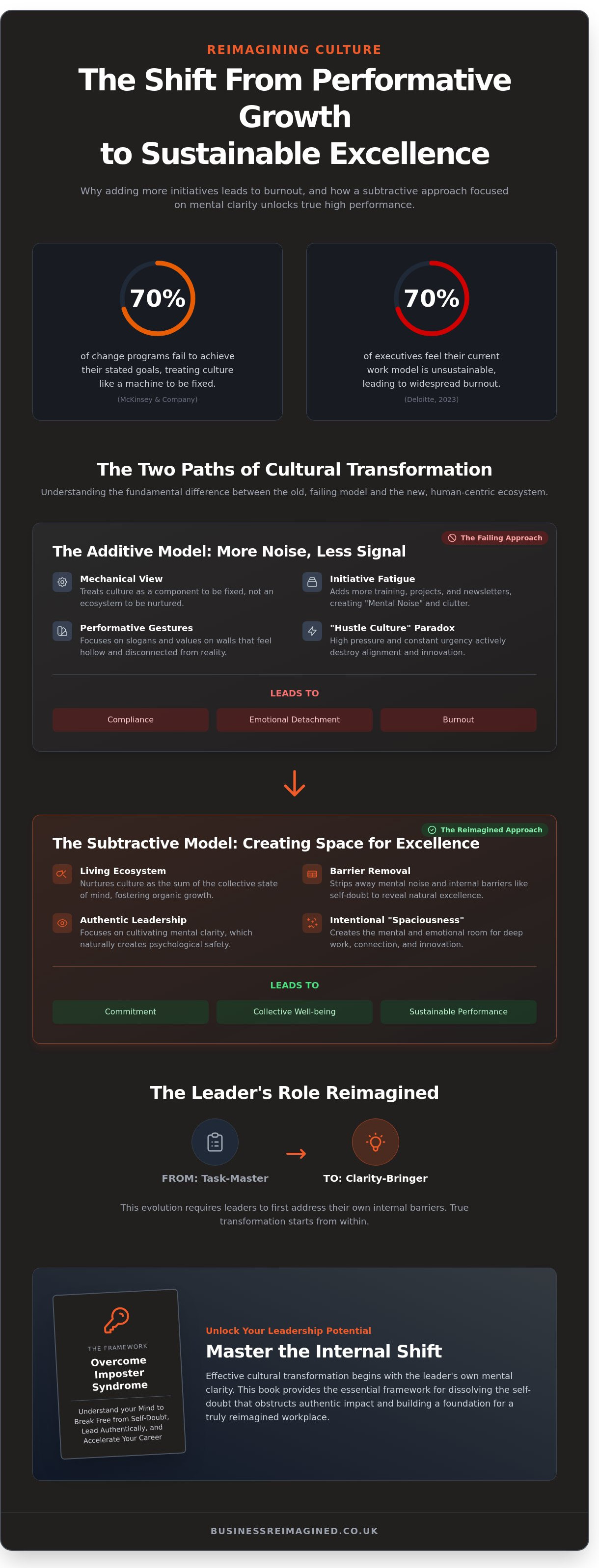
This failure isn't due to a lack of effort. It stems from a fundamental misunderstanding of what culture is. We’ve been taught to treat it as a mechanical problem—something to be fixed by adding more processes, more training, and more initiatives. But this approach often backfires, leading to cynicism and exhaustion.
- The trap of performative culture: Posters declaring values of ‘innovation’ and ‘collaboration’ mean little when daily behaviours are driven by fear and bureaucracy. True culture is what people do when no one is watching, not what is written on the walls.
- The "Hustle Culture" paradox: In an attempt to drive performance, many organisations create high-pressure environments that actively destroy the psychological safety and trust required for genuine cultural alignment.
- Initiative fatigue: The modern workforce is tired. Adding another "culture project" to their already overflowing plates is often the fastest way to guarantee its failure. People don't have the capacity for more; they are desperate for less.
- Moving from a machine to a living system: A business isn't a machine with interchangeable parts. It is a living, breathing network of human beings. An effective organisational culture transformation honours this complexity, focusing on the quality of thought and feeling within the system.
The Failure of Additive Change
The conventional approach to change is additive. We see a problem, so we add a solution: another training programme, a new communication platform, a stricter policy. But this often creates more noise, not more clarity. When we overload our people with information and instruction, we don't inspire change; we trigger a state of cognitive overwhelm that makes meaningful transformation impossible.
This leads to the crucial difference between compliance and commitment. An additive approach can, at best, secure compliance. People will follow the new rules to avoid trouble. A subtractive approach, however, fosters genuine commitment. It works by removing the "Mental Noise"—the ingrained assumptions, insecure thinking, and collective anxieties—that sabotages our natural capacity for collaboration and insight.
Reimagining the Metric of Success
For decades, we have measured success with external benchmarks and productivity targets. But what if the most vital business metric for 2026 is internal? What if we started measuring "spaciousness"—the mental capacity for clear, innovative, and strategic thinking?
The pressure on modern leaders is immense. A recent Deloitte survey found that 73% of C-suite executives report struggling with their mental health, with many feeling overwhelmed and exhausted (Source: Deloitte). This is not sustainable.
The role of a leader must shift from a "task-master" to a "clarity-bringer." Their primary function is not to add more pressure but to create an environment where the team's collective intelligence can emerge. This begins with their own internal state.
The Neuroscience of Culture: How State of Mind Shapes Collective Behaviour
At its core, organisational culture is simply the sum of the collective "state of mind" within the business. It’s the shared patterns of thinking, feeling, and perceiving that dictate how people interact, make decisions, and respond to challenges.
Our brains are wired for survival. When individuals feel threatened, insecure, or overwhelmed, the brain's threat response (the amygdala hijack) is activated. This floods the system with cortisol, shutting down the prefrontal cortex—the centre for rational thought, creativity, and collaboration. The result? Defensive behaviours, siloed thinking, and a culture of fear.
Conversely, a state of mental clarity allows for greater access to our innate intelligence and resilience. Psychological safety isn't a standalone initiative to be implemented; it is the natural byproduct of a leadership team that operates from a place of clarity and security.
The Ego in a Business Context
The ego, in a business context, is the insecure, conditioned part of our thinking that drives self-preservation. When a leader operates from this state, they inadvertently create "double binds" for their teams—paradoxical situations where employees are punished no matter what they do. This cycle of self-projecting, where a leader’s own anxieties are cast onto their team, is a powerful barrier to a healthy culture. For an in-depth look at this dynamic, you can read our guide on the double bind in leadership and how it paralyses teams.
Habituation, in a psychological sense, is the process where repeated exposure to the same stimuli—such as outdated processes or toxic leadership behaviours—diminishes our response, effectively rendering the organisation blind to the very issues that prevent its cultural evolution.
Neuroplasticity and Cultural Change
The science of neuroplasticity proves that our brains can and do change throughout our lives. This same principle applies to organisations. An old culture can learn new tricks. This "organisational rewiring" doesn't happen through force; it happens by changing the conditions that shape the collective state of mind.
The quality of our state of mind directly impacts the speed and quality of our decisions. The "Clarity" effect is profound: when a leader operates from a calm, grounded state, they act as a regulator for the entire team. Their clarity becomes contagious, creating the stability needed for others to do their best work.
Subtractive Transformation: Why Less is More for High-Performing Cultures
True organisational culture transformation is not about adding more. It’s about taking away what is getting in the way. This is the philosophy of subtractive transformation: removing the invisible barriers that block the natural excellence, creativity, and alignment already present within your people.
| Additive Transformation (Traditional) | Subtractive Transformation (Reimagined) |
|---|---|
| Adds new rules, processes, and training. | Removes mental noise, outdated rules, and complexity. |
| Focuses on changing external behaviours. | Focuses on shifting the internal state of mind. |
| Measures success through compliance and activity. | Measures success through clarity, insight, and alignment. |
| Often leads to initiative fatigue and overwhelm. | Creates "spaciousness" and sustainable performance. |
Subtractive Psychology simplifies the path to organisational effectiveness. It invites leaders to ask a different question: instead of "What do we need to add?", we ask, "What can we remove to allow our people to thrive?" This could be a pointless weekly meeting, a convoluted approval process, or an unwritten rule that encourages presenteeism. These "wasteful" cultural rituals drain energy and stifle innovation.
The 3 Principles in a Cultural Context
This approach is grounded in an understanding of the three principles of Mind, Consciousness, and Thought. These are the invisible drivers behind all human experience, including workplace behaviour.
- Mind: The intelligence and energy behind all life.
- Consciousness: The capacity to be aware of our experience.
- Thought: The creative power we use to form our moment-to-moment reality.
By helping leaders understand this system, we move them beyond relying on temporary "strategies" and toward a place of genuine "insight." Lasting change comes from a shift in understanding, not from memorising a new technique.
Creating Spaciousness for Innovation
Why is a quiet mind the most productive tool in your organisation? Because it is only from a state of mental clarity that true insight and innovation can emerge. When our minds are cluttered with stress, deadlines, and insecure thinking, we default to habitual, reactive patterns.
Reducing this "mental noise" is the primary goal of a subtractive transformation. It allows the collective intelligence of the group to surface. This is the heart of the "Quiet Rebellion"—a conscious move away from the cult of constant urgency and toward a more intentional, impactful way of working.
The 5 Pillars of Sustainable Cultural Reimagining
This journey from a noisy, reactive culture to one of clarity and alignment is built on five key pillars. It’s a deliberate, grounded process that starts from the inside out.
- Radical Diagnosis: We go beyond surface-level surveys to find the "pivotal moment" where the culture truly breaks down. Is it in the weekly leadership meeting? During performance reviews? We identify the root cause, not just the symptoms.
- Leader Alignment: Organisational culture transformation always starts with the executive team. We focus first on their internal state, helping them find the clarity and resilience needed to lead the change with authenticity, not authority.
- Permission for Spaciousness: We work with you to make structural changes that support mental clarity. This could mean introducing "no-meeting" days, simplifying communication channels, or redefining what "urgency" truly means.
- Subtractive Intervention: Together, we identify and systematically remove the rules, rituals, and habits that no longer serve the vision. This is a process of simplification, not addition.
- Nurturing the New Culture: We help you sustain momentum through ongoing reflection and insight-based conversations, building a culture that is resilient, adaptive, and self-correcting.
Diagnosing the Invisible Barriers
To create real change, you must learn to see past the surface symptoms (like low engagement scores or high turnover) to the root "state of mind" issues driving them. Are your people operating from a place of fear? Scarcity? Overwhelm? Our Transformation and change accelerators are designed to speed up this diagnostic process, helping you pinpoint the core challenges quickly and effectively.
Sustaining Momentum Without Hustle
Sustainable high performance is not about "grinding" or "hustling." It's about building a deep well of organisational resilience that doesn’t rely on adrenaline. This means embedding practical rituals for maintaining collective clarity, especially during periods of rapid change or transition. A culture rooted in clarity can navigate uncertainty with grace and intelligence, rather than panic.
Cultivating a Healthy Leadership Culture: The Business Reimagined Approach
We believe that a thriving organisational culture is the natural outcome of healthy, clear-headed leadership. It’s not a separate project; it’s the foundation of everything else. Our work moves beyond "one-off workshops" to facilitate long-term leadership evolution.
Our Peak Performance Programme serves as a powerful foundation, equipping leaders with the tools to enhance their wellbeing and mental clarity. From this grounded state, they are better able to lead wider cultural shifts. For a full-scale organisational culture transformation, our Beyond Limits programme provides a bespoke, in-depth journey to reimagine how your entire organisation works.
Our Bespoke Leadership Programmes
Every leadership team is unique. That's why we tailor our transformation programmes to your specific context and challenges. Through a blend of group workshops and one-on-one coaching, we anchor deep, sustainable shifts in perspective and behaviour. Executive business coaching is a critical component, providing the confidential, reflective space where leaders can truly transform. For leaders grappling with the internal barriers of self-doubt, Kay Tear’s book, Overcome Imposter Syndrome, offers a profound guide to leading with authenticity.
Reimagining Your Professional Future
The long-term ROI of a culture rooted in clarity is immeasurable. It shows up in better decision-making, higher innovation, lower employee turnover, and a profound sense of shared purpose. It’s a call to the "Quiet Rebels" who know there is a better way to lead and are ready to build it.
If you are ready to move beyond performative change and cultivate a culture of sustainable performance, we invite you to begin the conversation.
Enquire about our Beyond Limits programme for your organisation
Frequently Asked Questions
How long does an organisational culture transformation actually take? True transformation is not a fixed-term project with a deadline; it's an ongoing evolution. However, you can expect to see significant shifts in mindset and behaviour within the first 6-12 months as leaders begin to operate with greater clarity. The key is to focus on creating sustainable momentum rather than a quick fix.
Can culture be changed if the CEO isn’t fully on board? It is extremely difficult. Culture change is driven from the top down. While pockets of positive change can be created within teams, a systemic organisational culture transformation requires the full commitment and active participation of the CEO and the entire executive team. Their behaviour sets the tone for everyone else.
What is the biggest barrier to successful cultural change in 2026? The biggest barrier is leadership burnout and cognitive overload. Leaders simply do not have the mental or emotional capacity to lead another complex, additive change initiative. Any successful transformation must first address the wellbeing and mental clarity of the leadership team, creating the space for them to lead effectively.
How do you measure the ROI of a "subtractive" culture transformation? The ROI is measured in both qualitative and quantitative terms. We look for leading indicators like improved decision-making speed, higher-quality strategic conversations, and increased cross-functional collaboration. Lagging indicators include reduced employee turnover, lower absenteeism, increased innovation, and ultimately, improved business performance and profitability.
Is it possible to change culture in a remote or hybrid team? Absolutely. Culture is about the quality of thought and interaction, not physical location. In a remote or hybrid setting, intentionality is even more critical. A subtractive approach works well here, as it focuses on simplifying communication, reducing digital noise, and creating psychological safety regardless of where people are working.
What is the difference between culture and employee engagement? Employee engagement is a symptom; culture is the root cause. Engagement measures an employee's emotional commitment to the organisation at a point in time. Culture is the underlying system of shared beliefs, assumptions, and behaviours that drives that level of engagement. You cannot fix low engagement without addressing the cultural dynamics that are causing it.
How do you handle employees who are resistant to cultural reimagining? Resistance is often a symptom of fear, misunderstanding, or burnout. The first step is to listen and seek to understand their concerns from a place of curiosity. Often, the "resistance" is a valid signal that the change is being perceived as another additive burden. A subtractive approach, which focuses on making work simpler and more human, typically encounters far less resistance.
What role does neuroscience play in modern culture initiatives? Neuroscience provides the "why" behind the "what." By understanding how the brain responds to threat versus safety, and how states of mind impact perception and behaviour, we can design interventions that work with our natural human wiring, not against it. It moves culture work from the realm of "soft skills" to a grounded, evidence-based discipline.