
Keynote Speaking: A Catalyst for Strategic Clarity and Cultural Transformation in 2026
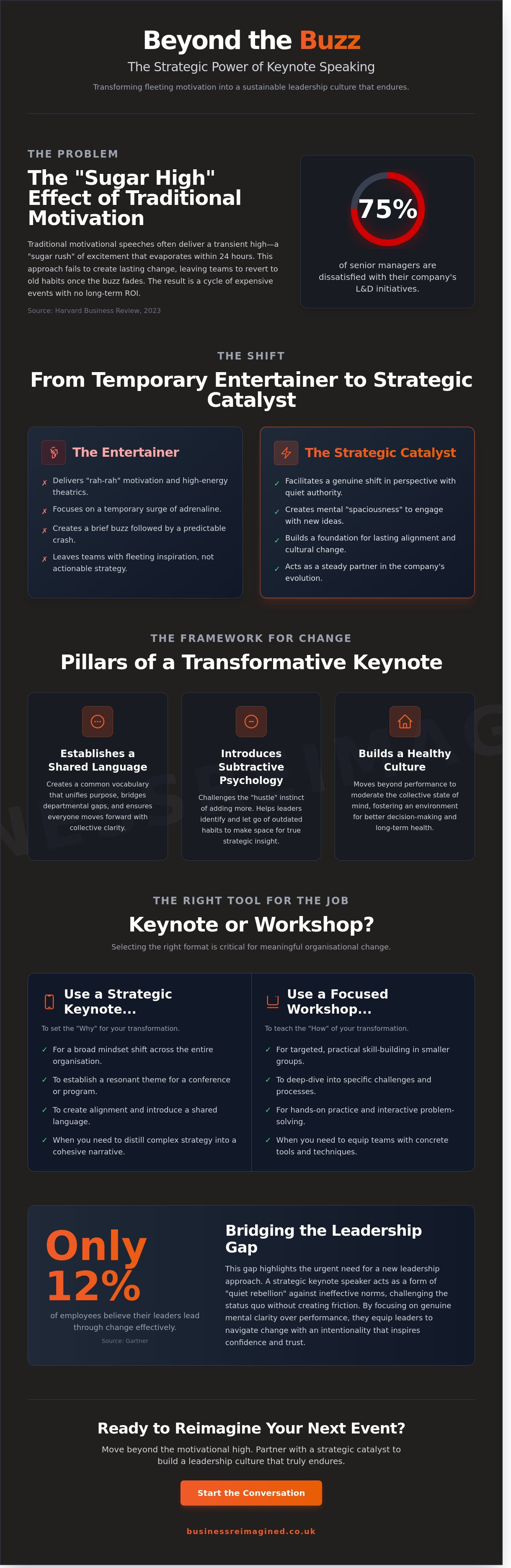
The traditional motivational speech is often little more than a transient high that evaporates before the first coffee break of the following morning. You've likely experienced this "sugar high" yourself; an expensive event leaves the room buzzing, yet 24 hours later, the old habits of hustle culture return. Strategic keynote speaking should be different. Research published in the Harvard Business Review (2023) indicates that 75% of senior managers are dissatisfied with their company's learning and development initiatives, often because the impact lacks longevity. You don't need another speaker shouting about "grinding" at all costs. You need a steady, strategic partner who understands that true transformation requires more than a temporary surge of adrenaline.
When approached with intention, a professional speaker transcends simple entertainment to become a catalyst for strategic clarity. This article reveals how the right voice can help you move beyond tired tropes to build a healthy leadership culture that can actually endure. We'll explore how shifting your collective mindset and establishing a shared language can create the internal alignment necessary for sustainable success in 2026. By the end, you'll understand how to measure the real value of an engagement through the lens of better decision-making and long-term organisational health.
Key Takeaways
- Move beyond the fleeting high of traditional motivation to establish a strategic theme that creates lasting alignment across your entire organisation.
- Discover how professional keynote speaking acts as a catalyst for a healthy leadership culture that can actually endure by introducing a shared language for change.
- Learn to identify whether your current organisational challenge requires the broad mindset shift of a keynote or the focused skill-building of a targeted workshop.
- Master the art of the "Quiet Rebel" briefing, shifting the focus from corporate logos to the underlying state of mind within your leadership environment.
- Explore how subtractive psychology helps leaders let go of outdated habits, replacing mental noise with the spaciousness needed for true strategic clarity.
Beyond the Motivational High: The Real Purpose of Keynote Speaking
Keynote speaking is far more than a scheduled break in a corporate itinerary. It serves as a strategic lever for establishing a resonant organisational theme that lingers long after the event ends. Many professionals ask What is a Keynote Speech? in the modern era. It's the "key note" that dictates the harmony of the entire gathering. By setting a clear tone, it provides the foundation for a leadership culture that can actually endure.
Traditional "rah-rah" motivation often feels like a sugar rush. It's intense, brief, and followed by a predictable crash. This style fails to create lasting change because it ignores the human need for depth and reflection. A true catalyst for transformation understands that their role is to create spaciousness. This is the mental room required for an audience to set aside their daily "hustle" and engage with new ideas. It's the difference between being a temporary entertainer and a steady partner in a company's evolution.
To better understand the standard required for this level of impact, watch this video:
The distinction between a standard speaker and a catalyst is found in the intent. A speaker delivers information. A catalyst facilitates a shift in perspective. They don't just present a deck; they moderate the collective state of mind. This requires a grounded presence that prioritises human connection over polished performance. It's about making the audience feel heard and understood while gently nudging them toward a reimagined future. When keynote speaking is approached this way, it stops being a performance and starts being a transformation.
The Framework of a Transformative Address
Buy-in must happen within the first sixty seconds. This is achieved by establishing the "why" with absolute clarity. Why does this change matter? Why now? A transformative address acts as a summary for a larger change programme, distilling complex strategies into a single, cohesive narrative. It provides the "why" that makes the subsequent "how" feel achievable rather than overwhelming. By acting as a moderator of the collective state of mind, the speaker ensures the room is ready for deep work.
Moving from Entertainment to Insight
Senior leaders are often weary of high-energy theatrics. They respond better to quiet authority and intentionality. This calm approach allows a speaker to challenge the status quo without creating unnecessary friction or defensiveness. It's a form of quiet rebellion against the loud, frantic norms of corporate life. Data suggests that leaders are struggling; Gartner reports that only 12% of employees believe their leaders lead through change effectively. Bridging this gap requires moving beyond entertainment and toward genuine mental clarity and the psychology of performance.
How Keynotes Shape a Healthy Leadership Culture
A healthy leadership culture doesn't happen by accident; it requires intentional shifts in how we relate to one another and the work itself. When an entire team gathers for a session of keynote speaking, they're doing more than listening to a presentation. They're adopting a shared language. This common vocabulary serves as a foundation for a leadership environment that supports long-term success, replacing fragmented jargon with unified purpose and clarity. For organizations in international hubs like Singapore, this clarity is often reinforced through professional communication development at English Explorer. By establishing these shared definitions, a speaker helps bridge the gap between disparate departments, ensuring everyone moves in the same direction with a sense of collective belonging.
Keynote sessions also function as a catalyst for subtractive psychology. In many corporate settings, the default response to a challenge is to add more; more tasks, more metrics, and more meetings. A wise speaker challenges this "hustle" instinct by helping leaders identify which outdated habits to discard. It's about letting go of the noise to find the essence of leadership. This process humanises the person on stage, addressing the traditional "problem with authority" by showing that even the most experienced visionaries value vulnerability and reflection. It creates a pivotal moment where leaders see themselves not as cogs in a machine, but as human beings capable of leading with soul and intention.
Neuroscience and the Power of the Stage
Our brains are often cluttered with mental noise that prevents effective decision-making. Research published on January 4, 2022, highlights how strategic clarity in communication is essential for effective leadership, particularly during times of high stress or global change. By reducing cognitive load through simple, resonant messages, a speaker ensures the strategy actually sticks. Stories bypass the analytical filters that data-heavy slides often trigger, allowing the brain to process information more deeply. You can explore this further in our guide to the Neuroscience of Leadership, which details how to move from mental noise to strategic clarity.
Cultivating Organisational Spaciousness
A powerful keynote gives a team permission to slow down. In a world that prizes speed above all else, taking an hour to reflect is a radical act. This intentional pause breaks the habituation of frantic workplace cultures. It creates spaciousness. When a speaker models their best, most authentic self, they invite others to do the same. This isn't about achieving a state of perfection; it's about alignment. If you're ready to explore how keynote speaking can shift the energy of your organisation, you can view our bespoke leadership services to see how we help teams find their rhythm again. Authentic leadership is a journey of returning to what matters most, and sometimes, all it takes is one shared moment of clarity to begin that transition.
Keynote vs. Workshop: Selecting the Right Format for Organisational Change
Choosing between a keynote and a workshop isn't about comparing quality. It's about evaluating the scope of the challenge you're facing. Do you need to shift the collective mindset or build a specific skill? A keynote speaking session acts as a catalyst for change. It's designed to spark a fire across 500 people at once, creating a unified moment of realisation. Workshops are the slow burn. They provide the necessary spaciousness for deep application within a team development programme, focusing on the granular "how" of daily operations.
The "ripple effect" of a keynote is its greatest asset. When an entire workforce hears the same message simultaneously, it creates a shared language. Research from the Harvard Business Review indicates that shared experiences are vital for building trust and collective identity. While a workshop might reach 15 people deeply, a keynote aligns the vision of the many. This alignment is what allows a business to move as one, rather than as a collection of disjointed departments.
Combining these formats creates a "transformation accelerator." You might start with a keynote to align the vision and follow with breakout workshops to ground that vision in practical habits. This approach bridges the gap between inspiration and implementation. Cost is also a factor. Virtual keynotes offer accessibility for global teams and can reduce logistical expenses by up to 60% according to 2024 industry data. However, live addresses provide a visceral connection that increases engagement by 34%, making them a worthy investment for critical cultural shifts.
When a Keynote is the Correct Strategic Choice
A keynote is the right choice when you're launching new values or navigating major industry shifts. It's about the power of the collective experience. It helps build a healthy leadership culture by ensuring everyone hears the same truth at the same time. This clarity often leads into deeper, more personalised work through Executive Business Coaching, where the seeds planted on stage can be nurtured into sustainable growth.
Identifying Your Primary Objective
What's the goal? If you need to initiate a difficult conversation, an external speaker is vital. Leaders often face a "Double Bind" where they're expected to be both the authority and the empathetic peer. A neutral speaker can say the things internal leaders can't. This helps maintain a leadership environment that supports long-term success. This alignment often requires leaders to Overcome Imposter Syndrome, moving beyond self-doubt to lead with genuine clarity. The speaker's tone must align with your existing culture, acting as a natural evolution rather than a forced change.
Maximising Impact: A Guide to Planning a Transformative Keynote Event
A transformative event requires more than a stage and a spotlight. It demands a departure from the traditional corporate checklist. When you approach keynote speaking as a strategic intervention, the planning process becomes an act of intentional design. It's about creating a space where your team can breathe, reflect, and eventually, evolve. This doesn't happen by accident; it happens through a commitment to clarity and a rejection of the superficial.
To ensure the message lands without distraction, the technical delivery must be flawless. Engaging a professional corporate event production company UK allows you to integrate creative and technical solutions that enhance the overall experience, turning a simple conference into a landmark moment for your team.
Subtractive psychology plays a vital role here. Before adding new ideas, we must clear the existing clutter. This involves inviting your team to reflect on what they need to let go of before the event even begins. By reducing the "mental noise" that clogs daily operations, you create the spaciousness necessary for new insights to take root. Without this preparation, even the most powerful message risks being drowned out by the frantic pace of the status quo.
The Art of the Brief
Most organisers hand over a brand guidelines PDF and call it a day. That isn't a brief; it's a brochure. To truly leverage keynote speaking, you must invite the speaker into the room's invisible architecture. What is the current "mental noise" within your leadership team? Understanding the specific "ego" dynamics and self-projecting habits of the group allows the speaker to address the unspoken resistance that usually blocks change. Defining these desired outcomes before the contract is signed ensures that the session is aligned with a leadership culture that can actually endure. You aren't just booking a talk; you're commissioning a catalyst for alignment.
Integration and Follow-Up
Transformation shouldn't end when the applause fades. Without a post-event strategy, even the most profound talk becomes mere escapism. You're aiming for a six-month cultural shift, not a sixty-minute high. Research from McKinsey (2024) suggests that 70% of change programmes fail due to employee resistance and lack of management support. To avoid this, you must create intentional feedback loops that capture the quiet realisations people had during the session. Resources like Overcome Imposter Syndrome by Kay Tear can serve as a bridge, helping leaders move from theory to grounded, authentic practice. This ensures the insights aren't lost to the next urgent email, but instead become part of a healthy leadership culture. Measuring success then becomes about observing shifts in how people relate to one another, rather than just tallying "likes" on a feedback form.
Reimagining the Stage: Keynote Speaking with Business Reimagined
Chantal Burns and Kay Tear don't just step onto a stage; they invite you into a different way of being. This "Quiet Rebel" approach rejects the high-octane, frantic energy often found in corporate events. Instead, we focus on dismantling the mental noise that clouds decision-making. By applying the 3 Principles, we help leaders find strategic clarity. It's about shifting from a state of constant "doing" to a state of purposeful "being." We focus on subtraction rather than addition. When leaders operate from a place of internal quiet, they make better decisions without the heavy cost of burnout. Our keynote speaking sessions feel less like a lecture and more like a high-level conversation that respects the intelligence and experience of the audience.
Our Core Themes and Topics
We explore what it means to lead with clarity when the world feels increasingly loud. Leadership Reimagined isn't about more tasks; it's about better presence and intentionality. We also dive into the neuroscience of high performance. This goes beyond traditional metrics and surface-level "hacks." For example, research from the University of California, Irvine, indicates that it takes an average of 23 minutes and 15 seconds to return to a task after an interruption. We help teams understand these cognitive loads to reclaim lost focus. You can see our reflective and grounded style in action on our YouTube channel.
A Partnership Approach to Events
We don't view ourselves as vendors. We are strategic partners invested in your long-term success. A single address is often the spark, but we ensure the flame stays lit by connecting our message to the Clarity Wellbeing Programme. This helps build a leadership culture that can actually endure. A 2023 Gallup report found that only 23% of employees globally are truly engaged at work. We aim to change that by ensuring the insights shared on stage translate into a healthy leadership culture within your organisation. If you're ready to align your event with these values, you can schedule a call with Kay Tear to discuss your goals. Our approach to keynote speaking ensures that your event leaves a lasting, sustainable impact on your people.
Crafting a Leadership Culture That Endures
The landscape of leadership is shifting. By 2026, the traditional "hustle" will have lost its lustre, replaced by a deep-seated need for intentional alignment and genuine human connection. True keynote speaking isn't about a fleeting rush of adrenaline. It's about creating a leadership environment that supports long-term success by grounding every word in strategy and soul. We've explored how subtractive psychology and neuroscience can strip away the noise, leaving only the clarity your team needs to thrive.
As international speakers with over 20 years of experience and authors of best-selling leadership books, we understand that transformation requires more than a stage; it requires a reimagining of how we work. You don't need more pressure. You need the spaciousness to lead with purpose and a healthy leadership culture that can actually endure. It's time to move beyond the temporary high and start building something that lasts. We invite you to book a discovery call to reimagining your next event and explore what's possible when we choose alignment over exhaustion. Your future leadership is waiting to be written.
Frequently Asked Questions
What is the difference between a keynote speaker and a guest speaker?
A keynote speaker sets the underlying tone and primary theme for an entire event, while a guest speaker typically provides specific expertise on a niche topic. The keynote serves as the anchor, aligning the audience with a shared vision or strategic direction. Guest speakers fill the gaps, offering technical insights or personal stories that support the broader narrative established by the keynote's opening message.
How much does a professional keynote speaker cost in the UK?
Professional keynote speaking fees in the UK generally range from £2,500 to £10,000 for experienced industry experts. Data from the Professional Speaking Association (PSA) shows that top-tier speakers or public figures often command fees upwards of £25,000. These figures reflect the speaker's deep expertise and the preparation required to foster a leadership culture that can actually endure.
How long should a typical keynote address last for maximum impact?
An impactful keynote address typically lasts between 45 and 60 minutes. This timeframe provides enough spaciousness for deep ideas to land without overwhelming the audience. Research into adult learning suggests that cognitive engagement begins to decline after 20 minutes, so a skilled speaker uses storytelling and rhythmic shifts to maintain focus. It's a balance between delivering strategic clarity and respecting the mental energy of the room.
Can a keynote speaker help with organisational culture transformation?
A keynote speaker acts as a catalyst for cultural transformation by articulating a shared purpose that resonates on a human level. They move beyond corporate jargon to foster a healthy leadership culture where employees feel seen and heard. By challenging the status quo and inviting intentional reflection, a speaker can spark the internal alignment necessary for a genuine, sustainable shift in organisational behaviour. This focus on confident communication is just as vital for the leaders of tomorrow; through enrichment centres like SuperMinds, you can learn more about how these skills are developed in children and teenagers.
Is it better to have a keynote speaker at the beginning or the end of an event?
Placing a keynote speaker at the start of an event is ideal for setting a strategic tone and aligning the collective energy of the participants. This opening session provides the clarity needed for people to engage deeply with subsequent workshops. Conversely, a closing keynote serves to synthesise the day's learnings, leaving the audience with a sense of empowerment and a clear path toward a leadership environment that supports long-term success.
How do you measure the ROI of a keynote speaking engagement?
Measuring the ROI of keynote speaking involves tracking qualitative shifts in employee sentiment alongside quantitative metrics like a 15% increase in post-event engagement scores. Organisations often use follow-up surveys 90 days after the event to assess how many participants have implemented specific strategic changes. True value is found in the long-term health of the leadership environment rather than immediate, fleeting excitement.
What are the best topics for a leadership-focused keynote in 2026?
The most relevant topics for 2026 focus on human-centric leadership, the ethics of AI integration, and psychological safety in a hybrid world. For those navigating the complexities of digital identity, check out Aria Operations to learn how AI can help protect and elevate your professional reputation. Leaders are increasingly seeking guidance on how to build a leadership environment that supports long-term success while resisting the burnout of traditional hustle culture. Addressing internal barriers is also vital; as Kay Tear explores in her book, Overcome Imposter Syndrome, understanding the mind is Bird-essential for leading authentically in complex times.
Do keynote speakers provide follow-up materials or workshops?
Most professional speakers provide intentional follow-up materials such as reflective workbooks, digital summaries, or deep-dive workshops to ensure the message takes root. These resources prevent the inspiration fade that often follows large corporate events. By offering a practical roadmap for implementation, the speaker helps transition the audience from passive listeners to active participants in reimagining their professional lives.