
How to Retain High Potential Employees: A Guide to Sustainable Leadership Culture
What if the most effective way to protect your organisation's future isn't a more aggressive bonus structure, but a commitment to mental spaciousness? According to 2023 research from Gallup, the cost of replacing a single employee can reach 200% of their annual salary, yet many firms still find themselves wondering how to retain high potential employees as their best talent quietly burns out. You've likely felt the heavy silence that follows an executive departure, witnessing the slow erosion of culture and the loss of invaluable institutional knowledge.
We agree that the old ways of "grinding" are no longer sustainable. Real success requires a shift from frantic management to intentional presence. In her book, Overcome Imposter Syndrome, Kay Tear highlights how understanding the mind is the first step toward leading authentically; a principle that sits at the heart of a leadership culture that can actually endure. This guide promises to show you how to move beyond traditional perks by fostering a leadership environment that supports long-term success, helping you build a reimagined culture through psychological insight and reduced mental noise.
You'll discover a clear framework for sustainable performance that values human well-being as much as your bottom line.
Key Takeaways
- Understand why traditional perks fail to address the "intent to jump ship," with research showing [25% of high-potential employees](https://hbr.org/2010/05/how-to-keep-your-best-employees) plan to leave their organisations within a year.
- Discover how to retain high potential employees by shifting away from hustle culture toward a leadership culture that can actually endure.
- Explore the neuroscience of top performance and learn how "mental noise" inhibits the prefrontal cortex, clouding the clarity and loyalty of your most strategic thinkers.
- Implement a five-step framework to audit energy drains and foster authentic leadership that moves beyond the constraints of [Imposter Syndrome](https://www.amazon.co.uk/Overcome-Imposter-Syndrome-Understand-Authentically/dp/B0FMRZD395).
- Learn how executive coaching serves as a strategic partner in creating a leadership environment that supports long-term success through intentional alignment and spaciousness.
The High-Potential Paradox: Why Traditional Retention Strategies Often Fail
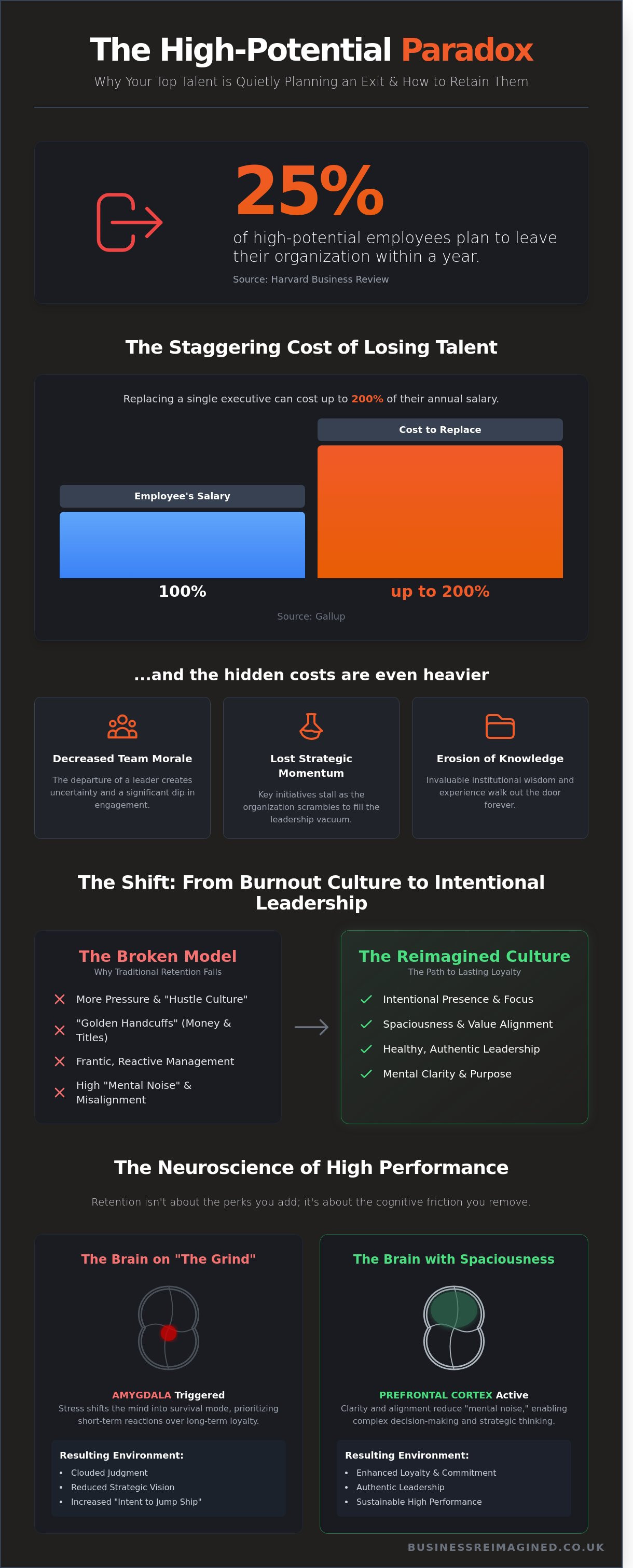
Identifying high potential (HiPo) employees is only the first step. These individuals possess both the innate capacity and the clear intent to rise into senior leadership positions. They are the strategic lifeblood of any organisation. However, a startling Harvard Business Review study revealed that 25% of HiPos plan to leave their current employer within a year. If you are wondering how to retain high potential employees, you must first recognise that the old "hustle" narrative is broken. More pressure doesn't create more loyalty. It creates an exit strategy.
Real loyalty grows within a healthy leadership culture. This is a space where work feels intentional rather than frantic. To build a leadership culture that can actually endure, we must move away from the noise of constant growth and toward a more grounded, human-centric approach. High potentials aren't looking for a race. They're looking for a mission that aligns with their values. Understanding the foundations of employee retention is essential for any organisation that wants to protect its future and foster genuine commitment.
To better understand the nuances of developing and keeping your best people, watch this helpful video:
The True Cost of Executive Turnover
Losing a key leader is expensive. Research from the Work Institute shows that the financial impact often sits between 25% and 200% of an annual salary. The hidden costs are even heavier. When a high potential leaves, the team experiences a significant dip in morale. Strategic momentum is lost. These individuals are particularly sensitive to "mental noise" in the workplace. This noise is the friction caused by poor communication and misaligned values. They require a leadership environment that supports long-term success, free from the exhaustion of unnecessary urgency.
Moving Beyond the 'Golden Handcuffs'
Money and titles are no longer enough to anchor a modern leader. High potentials now prioritise "spaciousness" and "alignment" over the traditional "golden handcuffs." They want to lead authentically without being consumed by their roles. In her book, Overcome Imposter Syndrome, Kay Tear discusses how leaders can break free from self-doubt to lead with clarity. When organisations fail to provide this alignment, they inadvertently create a "double bind" for talent. This forces them to choose between their career and their well-being. Knowing how to retain high potential employees means offering them a path that honours both their professional ambition and their personal peace. It's about reimagining the rules of work to suit a more sustainable way of leading.
Understanding the High-Potential Mind: A Neuroscience Perspective
Retention is rarely about the perks we add. It's about the friction we remove. To truly grasp how to retain high potential employees, we must look at the biological landscape of the brain. High performers operate with a highly active prefrontal cortex, the region responsible for complex decision-making and strategic vision. However, when an organisation prioritises "the grind" over clarity, this area of the brain begins to shut down. Stress triggers the amygdala, shifting the mind into a survival state where long-term loyalty feels like an expensive luxury.
We often talk about "mental noise," that internal chatter of anxiety and over-complication that clouds judgement. When this noise becomes deafening, even the most dedicated leaders lose their sense of direction. A 2024 report by Gallup found that 51% of workers are actively seeking new roles, often because their current environment creates more mental friction than it does purpose. By applying neuroscience to leadership development, we can shift from a culture of busyness to one of strategic clarity.
Subtractive psychology offers a powerful alternative to traditional incentives. Rather than adding more meetings or complex reward programmes, consider what can be taken away. Is it the redundant reporting? The culture of "always-on" notifications? By clearing the path, you allow the prefrontal cortex to thrive, creating a leadership culture that can actually endure. This approach acknowledges that high potentials don't need more "stuff"; they need the space to think.
The Psychology of Performance and Presence
A leader's state of mind is the most accurate predictor of their resilience. When work becomes mechanical, habituation sets in. This is a neurological process where the brain stops responding to repetitive stimuli, leading to the profound boredom that often precedes a resignation. Presence is not just about being in the room. It's a metric of employee health. In her book, Overcome Imposter Syndrome, Kay Tear explores how internal narratives can erode this presence, making even high achievers feel disconnected from their own success. When leaders are present, they are engaged; when they are habituated, they are halfway out the door.
Breaking the Cycle of Burnout
Neurological safety is the foundation of a leadership environment that supports long-term success. Constant "grinding" is not a badge of honour. It's a biological threat to talent. Organisations must value mental clarity over the optics of busyness. Implementing retention strategies for top talent involves creating a space where employees feel safe to pause and reflect. This safety allows the brain to recover, ensuring that commitment is born from inspiration rather than exhaustion. If you want to foster a team that stays, start by protecting their capacity for quiet thought. You can explore how to build these foundations through our tailored leadership services.
Building a Leadership Culture That Can Actually Endure
Retaining your most talented people isn't about adding more perks or higher bonuses. It's about the air they breathe within your organisation. If you want to know how to retain high potential employees, you must first look at the foundations of your internal environment. A leadership culture that can actually endure prioritises mental clarity over the frantic noise of traditional corporate life. It's a shift from seeing people as assets to be squeezed to seeing them as partners in a shared vision.
From Hustle to Healthy: A Cultural Comparison
Traditional hustle culture thrives on urgency. It treats every task as a fire to be extinguished. This urgency-driven style often leads to a short-term spike in output followed by a long-term collapse in morale. In contrast, clarity-driven leadership focuses on sustainable alignment. It asks whether a project serves the long-term vision rather than just the quarterly target. A 2023 Deloitte survey found that 77% of professionals have experienced burnout at their current job, proving that "scaling at all costs" is a failing strategy. A gentle approach to management doesn't mean lowering standards. It means creating a pace that allows for excellence without exhaustion.
The Role of Vulnerability and Authenticity
High potentials are often burdened by the "ego mask." They feel they must appear invincible to be respected. However, authentic leadership allows talent to lead without this weight. When leaders show vulnerability, they give permission for others to do the same. This concept is explored deeply in "Overcome Imposter Syndrome: Understand your Mind to Break Free from Self-Doubt, Lead Authentically, and Accelerate Your Career" by Kay Tear. By understanding the mind's tendency toward self-doubt, leaders can foster a leadership environment that supports long-term success where people lead from their true selves.
Strategic leaders also embrace subtractive thinking. Instead of asking "what else can we do?", they ask "what can we remove to create more focus?". This creates the spaciousness needed for HiPos to experiment and fail safely. If your best people feel they have the room to breathe, they won't look for the exit. This is the secret to how to retain high potential employees; you give them a place where they can grow without being consumed. It's about building an environment that values the human being as much as the human doing.
Five Steps to Reimagining Talent Retention in Your Organisation
Understanding how to retain high potential employees requires a shift from reactive management to intentional culture building. It is not about adding more to the plate; it is about refining the environment so your best people can breathe and contribute. This process involves five deliberate steps to create a healthy leadership culture that can actually endure.
- Step 1: Audit the Mental Noise. Identify the invisible drains on your talent's energy. This involves looking beyond task lists to find the cultural friction points that cause fatigue.
- Step 2: Foster Authentic Leadership. Move beyond the mask of perfection. When leaders show up authentically, they give their teams permission to do the same.
- Step 3: Implement The Clarity Wellbeing Programme. Treat health as a primary performance metric. A 2023 Gallup study revealed that 52% of employees feel burned out; addressing this is a strategic necessity.
- Step 4: Customise Growth Paths. Replace rigid structures with transformation accelerators. These allow for fluid, personal development that aligns with individual values.
- Step 5: Prioritise Connection. Use team development workshops to cultivate collective intelligence. Genuine connection is the anchor that prevents talent from drifting away.
Addressing the Silent Retention Killer: Imposter Syndrome
High achievers are frequently the most susceptible to internal narratives of inadequacy. This self-doubt creates a glass ceiling that prevents them from fully stepping into their power. In her book, Overcome Imposter Syndrome, Kay Tear explains how these narratives limit growth and stifle authentic self-expression. To support your team, create a leadership environment that supports long-term success by encouraging vulnerability. Normalise the conversation around self-doubt to help your high potentials move from fear to grounded confidence.
Designing Bespoke Leadership Journeys
One-size-fits-all development programmes often lead to quiet disengagement. The 2024 LinkedIn Workplace Learning Report found that 94% of employees would stay at a company longer if it invested in their career development. Focus on pivotal moments, such as a promotion or a shift in responsibility, to offer strategic transformation. By treating professional growth as a personal evolution rather than a checklist, you demonstrate a deep commitment to the individual. This is the true secret of how to retain high potential employees for the long term.
Success is personal. If you are ready to move away from hustle culture and build a team that thrives through clarity and intention, explore our tailored approach to leadership development services.
The Role of Executive Coaching in Sustaining High-Performance Talent
Retention isn't a puzzle to be solved with a spreadsheet; it's a relationship to be nurtured through intentionality. Executive coaching acts as a vital strategic partner in this journey, offering the quiet space high performers need to align their personal values with organisational goals. When leaders feel seen and understood, they stay. This is the core of how to retain high potential employees in a way that feels human rather than mechanical.
One-on-one coaching provides the clarity that high achievers crave. Without it, the constant pressure to perform can lead to a sense of being lost in the noise. By focusing on individual growth, businesses transition from simply managing talent to nurturing a leadership environment that supports long-term success. This shift ensures that your most valuable people feel their career path is a living part of their life, not a separate, combative entity. It's about moving away from the "hustle" and toward a sense of grounded purpose.
Why High Potentials Value External Perspectives
Internal mentors are valuable, but they remain part of the corporate hierarchy. An external coach serves as a steady, strategic partner outside the immediate politics of the office. This distance allows for honest reflection and deep alignment. According to the 2022 ICF Global Consumer Awareness Study, 70% of coaching clients saw an improvement in work performance and 51% saw an increase in team effectiveness. These results prove that coaching is a catalyst for organisational effectiveness, not just a luxury for the individual.
- Coaching helps talent navigate transformation and change accelerators without the weight of burnout.
- It provides a buffer against traditional hustle culture, offering a path to lead authentically.
- It addresses the internal barriers, such as self-doubt, that often stall high performers in new roles.
In her book, Overcome Imposter Syndrome, Kay Tear explores how high potentials can break free from self-doubt to lead with genuine confidence. This internal work is essential for creating a leadership culture that can actually endure, as it prevents the exhaustion that comes from trying to "fake" competence in a high-pressure environment.
Taking the Next Step Toward Reimagined Retention
It's time to stop seeing your business as a machine with replaceable parts. It's a living environment. When we shift toward intentional leadership, we create a leadership environment that supports long-term success. This isn't about grinding for results; it's about creating the spaciousness required for talent to thrive over the long term. If you want to know how to retain high potential employees, you must first decide to lead with purpose rather than urgency.
Explore the full range of Business Reimagined Services to see how we can support your leadership team. To discuss a bespoke strategy that moves your business toward a healthier, more sustainable future, book a discovery call with Kay Tear today.
Nurturing the Future of Your Leadership
Retention isn't a frantic race to provide the most perks; it's the quiet work of building a leadership culture that can actually endure. We've explored how traditional models often ignore the neuroscience of high performance, leading to burnout rather than brilliance. Since 2011, international speaker Kay Tear has helped organisations move away from the noise of hustle culture to find a more grounded path. By implementing The Clarity Wellbeing Programme and our neuroscience-backed approach, you can create a leadership environment that supports long-term success and human alignment.
Mastering how to retain high potential employees starts with reimagining the workplace as a space for intentional growth. If you're ready to lead with more authenticity and less self-doubt, Kay Tear's book, Overcome Imposter Syndrome, provides the strategic tools needed to accelerate your career without sacrificing your well-being. There's a more spacious way to do business, and it begins with clarity.
Reimagine your talent strategy with our bespoke leadership programmes.
Your organisation's potential is vast. Let's work together to build a healthy leadership culture where your most talented people feel truly seen, heard, and inspired to stay.
Frequently Asked Questions
What is the number one reason high-potential employees leave?
The primary reason top talent departs is a lack of career development and advancement opportunities. According to a 2022 McKinsey study, 41% of employees cited this as their top motivator for quitting. When individuals feel their path is obstructed, they seek a leadership environment that supports long-term success elsewhere. It isn't just about the next title; it's about the intentional alignment of their personal growth with the organisation's vision.
How can I tell if my top talent is experiencing burnout before they quit?
You'll notice a shift from proactive engagement to a quiet, cynical detachment. Gallup's 2020 research indicates that 76% of employees experience burnout at least sometimes, often manifesting as reduced professional efficacy. Look for a sudden lack of spaciousness in their decision-making or a decline in their usual creative energy. These subtle signals suggest their internal resources are depleted, requiring a gentle intervention before the exhaustion becomes permanent.
Is compensation the most important factor in retaining senior leaders?
Compensation is a baseline requirement, but it isn't the primary driver for long-term retention. A 2022 Pew Research Center report found that 57% of workers cited feeling disrespected at work as a major factor for leaving. Senior leaders prioritise a healthy leadership culture where their contributions feel meaningful. They want to know how to retain high potential employees through shared values rather than just a higher salary.
What is subtractive psychology and how does it help with retention?
Subtractive psychology focuses on removing mental barriers and unnecessary pressures rather than adding more corporate perks. By eliminating the clutter of hustle culture, you create the mental clarity needed for authentic leadership. This approach helps retention by reducing the cognitive load on your team. It allows them to operate from a place of grounded presence, ensuring their work life is sustainable rather than a constant drain on their soul.
Can executive coaching actually reduce employee turnover rates?
Executive coaching significantly reduces turnover by fostering deeper self-awareness and emotional intelligence in leaders. The International Coaching Federation notes that 86% of organisations see a return on their investment through improved team dynamics and individual performance. When leaders learn to lead with soulful empathy, they create a leadership culture that can actually endure. This investment signals to high-potential staff that their professional journey is valued and supported.
How do I create a healthy leadership culture in a high-pressure industry?
Creating a healthy leadership culture requires a deliberate shift from frantic urgency to intentional action. Deloitte's 2023 findings show that 77% of professionals have experienced burnout, suggesting that traditional grinding is no longer viable. You must protect the spaciousness of your team's schedule, ensuring that high-pressure moments are balanced with periods of reflection. This grounded approach ensures that success doesn't come at the cost of your people's well-being.
What role does Imposter Syndrome play in employee disengagement?
Imposter Syndrome often causes high-potential employees to withdraw or overwork to compensate for perceived inadequacies. This internal conflict is explored deeply in Overcome Imposter Syndrome: Understand your Mind to Break Free from Self-Doubt, Lead Authentically, and Accelerate Your Career by Kay Tear. When left unaddressed, this self-doubt leads to disengagement as individuals protect themselves from potential exposure. Understanding these psychological nuances is essential when learning how to retain high potential employees who may be struggling in silence.