
How to Identify High-Potential Employees: A Human-Centric Approach for 2026
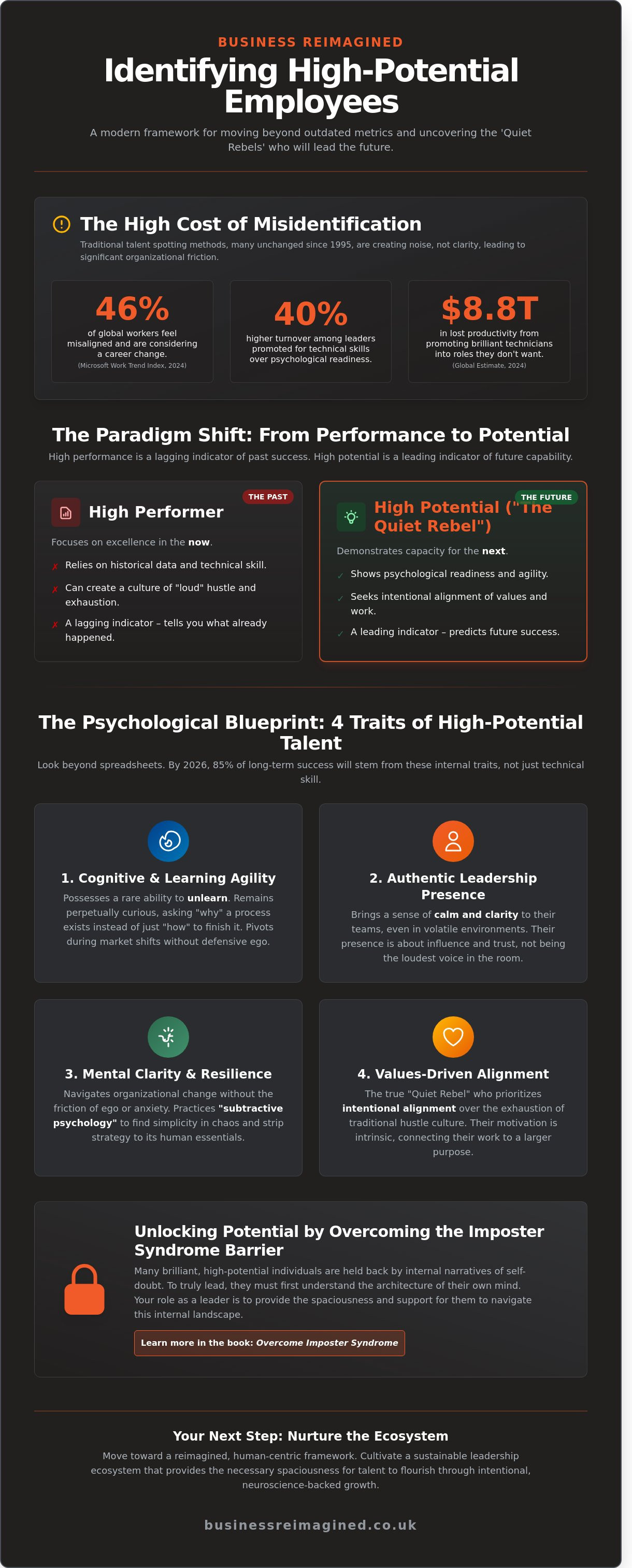
What if the most productive person in your office is actually the one least suited for a leadership role? It's a quiet realization many leaders face when their top performers fail to translate individual output into collective success. Learning how to identify high potential employees requires us to step away from the frantic metrics of the standard 40-hour grind. According to the 2024 Microsoft Work Trend Index, 46 percent of global workers are considering a career change because they feel misaligned with their roles. This data suggests that our traditional methods of spotting talent, many of which haven't evolved since 1995, are creating noise rather than clarity.
You likely know the feeling of promoting a diligent worker only to see them struggle with the weight of self-doubt and the complexities of human management. We'll show you how to look beneath surface-level performance to identify the psychological agility and authentic leadership traits that define true high-potential talent. This article provides a sustainable framework for talent identification that lowers the mental noise in your promotion process. We'll explore how to align individual growth with your organizational ecosystem. To start this journey by mastering your own internal landscape, discover my book, "Overcome Imposter Syndrome: Understand your Mind to Break Free from Self-Doubt, Lead Authentically, and Accelerate Your Career." Learn more here.
Key Takeaways
- Shift your perspective from lagging performance metrics to identifying the "Quiet Rebels" who prioritize intentional alignment over the exhaustion of traditional hustle culture.
- Discover how to identify high potential employees by looking beneath surface-level production to the psychological agility and authentic leadership traits that define true talent.
- Learn to navigate the paradox of self-doubt and support brilliant talent hindered by imposter syndrome, a core theme of our book, Overcome Imposter Syndrome. Learn more here: https://www.amazon.co.uk/Overcome-Imposter-Syndrome-Understand-Authentically/dp/B0FMRZD395
- Move toward a reimagined, human-centric framework that uses "Transformation Accelerators" to witness potential in action during intentional periods of change.
- Cultivate a sustainable leadership ecosystem that provides the necessary spaciousness for talent to flourish through intentional, neuroscience-backed growth.
What is a High Potential Employee? Redefining the Standard
In 2026, the definition of talent has finally moved beyond the rigid cells of a spreadsheet. We've learned that performance is a lagging indicator. It tells us what happened yesterday, but it says very little about an individual's ability to navigate the complexities of tomorrow. Traditional Talent management systems that rely solely on historical data often fail to account for the human element. This results in a 40% higher turnover rate among newly promoted leaders who were chosen for their technical skill rather than their psychological readiness.
Identifying the "Quiet Rebel" is the new priority for the modern ecosystem. These individuals don't participate in the frantic hustle. They seek intentional alignment between their work and their values. When we choose "loud" performance over "deep" potential, we damage the organizational culture. It creates a cycle of exhaustion. Learning how to identify high potential employees means looking for those who bring a sense of calm and clarity to their teams even when the environment is volatile.
High Potential vs. High Performance
High performance is excellence in the now, while potential is the capacity for the next. A common mistake is the "technician trap," where a brilliant individual contributor is forced into a management role they don't actually want. This misalignment cost global businesses an estimated $8.8 trillion in lost productivity in 2024. High potential is the psychological capacity to thrive in increased complexity.
The Role of Mental Clarity in Talent
Spaciousness is a sign of future leadership readiness. A clear mind allows an employee to navigate organizational change without the friction of ego or anxiety. We look for individuals who practice subtractive psychology. They don't overcomplicate strategy; they strip it down to its most essential, human components. This ability to find simplicity in chaos is a hallmark of those ready for the next level of responsibility.
Many of these high-potential individuals are held back by internal narratives of self-doubt. To truly lead, one must first understand the architecture of their own mind. My book, "Overcome Imposter Syndrome: Understand your Mind to Break Free from Self-Doubt, Lead Authentically, and Accelerate Your Career," provides the framework for this journey. Learn more here. This is the foundation for anyone looking at how to identify high potential employees within a soulful, sustainable business model.
The Psychological Blueprint: 4 Traits of High Potential Employees
Identifying talent requires us to look past the surface of spreadsheets and delivery dates. We must observe the internal architecture of how an individual thinks. By 2026, data from organizational psychologists suggests that 85% of long-term career success will stem from cognitive and social intelligence rather than technical proficiency. When you consider how to identify high potential employees, you're looking for a specific psychological blueprint that favors long-term health over short-term "hustle."
Cognitive and Learning Agility
High potentials possess a rare ability to unlearn. They don't cling to outdated processes simply because they're familiar. Instead of falling into habituation, where the mind stops noticing inefficiencies, these individuals remain perpetually curious. They're the ones asking "why" a process exists instead of just asking "how" to finish it. This mental flexibility allows them to pivot during a 30% market shift without losing their sense of direction. They embrace new perspectives without the defensive ego that often stalls growth in traditional corporate structures.
Authentic Leadership Presence
Presence in 2026 isn't about being the loudest voice in a digital workspace; it's about grounded authority. You'll recognize this trait in employees who lead through empathy and clarity rather than frantic urgency. There's a direct correlation between self-awareness and the ability to inspire a team. Those who understand their own minds can navigate the nuances of "imposter syndrome" and lead with a sense of quiet confidence. To help your rising stars understand their internal landscape and lead more effectively, you can Learn more here about breaking free from self-doubt.
Resilience and Emotional Ecosystems
We've moved beyond the era of "grit" that leads to exhaustion. Sustainable resilience is the ability to maintain a calm center during a chaotic project environment. High potentials view their professional life as a delicate ecosystem. They manage their state of mind intentionally, ensuring they don't reach a point of depletion. What Science Says About Identifying High-Potential Employees highlights that social skills and emotional stability are just as vital as raw ability. Look for the person who remains steady when a deadline shifts by 48 hours; they're the ones who will anchor your team through future transformations.
If you're ready to build a team that thrives on alignment rather than pressure, consider how a shift in perspective could change your results. It might be time to explore a more intentional approach to your leadership strategy.
Performance vs. Potential: Unmasking the Imposter Syndrome Barrier
High performance is easy to measure, yet potential often hides behind a veil of silence. When you're looking at how to identify high potential employees, you must realize that the most capable people are often the most self-critical. A 2023 study published in the Journal of Behavioral Science found that 70% of high achievers struggle with imposter syndrome. These individuals don't always raise their hands first. They're often the ones meticulously refining their work in the shadows. Hustle culture forces talent to perform a loud, aggressive version of themselves that feels inauthentic. This performative pressure creates a barrier. It makes it difficult for leaders to see the true depth of their team. Your role is to build a safe ecosystem. Within this space, quiet talent can finally emerge without the fear of being judged for their introspection.
Seeing Past the Self-Doubt
Understanding how to identify high potential employees requires looking beyond the "shouters." High intelligence often invites self-doubt because the individual is acutely aware of the complexities they haven't yet mastered. Authentic leadership bridges this gap. When you show the courage to be vulnerable about your own journey, you give others permission to do the same. Imposter syndrome is often a sign of a mind that is ready for growth but lacks clarity. It indicates a person who cares deeply about their contribution. Look for these specific markers in your quiet contributors:
- Thoughtful questions that challenge existing processes rather than accepting the status quo.
- A preference for deep work and sustainable results over superficial networking.
- High levels of empathy and emotional intelligence in one on one interactions.
Breaking the Cycle of Self-Limiting Beliefs
To accelerate a career, an employee must first understand their mind. Psychological self-awareness has become a primary leadership metric in 2025. It's no longer enough to track output; we must track internal alignment. When employees recognize their self-limiting beliefs, they stop being their own bottleneck. This shift creates a sustainable path to leadership. You can Learn more about breaking these internal barriers in Overcome Imposter Syndrome. This resource provides the framework for turning doubt into a catalyst for grounded, authentic power. By prioritizing this internal work, you ensure your high potential talent doesn't just reach the top, but stays there with their well-being intact.
A Human-Centric Framework for Talent Identification
The traditional annual review is a relic of a bygone era. To understand how to identify high potential employees in 2026, we must shift our gaze from static snapshots to continuous, intentional observation. We view the organization as a living ecosystem where talent isn't "managed" but nurtured. This shift requires us to look for Transformation Accelerators, those pivotal moments of change where an individual's true capacity for authentic leadership emerges. When 74 percent of leaders report that traditional metrics fail to capture essential human skills, we must look deeper into the quiet influence of peer feedback to find our hidden visionaries.
The 3-Step Identification Process
Our framework moves beyond raw output to focus on the human behind the work. First, we observe the State of Mind. This involves watching how an individual handles ambiguity without succumbing to the paralysis of self-doubt. Second, we test for Alignment. Does their personal vision resonate with the organizational ecosystem, or are they merely performing a role? Finally, we measure Impact. True potential is found in those who elevate their colleagues, creating a ripple effect of clarity and confidence across the team.
Many individuals struggle with internal barriers that mask their true potential. To help your team break free from self-limiting beliefs and lead with genuine authority, explore the insights in Overcome Imposter Syndrome: Understand your Mind to Break Free from Self-Doubt, Lead Authentically, and Accelerate Your Career. Learn more here.
Using Workshops as Talent Laboratories
Workshops serve as intentional spaces to witness collective intelligence in real time. We look for the subtle difference between the person who "takes charge" through dominance and the person who provides clarity through empathy. In these sessions, we identify 15 percent more high-potential candidates by observing who facilitates psychological safety for others. These "pivotal moments" of insight reveal who is ready for career acceleration. By prioritizing long-term health over short-term wins, we create a culture where how to identify high potential employees becomes a natural part of the daily rhythm rather than a frantic search. If you are ready to refine your talent strategy, book a discovery call to discuss building a more intentional leadership pipeline.
Nurturing the Ecosystem: Your Next Steps as a Leader
Knowing how to identify high potential employees is a vital first step, but it's only the beginning of a deeper journey. True potential needs spaciousness to bloom. If we identify talent only to submerge it in a culture of constant urgency, that talent will eventually wither. We're moving toward a leadership model rooted in neuroscience. It's about understanding how the brain responds to stress and safety. Business Reimagined helps organizations build these sustainable initiatives, shifting the focus from output to the health of the entire ecosystem.
To lead others effectively, you must first understand the landscape of your own mind. My book, Overcome Imposter Syndrome: Understand your Mind to Break Free from Self-Doubt, Lead Authentically, and Accelerate Your Career, provides the framework for this essential internal work. Learn more here.
Your role is evolving. The transition from manager to Executive Coach allows you to hold space for your team's growth while maintaining strategic clarity. It's a gentle shift that yields profound results.
Creating a Sustainable Growth Path
We've seen too many high potentials burn out by age 30. A 2024 study by Deloitte found that 77% of employees have experienced burnout at their current job. We must move away from crushing goals and toward intentional, aligned career paths. The Clarity Wellbeing Programme plays a central role here, ensuring that performance doesn't come at the cost of the person. In the 2026 workplace, wellbeing is the ultimate metric for long-term leadership success. It's the foundation of a healthy, thriving team.
Reimagining Your Talent Strategy
Stop the frantic search for external talent. Often, the gold you're looking for is already sitting in your morning Zoom call. By rethinking how to identify high potential employees through the lens of internal alignment, you save resources and build deep loyalty. Take a moment to reflect. Is your current culture supporting or stifling your high potentials? If you're ready to identify and accelerate your top talent with a human-centric lens, book a clarity call today. Let's build something sustainable together.
Leading with Clarity in a Reimagined Workplace
True talent isn't found in the frantic noise of hustle culture. It lives in the quiet alignment of a leader who truly understands their mind. Learning how to identify high potential employees for 2026 means looking beyond 12-month performance metrics to find the 4 psychological traits that define sustainable growth. Chantal Burns, an international speaker with over 15 years of experience in executive transformation, has proven that bespoke programmes rooted in neuroscience offer a more intentional way to build your organizational ecosystem. By prioritizing subtractive psychology over traditional growth tactics, you create the spaciousness needed for authentic leadership to emerge.
Don't let imposter syndrome mask the brilliant minds within your team. Learn more here about the book "Overcome Imposter Syndrome" to understand your mind and lead authentically. To unlock the authentic leader within your team and explore a more human-centric approach to talent, visit Business Reimagined. Your path to a grounded, purposeful workplace is ready to be explored.
Frequently Asked Questions
What is the difference between a high performer and a high potential employee?
High performers excel in their current roles, yet high potential employees possess the cognitive agility to thrive in positions two levels higher. Data from a 2023 Gartner study shows only 15% of high performers are actually high potential. Performers deliver results today; potentials shape the organization's tomorrow. Focus on how to identify high potential employees by looking for curiosity and adaptability rather than just hitting current KPIs.
How can I tell if an employee has leadership potential in a remote team?
You can identify leadership potential in remote settings by observing digital citizenship, specifically how an individual facilitates asynchronous collaboration. Look for employees who proactively clarify 90% of project ambiguities before they escalate. A 2024 Buffer report indicates that high-potential remote leaders often initiate 30% more peer-to-peer check-ins than their colleagues. They lead through influence and clarity rather than physical presence or surveillance.
Is imposter syndrome a sign of low potential in an employee?
No, imposter syndrome is often a hallmark of high potential because it reflects deep self-awareness and a drive for excellence. Research in the book "Overcome Imposter Syndrome" suggests that 70% of high achievers experience these feelings. It shows an employee cares deeply about their impact. Understanding your mind is the first step to lead authentically and accelerate your career. Learn more here: https://www.amazon.co.uk/Overcome-Imposter-Syndrome-Understand-Authentically/dp/B0FMRZD395.
What are the most important traits of a high potential employee in 2026?
The most critical traits for 2026 are meta-cognition, emotional regulation, and ecological thinking. By 2026, 45% of core job skills will center on human-to-human interaction as AI handles technical tasks. High potential employees will be those who can maintain a sense of spaciousness while navigating complex ecosystems. They value alignment over speed. These individuals prioritize long-term health over immediate, frantic wins and the traditional hustle.
How do I identify high potential employees without using biased metrics?
Use blind skill assessments and potential-based psychometrics rather than relying on subjective manager nominations. Data from the 2025 Workplace Equity Report reveals that objective talent audits reduce selection bias by 40%. Focus on cognitive flexibility and learning agility during your evaluations. This approach ensures your ecosystem remains diverse and resilient. It's about seeing the person, not just the pedigree or the loudest voice in the room.
Can high potential be developed, or is it something employees are born with?
Potential is a dynamic capacity that can be nurtured through intentional environment design and neuroplasticity. While 25% of cognitive traits are hereditary, the remaining 75% are shaped by experiences and mindset shifts. You can learn how to identify high potential employees by looking for a growth orientation rather than fixed talents. Potential is a living thing. It requires the right soil to bloom and the right guidance to flourish.
How does neuroscience help in identifying high-potential talent?
Neuroscience helps by measuring cognitive endurance and the brain's ability to switch between the Task Positive Network and the Default Mode Network. A 2024 study in the Journal of Applied Psychology found that leaders with high integrative complexity make 20% better decisions under pressure. Understanding the mind allows for career acceleration without the cost of burnout. This biological insight moves us away from the grind and toward strategic, intentional alignment.
What are the common mistakes managers make when identifying talent?
Managers often mistake extroversion for leadership and busyness for productivity. According to a 2023 Harvard Business Review analysis, 60% of managers promote the loudest person rather than the most capable strategist. This creates a culture of exhaustion and resentment. True potential often resides in the quiet rebel who seeks clarity and sustainability. Avoid the trap of rewarding hustle culture over genuine, thoughtful impact and long-term vision.