
High-Potential Talent Assessment Tools: A Guide to Identifying Sustainable Leadership
What if the person hitting 115% of their quarterly targets is actually the most likely to burn out within six months of a promotion? It's a quiet, heavy reality that many organizations face today. According to research from Gartner in 2023, 70% of high-potential programs fail to produce the leaders they actually need. You likely recognize the weight of this risk. You've seen how easy it is to mistake a loud "hustle" for genuine leadership readiness, often overlooking the quiet talent that possesses the true clarity required for long-term success.
This guide promises to show you a more intentional path. We'll explore how specific high potential talent assessment tools can move your focus from external benchmarks to internal alignment and psychological readiness. As Kay Tear explores in her book, "Overcome Imposter Syndrome," leading authentically requires a deep understanding of one's own mind to move past self-doubt. By the end of this article, you'll have a framework to build a leadership culture that can actually endure. We'll look at the tools that support a human-centric approach to growth, ensuring your future leaders feel empowered rather than overwhelmed.
Key Takeaways
- Learn to distinguish between the "doing" of high performance and the "being" of high potential to identify the reflective leaders often missed by traditional, hustle-centric metrics.
- Discover how high potential talent assessment tools evaluate psychological readiness through the three essential pillars of aspiration, ability, and engagement.
- Move beyond generic benchmarks to define leadership excellence within a leadership environment that supports long-term success and intentional growth.
- Transition from simple data extraction to a process of leadership evolution that provides the necessary spaciousness for true professional alignment.
- Explore how these insights help candidates lead authentically and navigate the internal hurdles detailed in Kay Tear’s "Overcome Imposter Syndrome" to ensure their growth is both grounded and sustainable.
Beyond the Hustle: Why Traditional Talent Identification Often Fails
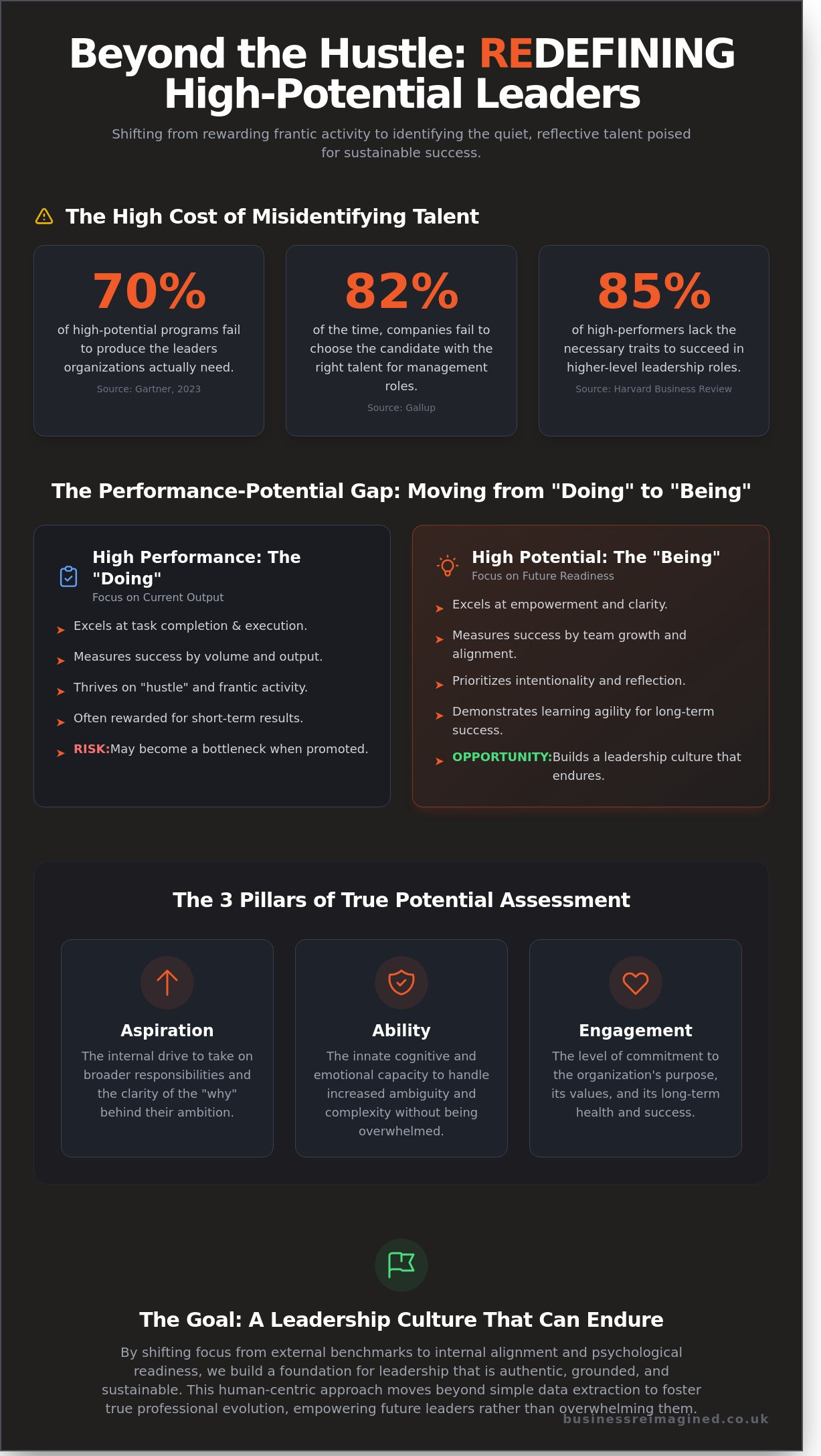
Most organizations mistake volume for value. We celebrate the person who stays latest, answers emails at midnight, and shouts loudest in meetings. This creates a dangerous trap. Traditional high potential talent assessment tools often measure current output rather than future readiness. They reward the "hustle" while ignoring the inner qualities that sustain a healthy leadership culture. When we focus purely on "doing," we miss the "being" that defines a truly great leader.
The cost of this oversight is steep. A study by Harvard Business Review revealed that only 15% of high performers possess the traits necessary to succeed in higher-level leadership roles. When the remaining 85% are promoted, the results are predictable: burnout, cultural decay, and high turnover. We need to find the "Quiet Rebel," the reflective leader who prioritizes intentionality over frantic activity. These individuals often go unnoticed because they don't fit the stereotypical mold of the loud achiever.
The Performance-Potential Gap
Your best individual contributor might be your most risky leadership hire. The shift from "doing" to "leading" requires a total psychological metamorphosis. While a performer excels at task completion, a leader must excel at empowerment. In her book, Overcome Imposter Syndrome, Kay Tear explores how understanding your own mind is vital for leading authentically. Without this inner clarity, a promoted high performer often clings to their old tasks, stifling their team's growth and creating a bottleneck of "frantic activity" rather than intentional progress.
The Problem with Traditional Metrics
Volume isn't victory. When we reward "scaling" at all costs, we build a leadership environment that can actually endure only as long as people's adrenaline lasts. Research from Gallup shows that companies fail to choose the right talent for management roles 82% of the time. To fix this, we must use high potential talent assessment tools that prioritize alignment over simple aptitude. We need to move toward a more spacious definition of success, one that values a leader's ability to create a sense of calm and clarity within their team rather than just hitting a quarterly target.
The Psychology of Potential: What High-Potential Talent Assessment Tools Actually Measure
High potential talent assessment tools are not merely filters for performance; they are standardized evaluations designed to look beyond what a person does today to predict what they could achieve tomorrow. They provide a window into a leader's capacity to navigate complexity and hold space for others. These tools move the conversation away from historical data and toward a future-focused understanding of human capability.
To identify sustainable leadership, we must look at three specific pillars that define a person's trajectory. These pillars help ensure the individual is in alignment with both their own values and the needs of the organization:
- Aspiration: The internal drive to take on broader responsibilities and the "why" behind their ambition.
- Ability: The innate cognitive and emotional capacity to handle increased ambiguity.
- Engagement: The level of commitment to the organization's purpose and its long-term health.
The true value of high potential talent assessment tools lies in their ability to map the internal landscape of a future leader. Using neuroscience-informed metrics, these evaluations reveal how a person manages their mental energy. We focus on "mental clarity" as the primary foundation for decision-making. When a leader possesses clarity, they can see through the noise of daily operations to make choices that are intentional and grounded.
Cognitive Ability and Learning Agility
The brain's ability to process new information is more vital than any existing technical skill. Learning agility is the willingness to learn from experience and apply that learning to perform successfully under new conditions. We utilize "subtractive psychology" to help leaders clear the mental clutter that often blocks their natural intelligence. This approach allows them to process complexity without feeling overwhelmed; it fosters a leadership culture that can actually endure.
Personality and Leadership Derailers
Even the most talented individuals have "dark side" traits that only surface during periods of high pressure or exhaustion. These derailers, such as excessive caution or sudden detachment, can stall a career and disrupt the collective harmony of a team. Often, these behaviors are rooted in deep-seated self-doubt. In her book, Overcome Imposter Syndrome, Kay Tear explains that understanding your own mind is the essential first step to leading others with authenticity.
According to a 2017 study by Harvard Business Review, roughly 40% of high-potential promotions end in failure. This usually happens because organizations focus on technical brilliance while ignoring emotional readiness. By identifying these patterns early, you can provide the support needed to transform a potential derailer into a moment of growth. If you are ready to explore how these insights can shift your approach to leadership, you might find it helpful to book a quiet conversation to discuss your specific needs.
A Comparison of Leading High-Potential Assessment Frameworks
Selecting high potential talent assessment tools is an exercise in discernment. We move away from the frantic search for "more" and toward a search for "alignment." Traditional methods often prioritize raw output, yet a 2023 DDI Global Leadership Forecast found that only 12% of companies have full confidence in their leadership bench strength. This gap exists because we often measure what is easy rather than what is enduring.
Psychometric-led assessments, such as Hogan, delve into the inner architecture of a leader. They identify the "dark side" traits that might lead to burnout or friction in a healthy leadership culture. Competency-led frameworks, like Korn Ferry, focus on the external fit. They ask whether a candidate’s skills mirror the specific needs of the business. Both offer clarity, but they serve different purposes. Behavioral simulations take this further by placing leaders in an intentional space where they must navigate complex, human-centric challenges. This reveals the "Quiet Rebel," the leader who prioritizes sustainable results over short-term noise.
360-degree feedback remains a vital mirror. It gathers diverse perspectives to ensure a leader’s impact matches their intent. While data-heavy approaches provide objective benchmarks, they can feel cold. A human-centric approach balances these numbers with empathy, ensuring the assessment process feels like an invitation rather than an interrogation.
Evaluating the Big Three: Hogan, SHL, and Korn Ferry
- Hogan: This is the gold standard for deep personality insights. It is particularly effective at identifying leadership derailers, helping you understand how a person might react when the pressure mounts.
- Korn Ferry: Best for aligning talent with "Success Profiles." It ensures that leadership development isn't happening in a vacuum but is directly tied to the strategic needs of a leadership culture that can actually endure.
- SHL: Use this for scalability. If you need to assess large talent pools for cognitive ability and behavioral fit quickly, SHL provides a robust, data-driven foundation.
The Rise of Mindset-Based Assessments
The conversation is shifting. We are seeing a move toward measuring resilience and emotional intelligence as core metrics for success. Assessments are no longer just about IQ; they are about the capacity to remain grounded in a chaotic world. Integrating wellbeing metrics into your talent identification process ensures you aren't just finding leaders who can do the job, but leaders who can do the job without sacrificing their humanity.
Understanding this internal landscape is vital. As Kay Tear explores in her book, Overcome Imposter Syndrome, leading authentically requires breaking free from the self-doubt that often hides behind high performance. Choosing tools that offer a gentle candidate experience is essential. A combative assessment process only breeds anxiety. When we create a spacious, reflective evaluation environment, we allow a candidate’s true potential to emerge naturally.
How to Choose the Right Tool for a Leadership Culture That Can Actually Endure
Selecting the right tool for your business isn't about chasing the latest industry trend. It's about finding a mirror for your unique culture. You need to define "what good looks like" based on your specific values, not a generic corporate standard. Most high potential talent assessment tools fail because they apply a one-size-fits-all lens to leadership. This often misses the subtle nuances of how your people actually work together.
We look for tools that provide "developmental spaciousness" rather than a simple pass or fail score. A binary result is a dead end. Instead, an assessment should feel like a map. It should highlight where a leader is today and where they have the room to grow. This approach addresses the internal psychological readiness of the candidate. We want to know if they have the mental clarity to hold space for others. The experience itself matters deeply. Does the process feel like an interrogation or a gentle invitation to reflect? A 2023 survey by Gartner revealed that only 14% of organizations feel confident in their leadership pipeline. This gap often stems from using tools that don't provide actionable insights for a leadership environment that supports long-term success.
The ROI of Intentional Talent Selection
Calculating the long-term value of a healthy leadership culture requires looking beyond the immediate hire. According to a 2024 report by the Brandon Hall Group, organizations with strong talent programs see a 10% increase in revenue per employee. The right tool reduces the need for "remedial" coaching later by identifying alignment issues before they become crises. Research from the International Coaching Federation in 2020 suggests that effective early intervention can reduce leadership turnover by 25%. By linking assessment data to your transformation and change strategy, you ensure that every leadership appointment supports the long-term health of your organization.
Avoiding the "Imposter Trap" in Selection
We must ensure our tools don't accidentally filter out those with authentic self-doubt. Many high-performing individuals possess a quiet humility that standard assessments misinterpret as a lack of drive. Imposter syndrome can mask high potential in reflective leaders by causing them to downplay their achievements and hesitate during high-stakes evaluations, which a standard assessment might misinterpret as a lack of capability. We encourage candidates to Overcome Imposter Syndrome by understanding their own minds during the assessment process. This allows for a more authentic and grounded leadership culture.
Ready to build a leadership environment that supports long-term success? Explore our intentional leadership services.
Reimagining Talent: Integrating Assessment with Leadership Development
Identifying a future leader is a moment of clarity, but it isn't the destination. While high potential talent assessment tools provide the necessary map, they don't walk the path for you. Most corporate environments treat these tools as a final box to tick. They extract data, label the individual, and wait for results. This approach is transactional. It creates pressure rather than growth. To build a leadership culture that can actually endure, we must shift our focus from data extraction to leadership evolution. This means moving beyond the report and into the lived experience of the leader.
From Data to Insight: The Clarity Wellbeing Approach
Our methodology goes beyond the initial metrics. We use the findings from high potential talent assessment tools as the foundation for our Clarity Wellbeing Programme. This isn't another high-pressure training course. It's a space for reflection. We believe that true leadership requires mental spaciousness, a quality often sacrificed in the rush to perform. When leaders lack this room to breathe, they fall back into old patterns of self-doubt. In her book, Overcome Imposter Syndrome, Kay Tear highlights how these internal barriers can stall even the most promising careers. Our bespoke programmes help individuals bridge the gap between their raw potential and their authentic authority, ensuring they lead from a place of grounded confidence rather than frantic overcompensation.
Your Next Step Toward Sustainable Leadership
A healthy leadership culture doesn't happen by accident. It's the result of intentional choices and human-centric partnerships. Research from the 2023 DDI Global Leadership Forecast shows that only 12% of organizations feel they have a strong leadership pipeline, a figure that has decreased by 20% over the last decade (DDI, 2023). You don't have to be part of that statistic. Reimagining your leadership pipeline starts with a conversation that values the person behind the performance metrics. If you're ready to move away from the hustle and toward a more intentional way of leading, let's talk. You can book a consultation to discuss your talent strategy and explore how we can support your journey toward a leadership environment that supports long-term success.
Cultivating a Leadership Culture That Can Actually Endure
Identifying the next generation of leaders shouldn't feel like a frantic race. It's an intentional process of seeing people for who they truly are, rather than how hard they can hustle. A 2023 report by Gartner found that only 14% of business leaders believe they have the bench strength needed to meet future goals. This statistic highlights why high potential talent assessment tools are vital; they provide the clarity needed to bridge the gap between current performance and future readiness. By focusing on the neuroscience of leadership and the 3 Principles, you can move away from external benchmarks and toward internal alignment.
With over 15 years of experience in bespoke leadership development, I've seen how a healthy leadership culture thrives when individuals feel truly supported. In my book, Overcome Imposter Syndrome: Understand your Mind to Break Free from Self-Doubt, Lead Authentically, and Accelerate Your Career, I discuss how breaking free from self-doubt is the first step toward leading with genuine authority. You're invited to step back from the noise and consider a more grounded, intentional approach to growth.
Explore how to reimagine your leadership pipeline; book a call today. It's time to build a leadership environment that supports long-term success without the burnout.
Frequently Asked Questions
What is the difference between a high performer and a high potential?
Performance is about current excellence in a specific role, while potential is about the capacity to lead in more complex future environments. Research from the Harvard Business Review suggests that only 15% of high performers possess the traits necessary to succeed in higher level leadership. Identifying this difference is essential for building a healthy leadership culture that can actually endure.
Can assessment tools really predict future leadership success?
Validated assessments provide a reliable roadmap of how an individual might handle future pressure and complexity. Data from the Journal of Applied Psychology shows that cognitive and personality assessments are strong predictors of future career success. These high potential talent assessment tools allow you to move beyond gut feelings toward a more intentional and grounded selection strategy.
How do I identify high-potential employees without causing resentment in the team?
Transparency is the most effective way to maintain trust and prevent a sense of exclusion within your team. A 2022 Gartner study revealed that 70% of employees desire more clarity regarding their career progression. When you communicate that growth is a personal journey rather than a race, you foster a leadership environment that supports long-term success for everyone.
Are psychometric tests for leadership potential biased?
While human judgment is often clouded by unconscious bias, scientifically designed assessments are built to minimize these systemic errors. The Society for Industrial and Organizational Psychology sets rigorous standards to ensure assessments remain fair across different demographics. Using these tools helps you see the true person beneath the surface, ensuring your selection process remains deeply human-centric and equitable.
How often should high-potential assessments be conducted?
You should revisit your assessment process every 12 to 18 months to stay aligned with individual growth and organizational shifts. According to the Deloitte 2023 Global Human Capital Trends report, the half-life of professional skills is now roughly five years. Regular check-ins ensure that your talent strategy remains a living part of your organization rather than a stagnant annual chore.
What are the best high-potential assessment tools for small businesses?
Small businesses often find the most clarity using validated, accessible tools like the Hogan Assessment or the Predictive Index. These platforms offer sophisticated data without requiring a massive HR department to interpret the results. They provide the spaciousness needed to make informed decisions without the frantic pressure of traditional corporate hiring cycles, ensuring every new leader is a sustainable fit.
How can I help a high-potential employee who suffers from imposter syndrome?
Supporting a talented leader through self-doubt requires a gentle, empathetic approach to professional development. You might encourage them to read "Overcome Imposter Syndrome: Understand your Mind to Break Free from Self-Doubt, Lead Authentically, and Accelerate Your Career" by Kay Tear. This resource helps individuals find internal alignment, allowing them to lead from a place of quiet authority rather than constant fear.
What happens if the assessment tool suggests a top performer has low leadership potential?
It's vital to remember that not every brilliant contributor is meant to manage people. Gallup research indicates that companies choose the wrong candidate for management roles 82% of the time. By creating expert-track roles, you honor their unique contribution and protect the health of your leadership culture without forcing them into a misaligned management position.