
Family Business Coaching: Navigating the Intersection of Legacy and Leadership
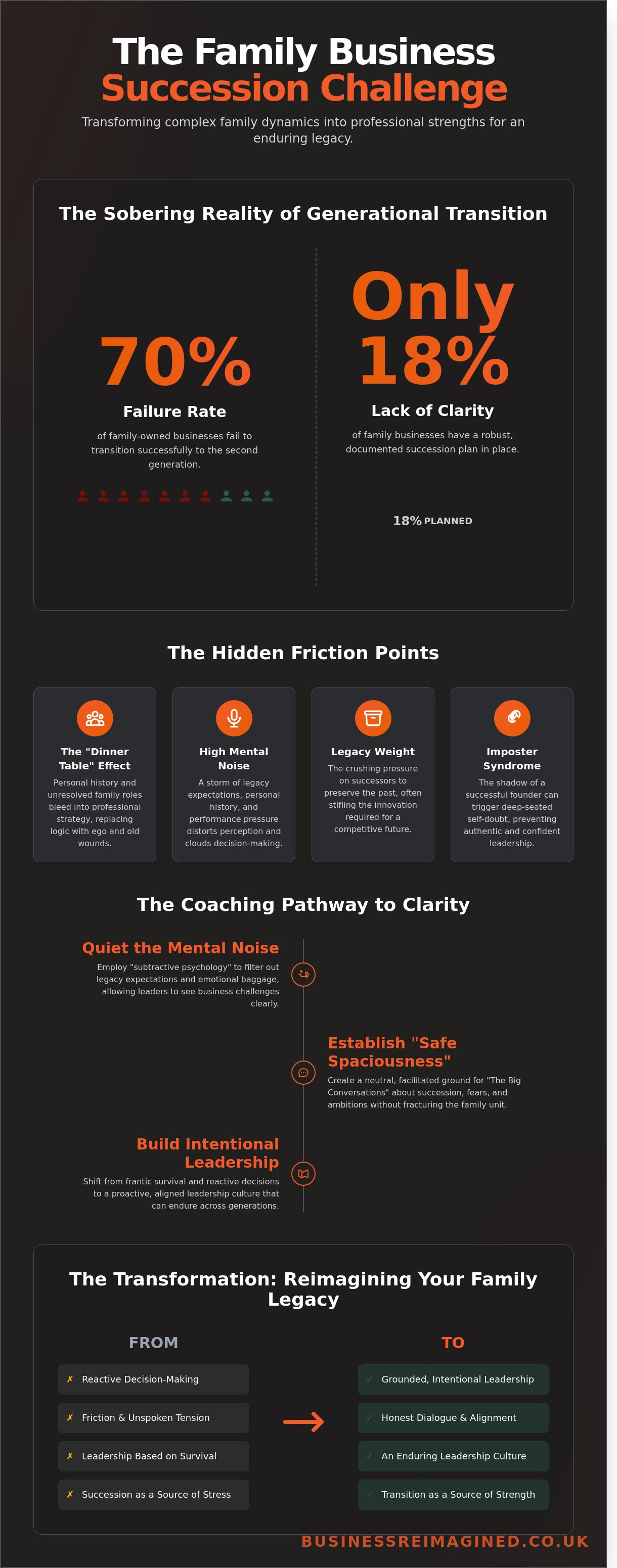
What if the shared history that defines your family is the very thing creating a ceiling for your firm's future? It's a heavy realisation when the kitchen table starts to feel like a boardroom and the boundaries of home and work begin to dissolve. You aren't alone in this tension. PwC’s 2023 Global Family Business Survey found that only 18% of family businesses have a robust, documented succession plan. This lack of clarity often stems from high mental noise and the emotional weight of legacy. Through intentional family business coaching, you can begin to untangle these threads, shifting from reactive decision-making to a place of grounded leadership.
We understand that you want your business to thrive without sacrificing the harmony of your private life. You likely feel the pressure to honour the past while securing a future for those who follow. This article explores how to transform these complex dynamics into professional strengths by fostering mental clarity. We'll look at how to build a leadership culture that can actually endure, ensuring your succession is a transition of strength rather than a source of stress. We’ll also touch on how to Overcome Imposter Syndrome during these pivotal shifts, helping you lead with authentic confidence as we reimagine what success looks like for your family.
Key Takeaways
- Understand why specialized family business coaching is vital for firms where personal and professional identities overlap, helping to navigate the risks that lead to the 70% failure rate in second-generation transitions.
- Explore the concept of "subtractive psychology" to quieten mental noise, allowing leaders to see through the fog of family dynamics and reclaim a sense of grounded clarity.
- Learn to establish a "safe spaciousness" for honest dialogue between generations, moving away from friction towards a leadership environment that supports long-term success.
- Discover how to transform your family legacy by prioritising alignment and intentionality over traditional hustle culture and aggressive growth metrics.
- Gain insights into how understanding your mind can help you overcome imposter syndrome and lead with authentic presence during pivotal moments of transition.
Beyond the Boardroom: Why Family Business Coaching is a Unique Necessity
At the heart of every family-run firm lies a complex paradox where the warmth of the home meets the cold logic of the balance sheet. Family business coaching exists as a specialised intervention designed specifically for these environments, where personal and professional identities don't just touch; they fuse. When you are Understanding Family Business Dynamics, you quickly realise that the standard rules of corporate engagement rarely apply. The boardroom isn't just a place for strategy; it's a theatre where decades of family history play out in every decision.
The numbers tell a sobering story of how difficult this balance is to maintain. Research frequently cited by the Harvard Business Review indicates that 70% of family-owned businesses fail to transition successfully to the second generation. This isn't usually due to a lack of talent or market shifts. It happens because the emotional architecture of the family collapses under the weight of the business. To prevent this, we must look beyond traditional metrics and focus on building a healthy leadership culture that can actually endure across decades.
To better understand this concept, watch this helpful video:
Conventional leadership development often fails because it treats the executive as an isolated unit. In a family firm, no one is an island. A CEO isn't just a boss; they are also a father, a sister, or a cousin. These roles carry heavy emotional baggage that can't be checked at the door. Effective family business coaching acknowledges these invisible threads, helping leaders untangle their professional responsibilities from their domestic roles to create a leadership environment that supports long-term success.
The "Dinner Table" Effect: When Personal History Meets Professional Strategy
Friction in the boardroom is often just a continuation of an argument started twenty years ago at the dinner table. When unresolved parent-child roles manifest in business meetings, logic often takes a backseat to ego or old wounds. In the UK, family firms face specific stressors, including the shifting landscape of inheritance tax and the pressure to modernise traditional industries. Next-generation leaders often struggle with "legacy weight," the crushing feeling that they must preserve the past rather than innovate for the future. This internal conflict is a core focus of Overcome Imposter Syndrome by Kay Tear, which highlights how the shadow of a successful founder can trigger deep-seated self-doubt in their successors.
The High Stakes of Succession and Continuity
Succession isn't a legal transaction; it's a profound psychological transition for everyone involved. For the founder, it's a relinquishing of identity; for the successor, it's a daunting step into the unknown. Coaching facilitates "The Big Conversation" long before a crisis forces the issue. It provides a spacious, neutral ground to discuss fears and ambitions without the fear of fracturing the family unit. By addressing these transitions with intention, firms can move away from frantic survival and toward a leadership culture that can actually endure for generations to come.
The Psychology of the Family Firm: Moving from Mental Noise to Clarity
The internal landscape of a family firm is often crowded with what we call mental noise. This noise is a collection of legacy expectations, personal history, and the pressure to perform. It distorts how leaders perceive current business challenges, making simple decisions feel heavy or insurmountable. When a leader is caught in this static, they often seek more tools or try to hustle harder. However, effective family business coaching leans into subtractive psychology. This approach suggests that clarity doesn't come from adding more strategies or frameworks. Instead, it comes from clearing the mental debris that obscures your natural wisdom.
Habituation plays a significant role in keeping leaders stuck. Research from the Family Firm Institute indicates that family businesses contribute roughly 70% to 90% of global GDP annually, yet many struggle with generational transition due to fixed psychological patterns. Leaders become habituated to reacting to their relatives through the lens of old family roles. They aren't seeing the professional colleague; they're seeing the sibling they argued with thirty years ago. Breaking these patterns requires a shift in understanding how our minds work in the moment. Through intentional family business coaching, leaders learn that their state of mind is the most valuable asset in the boardroom.
Breaking Free from the Imposter Syndrome in the Family Shadow
Inheriting a legacy brings a unique weight. You aren't just building a career; you're maintaining a monument. This often breeds a specific type of imposter syndrome where the successor feels like an actor in someone else’s play. To navigate this self-doubt, many find clarity in Overcome Imposter Syndrome by Kay Tear, which explores how to lead authentically while honouring the past. Mental noise creates the illusion of inadequacy in high-potential talent by filtering every achievement through the impossible standards of a predecessor.
The 3 Principles: A New Framework for Family Harmony
True leadership isn't about managing people; it's about understanding the nature of Mind, Consciousness, and Thought. These three principles dictate a leader's state of mind. When a leader operates from a higher state of consciousness, conflict often dissolves without the need for complex management techniques. Individual clarity is the foundation for a leadership environment that supports long-term success. By understanding how thought creates their reality, family members can interact with a sense of spaciousness. If you're ready to explore how this clarity can transform your firm, you can book a quiet conversation to discuss your specific context.
Case Study Analysis: Reimagining Success in a Multi-Generational Firm
Consider the case of a mid-sized manufacturing firm, a composite of many families we've partnered with during their most fragile moments of transition. For years, the founder and the successor operated in a state of high friction. Growth had remained stagnant for 22 months, while senior staff turnover peaked at 18 percent. The founder was exhausted, averaging five hours of sleep and struggling with the weight of a 40-year legacy. This wasn't just a business problem; it was a health crisis disguised as a corporate one.
We introduced a bespoke approach to family business coaching that prioritised a "slow business" philosophy. We moved away from the frantic pursuit of more, focusing instead on alignment and intentionality. By choosing to stop the "hustle," the family created the mental space required to actually lead. This shift allowed them to build a healthy leadership culture that supports long-term success rather than one that consumes the people within it.
From Conflict to Collective Intelligence
When the noise of daily operations is deafening, families often fall into defensive, ego-driven patterns. They stop hearing each other. Our intervention focused on quietening this internal static. Once the mental clutter cleared, the family began to access their collective intelligence. They moved from reactive arguments to collaborative problem-solving. This transition is essential for any firm wanting to find clarity in leadership and make decisions from a place of calm rather than fear. Instead of competing for control, they began to leverage their different perspectives as a strategic advantage.
The ROI of The Clarity Wellbeing Programme
The wellbeing of a founder isn't a luxury; it's a financial imperative. According to the PwC Global Family Business Survey 2023, only 43 percent of family businesses have a documented succession plan. This lack of clarity often stems from the founder’s inability to step back. By implementing The Clarity Wellbeing Programme, the firm saw a 25 percent reduction in decision-making cycles. When the leader is grounded, the entire firm moves with more grace and speed.
Success here is measured by a leadership culture that can actually endure. This often involves addressing the internal barriers that keep leaders small. In her book, Overcome Imposter Syndrome: Understand your Mind to Break Free from Self-Doubt, Lead Authentically, and Accelerate Your Career, Kay Tear explores how understanding the mind is the key to leading with authenticity. For this family, that understanding was the foundation of their new, sustainable chapter. By investing in family business coaching that values the person as much as the profit, they secured their legacy for the next generation.
Navigating Succession and Conflict: A Practical Guide to Intentional Leadership
Succession is rarely a simple hand-over of keys. It's a profound psychological transition that requires a departure from the frantic energy of traditional growth. When we engage in family business coaching, the goal isn't just to move names on an organisational chart. It's about creating a leadership culture that can actually endure for decades to come.
To navigate this shift without fracturing the family bond, consider these five intentional steps:
- Step 1: Audit the Mental Noise. Identify the internal scripts that dictate your decisions. Are you acting out of a genuine strategic vision, or are you reacting to the weight of a predecessor's expectations?
- Step 2: Establish Safe Spaciousness. Dialogue requires room to breathe. Create a dedicated environment where the younger generation can voice concerns without the fear of being perceived as disrespectful.
- Step 3: Define a Healthy Leadership Culture. Distinguish family traditions from professional requirements. A leadership environment that supports long-term success is built on clear accountability, not just shared history.
- Step 4: Implement a Transition Programme. Prioritise the health and performance of the incoming leader. A transition shouldn't be a trial by fire; it should be a deliberate cultivation of their unique strengths.
- Step 5: Move to Intentional Progress. Abandon the "hustle" for a rhythm that respects the long game. Sustainable growth is born from clarity and calm, not constant urgency.
Managing the "Double Bind" in Family Roles
Navigating the boundary between "CEO" and "Sibling" is a delicate art. When a leader is both a boss and a parent, the lines often blur, creating a double bind where every professional decision feels like a personal slight. To manage this, practice staying present during difficult conversations. Focus on the data and the human in front of you, rather than the decades of family history behind you. Authentic leadership requires a level of mental clarity that separates personal self-doubt from professional capability, a concept explored in Kay Tear's book, Overcome Imposter Syndrome.
Building a Leadership Environment for the Next Generation
Mentoring high-potential talent shouldn't mean creating a carbon copy of the founder. True mentorship provides the spaciousness for the next generation to apply their unique vision to the business. According to the PWC 2023 Global Family Business Survey, only 33% of family businesses have a robust, documented, and communicated succession plan. This lack of structure often leads to friction. By building a leadership environment that supports long-term success, you ensure the hand-over is a gentle transition rather than a collision of egos.
Succession is an opportunity to reimagine how your business serves your life. If you are ready to move away from the noise and toward a more intentional way of leading, explore our bespoke leadership programmes to start your journey.
Reimagining Your Family Legacy: The Path to Sustainable Performance
Clarity isn't just a soft skill; it's a strategic asset. According to a 2023 study by PwC, 71% of family businesses believe that trust and transparency are vital for long-term survival. When roles are blurred and expectations remain unspoken, the business suffers. We need to step away from the exhausting vocabulary of "crushing goals" or "aggressive scaling." These terms often mask a lack of direction and lead to burnout. They prioritize the machine over the human beings who operate it.
Instead, we focus on intentionality and alignment. Family business coaching provides the spaciousness needed to align your personal values with your commercial objectives. It's not about fixing a broken machine. It's about accelerating a high-potential legacy so it can flourish without burning out the people who built it. Reimagining what's possible for your family and your firm requires a shift in perspective, moving from frantic growth to purposeful presence.
Choosing a Partner for Your Transformation
Selecting a guide requires looking beyond standard business metrics. You need someone who understands the intricate psychology of family dynamics as deeply as they understand a balance sheet. A coach should act as a "Quiet Rebel," someone who challenges the traditional pressures of hustle culture to help you find a more sustainable path. This is about leading authentically and finding internal alignment rather than just hitting external benchmarks.
In her book, Overcome Imposter Syndrome, Kay Tear explores how understanding your own mind is the first step toward breaking free from self-doubt. If you're ready to move toward a leadership culture that can actually endure, I invite you to book a Clarity Call with Kay Tear. This is your opportunity to explore how family business coaching can transform your approach to leadership and legacy.
The Future of Your Firm: A Culture That Endures
Your legacy doesn't have to be a burden of constant stress. You can build a firm that is both profitable and peaceful. The rules you've followed for years aren't set in stone. They can be reimagined to support a life of purpose rather than one of frantic activity. By fostering a leadership environment that supports long-term success, you ensure the business serves the family, not the other way around.
Success is personal. It should feel as good on the inside as it looks on the outside. For ongoing insights on how to rewrite the rules of your business, you can follow Business Reimagined on YouTube. Let's create a future where your business is a source of joy and stability for generations to come. It's time to build a legacy that truly reflects your values and supports your well-being.
Creating a Legacy That Breathes
True leadership within a family firm requires more than just a strategic plan; it demands a shift in how you perceive your roles and your relationships. We have explored how moving from mental noise to clarity allows for a more intentional approach to succession. By focusing on subtractive psychology, you can strip away the unnecessary pressures that often cloud multi-generational decision-making. This process is essential for building a leadership culture that can actually endure across decades.
Business Reimagined, founded by Chantal Burns, author of the 2015 bestseller "Instant Clarity", brings over 15 years of experience to this delicate transformation. Our approach is rooted in neuroscience, helping leaders find the spaciousness needed to thrive without the burnout of traditional hustle culture. While navigating these transitions, leaders often face internal hurdles, as highlighted in Kay Tear's Overcome Imposter Syndrome, which offers vital insights into leading with authenticity. Investing in family business coaching provides the steady, strategic partnership required to turn complex family dynamics into a healthy leadership culture.
Book a Clarity Call to reimagine your family business leadership
Your business is a living part of your life. It's time to let it flourish with purpose and peace.
Frequently Asked Questions
What is the primary difference between executive coaching and family business coaching?
Family business coaching differs from executive coaching by addressing the emotional complexities of kinship alongside commercial strategy. While executive coaching focuses on individual performance, family-centric work explores the blurred lines between the boardroom and the dinner table. According to a 2023 PwC survey, 65% of family businesses experience conflict, making this specialized support essential for a leadership environment that supports long-term success.
How long does a typical family business coaching programme last?
A typical programme lasts between 6 and 18 months. This timeline provides the necessary spaciousness to address deep-seated patterns and implement intentional changes. We don't rush the process; instead, we focus on a steady rhythm that allows for sustainable growth and the gradual alignment of diverse family perspectives. It's about creating a healthy leadership culture that doesn't feel forced or frantic.
Can coaching help if family members are currently not on speaking terms?
Coaching can facilitate reconciliation even when family members aren't on speaking terms by creating a safe, neutral space for dialogue. The coach acts as a steady partner, helping individuals dismantle the self-doubt and defensive barriers that often arise in high-stakes environments. This process is similar to the journey of self-discovery found in Kay Tear's book, Overcome Imposter Syndrome, which encourages leading with authenticity.
Is family business coaching only for the senior generation or should the next-gen be involved?
Successful family business coaching must involve both the senior generation and the next-gen leaders to ensure a seamless transition. Inclusion ensures that the transition of power is a collaborative journey rather than a source of friction. By engaging both groups, you build a leadership culture that can actually endure, valuing the wisdom of experience while embracing fresh, intentional perspectives from the younger generation.
How do you measure the success of a coaching intervention in a family firm?
Success is measured through tangible benchmarks like the completion of a formal succession plan and improved retention rates. Data from the Family Business Institute shows that only 30% of family firms survive the transition to the second generation. Therefore, reaching key milestones in governance and communication serves as a vital indicator of long-term health and stability for the whole firm.
What happens if some family members are resistant to the coaching process?
If family members are resistant, we adopt a gentle, non-confrontational approach that prioritizes their sense of agency. We don't pressure individuals to conform; we invite them into a process of self-reflection. Often, resistance stems from a fear of losing control, so we work to provide clarity and reassurance that the process supports their personal well-being and the business's future.
How much does family business coaching cost in the UK?
In the UK, coaching costs vary based on the complexity of the firm and the coach's experience level. According to the 2023 Association for Coaching industry report, corporate coaching rates typically range from £200 to £1,000 per hour. It's important to view this as an investment in a leadership environment that supports long-term success rather than a simple overhead expense.
Is it possible to maintain family harmony while making tough business decisions?
It's entirely possible to maintain family harmony while making difficult commercial choices through value alignment. When decisions are rooted in a shared purpose, they feel less like personal attacks and more like intentional steps toward a common goal. This clarity allows for a professional life that supports your family life, ensuring that the business serves the family rather than consuming it.