
Executive Coaching vs Consulting: Which Path Leads to Lasting Leadership Clarity?
The relentless pursuit of "more" has left 70% of business leaders feeling so overwhelmed by data that they have simply given up on making certain decisions, according to a 2023 study by Oracle. You've likely felt that weight; the quiet realisation that the current "hustle" is simply unsustainable. When the mental noise becomes too loud, it's natural to seek external help, yet the choice between executive coaching vs consulting often adds another layer of confusion to an already crowded mind. You need a partner who understands that profit and well-being aren't rivals, but partners in a healthy leadership culture.
You deserve to step away from the frantic pace and move toward a more intentional way of leading. This article provides the framework you need to choose the right support for your professional growth and organisational health, ensuring your next investment delivers the highest ROI for your specific situation. We'll examine the distinct mechanics of both approaches to help you foster a leadership environment that supports long-term success while creating a leadership culture that can actually endure.
Key Takeaways
- Discover the fundamental shift between an expert-led intervention and a reflective partnership to identify which approach truly aligns with your path to clarity.
- Navigate the choice of executive coaching vs consulting by learning to distinguish between solving a temporary business symptom and nurturing your inherent potential.
- Uncover why "mental noise" often prevents strategic transformation and how a state of clarity is the essential foundation for any business reimagined.
- Use our diagnostic checklist to determine if your current challenges require a systemic project-based fix or a deeper shift in a leadership culture that can actually endure.
- Shift your perspective from external benchmarks to internal alignment, ensuring the support you choose fosters a healthy leadership culture rather than just a short-term win.
Executive Coaching vs Consulting: Understanding the Fundamental Shift
Choosing a path for professional growth often feels like standing at a crossroad with two distinct maps. The choice between executive coaching vs consulting isn't merely a matter of terminology; it's a fundamental shift in where the power of the solution resides. While one approach provides the answers, the other helps you find the right questions. Understanding this distinction is the first step toward reclaiming your time and your focus.
To better understand the practical differences between these two paths, watch this helpful video:
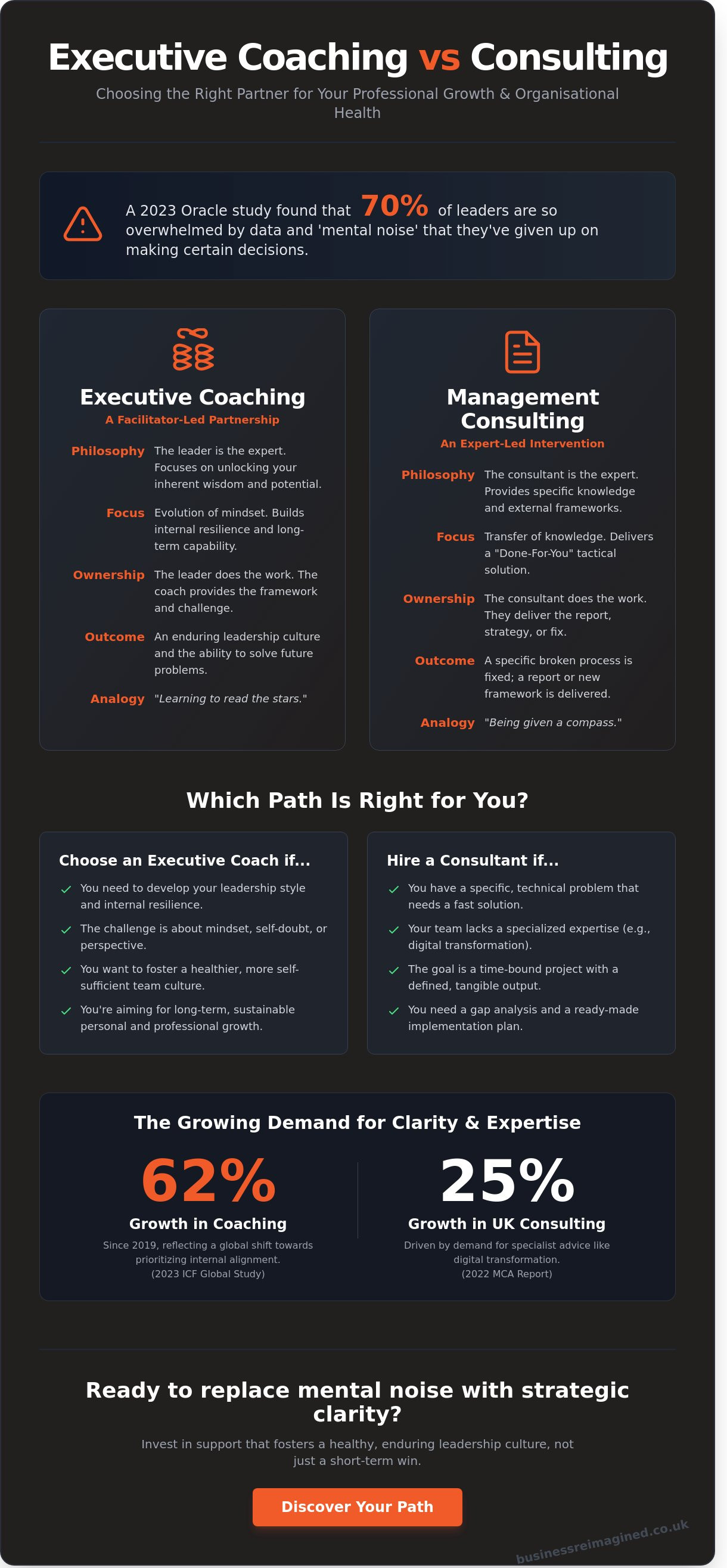
Leaders are often drowned in mental noise. This is the internal static created by competing priorities, self-doubt, and the relentless pace of modern work. Consulting attempts to silence this noise by providing external frameworks and ready-made business solutions. Coaching, however, aims to help the leader filter that noise themselves. It's the difference between being given a compass and learning how to read the stars. One solves a problem; the other evolves the person who solves the problem.
The Core Philosophy of Executive Coaching
In a Business and executive coaching context, the philosophy is simple: the leader is the expert of their own experience. This model is facilitator-led. It treats the individual as a "Quiet Rebel" who possesses the inherent wisdom to lead but requires the spaciousness to let that wisdom surface. This isn't about being told what to do. It's about creating a leadership culture that can actually endure by building internal resilience. According to the 2023 ICF Global Coaching Study, the coaching industry has grown to an estimated $4.564 billion globally, reflecting a 62% increase since 2019. This growth suggests that leaders are increasingly prioritising internal alignment over external instruction. Kay Tear explores this internal journey deeply in her book, Overcome Imposter Syndrome, which highlights how clarity is often buried under layers of learned doubt.
The Core Philosophy of Management Consulting
Management consulting operates on an expert-led model. The consultant is hired for their specific knowledge, bringing a "Done-For-You" approach to organisational problems. They typically perform a gap analysis to identify exactly where a business is falling short of its targets. A 2022 report by the Management Consultancies Association (MCA) showed that the UK consulting sector grew by 25%, driven by a demand for digital transformation and specialist advice. These interventions are usually tactical and time-bound. You receive a report, a spreadsheet, or a new framework, and the engagement ends. It's a vital tool for fixing a specific broken process, but it rarely addresses the developmental growth of the leader behind the process. Consulting fills the gap in the business; coaching fills the gap in the leader’s perspective.
Decoding the Differences: Focus, Ownership, and Expertise
When we examine executive coaching vs consulting, the first point of clarity involves accountability. In a consulting framework, the consultant is the primary actor. They're hired to do the work, provide the answer, and deliver the strategy. The burden of expertise sits with them. In coaching, however, the leader remains the primary actor. The coach provides the framework and the challenge, but the leader does the internal and external work required for change. This shift in ownership is vital for creating a leadership culture that can actually endure without constant external intervention.
This distinction shapes the duration and depth of the engagement. Consulting is typically project-based, focused on a specific "transfer of knowledge" or a technical fix. Once the report is delivered, the relationship often ends. Coaching is a relationship-based journey that facilitates an "evolution of mindset." It doesn't just solve a singular issue; it reshapes how a leader perceives every future challenge. Data from the 2023 ICF Global Coaching Study shows the industry grew to $4.564 billion globally, a 60% increase since 2019 (source). This growth reflects a global shift toward long-term leadership maturity over quick, external fixes.
Internal Growth vs. External Solutions
Think of the difference through a simple metaphor. A consultant brings the map, marking the most efficient path through the terrain. A coach helps you become the navigator. They ensure you can read the landscape, adjust to the weather, and lead your team even when the map becomes obsolete. While consultants focus on scaling systems, coaches focus on sustainable alignment. This approach fosters a leadership environment that supports long-term success rather than one that relies on external life support. You can explore how this philosophy underpins our Leadership Development Programmes, which focus on reimagining performance through personal clarity.
The Role of Expertise
Consultants are subject matter experts. You hire them for their deep knowledge in specific niches like finance, technology, or operations. They add to your "to-do" list by providing new strategies and external benchmarks. Executive coaches, conversely, are experts in the process of human performance and psychology. They don't just add more information; they often practice "subtractive psychology."
- Subtractive Psychology: This involves identifying and removing the mental barriers, biases, and self-doubts that cloud judgement.
- Authentic Presence: Moving away from performance-based leadership toward a grounded, intentional way of being that feels human.
- Process Mastery: Using reflective inquiry to unlock solutions that already exist within the leader's own experience and intuition.
By stripping away the noise of traditional hustle culture, coaches help leaders find a sense of spaciousness. If you're feeling the weight of self-doubt while trying to lead, you might find Kay Tear's insights on leading authentically particularly grounding. This internal work is what allows a leader to remain steady when the external environment becomes chaotic. Are you ready to stop adding more tasks and start finding more clarity? Perhaps it's time to start a conversation about your path forward.
When to Hire a Consultant vs. When to Partner with an Executive Coach
Leaders often mistake a technical bottleneck for a leadership failure, or vice versa. Deciding between executive coaching vs consulting requires a pause to look beneath the surface of daily operations. Is the problem a missing manual, or is it the hand holding the manual? To find clarity, you must first diagnose the nature of your current challenge.
- Is the solution an external framework or an internal shift?
- Does the project end with a physical report or a new way of thinking?
- Are you solving for a broken process or a misaligned person?
The dilemma usually rests in the difference between a symptom and a root cause. A consultant treats the symptoms of a fractured process by installing a new system. However, if the leader remains stuck in old patterns of "hustle culture," that new system will eventually fail. A 2023 study by the International Coaching Federation (ICF) found that 70% of individuals who receive coaching see improved work performance, largely because it addresses the person behind the strategy. Coaching isn't about fixing what's broken; it's about expanding the capacity of the person who leads.
Choose Consulting When...
Consulting is the right path when you require a specific, technical solution that your internal team cannot currently provide. You need an expert to conduct a neutral audit or implement a complex software system. These projects have a clear "done" state. The consultant provides the "arms and legs" to execute a methodology that has worked elsewhere, leaving you with a tangible asset or a refined process once their contract ends.
Choose Executive Coaching When...
Partner with a coach when you are a high-potential leader facing a pivotal moment, such as a major career transition or a shift in company direction. If your primary challenges are "people-based," involving team dynamics, ego, or a persistent lack of mental clarity, coaching provides the necessary spaciousness to reflect. This path allows you to build a leadership culture that can actually endure beyond a single project. To explore how these transitions can be managed with intentionality, you can connect with Kay Tear on LinkedIn.
The most common objection leaders raise is that they don't have time for coaching. This perspective views time as a dwindling resource to be spent rather than an asset to be invested. When you lack clarity, you waste hours on indecision and reactive fire-fighting. Coaching returns that time to you by creating alignment. By integrating both services, you ensure that your technical systems are supported by a leadership environment that supports long-term success.
Why Mental Clarity is the Missing Link in Professional Support
Strategies often fail not because they're poorly designed, but because the mind tasked with executing them is too crowded to see the path forward. High-level leadership requires a level of cognitive spaciousness that traditional hustle culture actively destroys. When a leader is caught in a cycle of reactive fire-fighting, even the most brilliant business plan becomes just another weight on their shoulders. This is where the distinction between executive coaching vs consulting becomes vital for long-term health.
A consultant provides the external map; a coach helps you clear the internal fog so you can actually read it. Without this clarity, professional support often acts as a temporary bandage on a deeper wound of exhaustion. According to Deloitte’s research, 77% of professionals have experienced burnout in their current roles. This statistic highlights a systemic failure in how we approach professional growth. We prioritise the "doing" while neglecting the "being." The Clarity Wellbeing Programme was developed as a hybrid approach to solve this, ensuring that performance is built on a foundation of mental stillness rather than frantic effort.
Beyond the Hustle: The Neuroscience of Performance
Your prefrontal cortex is the seat of strategic thought, decision-making, and emotional regulation. It functions at its peak only when mental noise is reduced. When you're overwhelmed, your brain shifts its resources away from this creative centre and toward the amygdala, the "threat" centre. This makes it biologically impossible to lead with vision. Coaching facilitates the habituation of better thinking patterns, training the brain to return to a state of calm focus more quickly. By reducing the static of daily demands, you create a leadership culture that can actually endure. This shift in the psychology of performance allows you to move from a state of constant "doing" to one of intentional "leading."
- Reduced Cortisol: Lowering stress levels to prevent cognitive decline.
- Enhanced Pattern Recognition: Seeing opportunities that others miss because their minds are cluttered.
- Neuroplasticity: Rewiring the brain to respond to challenges with curiosity rather than fear.
Addressing the Ego and Imposter Syndrome
External strategies cannot solve internal conflicts. A consultant might give you the tools to lead a global team, but they can't "fix" the underlying belief that you aren't qualified to be there. In her book, Overcome Imposter Syndrome, Kay Tear explores how you must understand your mind to break free from self-doubt. Coaching provides the reflective space to dismantle these ego-driven barriers. It allows you to address the root causes of imposter syndrome, ensuring your professional identity is grounded in reality rather than anxiety.
When you achieve this internal alignment, decision-making becomes significantly more intentional. You stop making choices based on how they'll be perceived or out of a fear of being "found out." Instead, you lead from a place of quiet authority. This clarity transforms the leadership environment from one of tension into one of sustainable growth. If you're ready to trade the noise for a more grounded way of working, you can book a discovery call to explore how to reclaim your mental spaciousness.
Choosing Your Path to a Healthy Leadership Culture
Deciding between executive coaching vs consulting isn't a binary choice between two competing products. Instead, it's a reflection on where your business currently feels the most friction. If your operational structures are brittle, the solution likely lies in the system. If the spirit of your leadership feels depleted or misaligned, the answer is found in the soul. True clarity arrives when these two forces are brought into harmony, allowing you to move away from the exhausting cycle of hustle and toward a more intentional way of working.
We encourage a perspective that views leadership as a process of alignment. It's about creating a leadership culture that can actually endure without requiring you to sacrifice your well-being. When you stop viewing your business as a machine to be fixed and start seeing it as a living part of your life, the path forward becomes significantly clearer. This shift in mindset is what allows for sustainable growth rather than the frantic, short term wins that often lead to burnout.
The Integrated Approach
Many traditional firms offer rigid, off-the-shelf consulting packages that ignore the human element of leadership. At Business Reimagined, we provide a blend of coaching and transformation accelerators designed for your specific context. We don't believe in one-size-fits-all solutions. Generic programmes often fail because they don't account for the 70% of organisational change initiatives that fall short due to cultural resistance, a figure highlighted by McKinsey in 2023. This is why we focus on bespoke interventions that respect your unique pace and values.
Our Services Page outlines how we integrate strategic rigour with personal growth. By combining the "how" of consulting with the "who" of coaching, we ensure that the changes you implement are rooted in your authentic leadership style. This integrated approach creates a leadership environment that supports long-term success, ensuring that your strategy and your state of mind are always in conversation with one another.
Your Next Step Towards Clarity
Take a moment to reflect on your current pivotal moment. Are you facing a challenge that requires a new strategy, or is it time for a new state of mind? Sometimes, the most strategic move you can make isn't adding another task to your list; it's engaging in a quiet, intentional conversation to find your centre. According to the 2023 ICF Global Coaching Study, the coaching industry has seen a 62% increase in active practitioners since 2019, which suggests that more leaders are seeking internal alignment to handle external pressures.
If you're ready to explore what a healthy leadership culture looks like for your business, I invite you to book a discovery call. This is a space for a calm, intentional conversation about your goals, free from the pressure of traditional sales tactics. For those who want to explore these themes further through visual insights, our YouTube channel provides additional reflections on leading with purpose and clarity. Let's find the path that feels right for you.
Reimagining Your Leadership Journey
The choice between executive coaching vs consulting isn't about finding a better method; it's about identifying where the ownership of change needs to reside. While a consultant provides the map, an executive coach helps you find the internal compass to navigate any terrain. True transformation happens when we stop chasing external fixes and start prioritising mental clarity as a vital strategic asset. This intentional shift creates a healthy leadership culture where high-potential talent can thrive without the heavy weight of traditional hustle culture.
Business Reimagined was founded by Chantal Burns, an international speaker and leadership expert who has spent over 20 years helping professionals find their quiet authority. Whether you require the structured growth of The Beyond Limits Programme for high-potential talent or the precision of our bespoke transformation and change accelerators, we're here to help you lead with purpose. You don't have to navigate this transition in a state of frantic urgency.
Book a Clarity Call with Kay Tear to find your path and begin building a leadership environment that supports long-term success. Your next step should feel like a breath of fresh air.
Frequently Asked Questions
What is the main difference between executive coaching and management consulting?
The main difference lies in the source of the solution; consultants provide external answers, while coaches facilitate internal discovery. Consulting focuses on fixing a specific business problem through expert advice and data analysis. Executive coaching prioritises the leader's personal growth and long-term clarity. A 2023 report by the International Coaching Federation (ICF) highlights that 25% of organisations use coaching specifically to improve leadership performance.
Is executive coaching more expensive than consulting in the UK?
Consulting fees in the UK often exceed coaching costs because they involve high-intensity project deliverables and team-wide interventions. While individual rates vary, the 2023 ICF Global Coaching Study lists the average hourly rate for Western European coaches at approximately £230. Consulting projects, by contrast, frequently involve five-figure sums for a single strategic overhaul or a deep dive into company operations.
Can a consultant also be an executive coach?
A professional can inhabit both roles, provided they're intentional about the boundaries of each engagement. A 2022 industry survey by CoachHub found that approximately 35% of coaches also offer consultancy services to their clients. This dual approach allows for a blend of strategic advice and personal reflection. If you're deciding between executive coaching vs consulting, it's vital to know if you need a mentor's map or a coach's mirror.
How do I know if my team needs a workshop or a full leadership programme?
Choose a workshop for immediate tactical needs and a full programme for deep, structural shifts in your leadership culture. Workshops are brief, targeted interventions for specific skills. A full programme fosters a leadership culture that can actually endure. Research published in the Harvard Business Review in 2019 indicates that sustained development is 30% more effective than isolated training events.
What is the typical ROI of executive coaching compared to consulting?
The ROI of executive coaching vs consulting differs in its focus, with coaching offering a median return of 700% on the initial investment. This figure, from a study by PwC and ICF, reflects improvements in productivity and team morale. Consulting ROI is usually measured by specific financial metrics or cost-savings achieved through the implementation of the consultant's specific strategic recommendations.
How long does a typical executive coaching engagement last?
Most executive coaching engagements last between six and twelve months to provide the spaciousness needed for genuine transformation. The Association for Coaching notes that roughly 70% of professional contracts are designed to span this duration. This timeframe allows for the rhythmic integration of new habits into your daily life. It isn't a frantic dash; it's a deliberate process that ensures your growth is grounded and intentional.
Does executive coaching help with imposter syndrome?
Executive coaching is a powerful remedy for imposter syndrome because it shifts the focus from external validation to internal alignment. It helps leaders dismantle the "hustle" narrative that often fuels self-doubt. Kay Tear's book, Overcome Imposter Syndrome, explains how understanding your mind can help you lead authentically. By working with a coach, you can break free from these patterns and reclaim your professional confidence in a grounded way.
What qualifications should I look for in a UK executive coach?
You should prioritise coaches with credentials from the International Coaching Federation (ICF) or the Association for Coaching (AC). These organisations require rigorous training and adherence to strict ethical standards. As of 2023, the ICF represents over 50,000 members globally, ensuring a high level of professional accountability. Choosing an accredited coach ensures your development happens within a leadership environment that supports long-term success.