
Executive Coaching London: A Leader’s Guide to Finding Clarity in the City
In the relentless 24/7 pulse of a global hub like London, the most radical act of leadership isn't doing more; it's choosing to pause. You likely feel the weight of decision fatigue and the profound loneliness at the top that defines much of the city's corporate culture. It's a heavy burden to carry in isolation. Finding the right executive coaching London provides is about more than just professional development; it's about reclaiming your internal spaciousness. When you quiet the mental noise, you stop reacting to the chaos and start leading with intention.
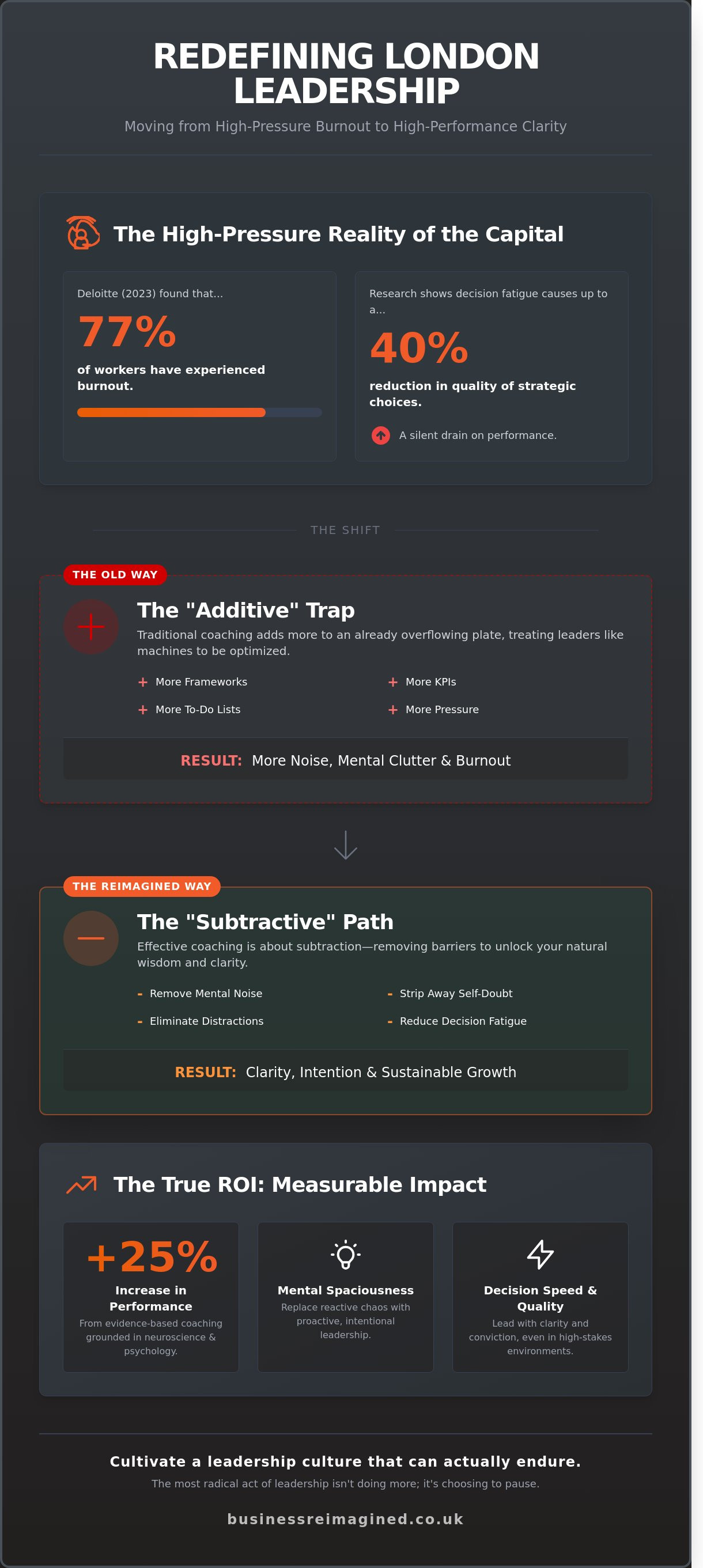
You deserve a leadership culture that can actually endure, rather than one that burns out by the next fiscal quarter. A 2023 report from Deloitte found that 77% of workers have experienced burnout, a statistic that highlights the urgent need for a more grounded approach to work. In this guide, you'll discover how to choose a coach who helps you move beyond the hustle to find genuine clarity. As Kay Tear suggests in her book, Overcome Imposter Syndrome, breaking free from self-doubt allows you to lead authentically. We'll examine the steps to refining your focus so your decision-making remains sharp, sustainable, and deeply human-centric.
Key Takeaways
- Understand why the unique intensity of the capital requires a specialized approach to executive coaching London to move beyond hustle culture and find true clarity.
- Learn to identify strategic partners who offer both psychological depth and high-level business acumen to navigate the complexities of global operations.
- Address the silent drain of self-doubt by applying principles from Kay Tear’s Overcome Imposter Syndrome to foster a more authentic and effective leadership presence.
- Redefine your ROI by prioritizing non-traditional metrics such as mental spaciousness and decision speed to ensure your growth remains sustainable.
- Discover how to cultivate a leadership culture that can actually endure by integrating neuroscience with an intentional, human-centric strategy.
Navigating the High-Pressure Realities of Leadership in London
London operates on a frequency that can feel vibratingly intense. It's a city of nine million people, each chasing a version of success that often feels just out of reach. For those at the helm of major firms, the pressure isn't just about hitting quarterly targets; it's about the psychological weight of staying relevant in a global hub that never sleeps. Finding the right executive coaching London provides is about more than just strategy. It's about reclaiming your mental space in a city that constantly demands your attention. Standard Business and executive coaching often misses this nuance, treating the leader like a machine to be optimized rather than a human being seeking clarity.
Cluttered thinking is expensive. Research from 2024 indicates that decision fatigue can reduce the quality of strategic choices by up to 40% in high-stakes environments. A leadership culture that can actually endure starts within your own mind. If the leader is frantic, the organization follows that same erratic rhythm. Moving beyond the hustle culture that leads to burnout requires a shift in perspective, where well-being is viewed as a prerequisite for profit rather than a luxury. True alignment happens when you stop reacting to the noise and start leading from a place of grounded intentionality.
To better understand how this process looks in practice, watch this helpful video:
The "Always-On" Culture of the Square Mile
The Square Mile and Canary Wharf aren't just geographic locations; they're psychological arenas. In these hubs, the 24/7 nature of global finance and tech means your competition is always awake. This geographic proximity creates a constant comparison trap where leaders measure their worth against the office across the street. The London leadership tax is the mental energy spent navigating high-stakes politics and the relentless noise of the capital. Breaking free from this trap requires a conscious effort to prioritize internal benchmarks over external validation.
Why Traditional Coaching Often Fails Busy Londoners
Most coaching is additive. It gives you more frameworks, more KPIs, and more things to do. When a leader is already "full," more advice just becomes more noise. You don't need a tactical instructor to tell you how to work harder; you need a Wise Visionary partner to help you find spaciousness. This is where Overcome Imposter Syndrome by Kay Tear becomes a vital resource, as it helps leaders move past the self-doubt that often hides behind a busy schedule. Effective executive coaching London leaders can trust focuses on subtraction, removing the barriers to your natural wisdom so you can lead with genuine authority.
Essential Criteria for Selecting an Executive Coach in London
Choosing a partner in the City isn't about finding someone to help you do more. It's about finding someone who helps you see more. A coach must possess deep business acumen to navigate the complexities of global operations centered in London. They should also understand the neuroscience behind how we function. Recent research studies on executive coaching highlight that evidence based approaches significantly improve self efficacy and goal attainment. These studies indicate that structured interventions can lead to a 25% increase in individual performance metrics when they are grounded in psychological theory rather than just surface level motivation.
The right coach doesn't just offer "additive" tools like more frameworks or to-do lists. Instead, they facilitate "subtractive" clarity. This process involves stripping away the mental noise that accumulates in high pressure environments. It allows you to find a leadership environment that supports long-term success without the constant weight of traditional hustle culture. When evaluating a coach, ask if they understand the psychological depth required to sustain a healthy leadership culture over decades, not just fiscal quarters.
The Shift from Performance to Clarity
Performance is often treated as the goal, but it's actually a byproduct of clarity. When your mind is clear, performance follows naturally. We focus on the Three Principles of Mind, Consciousness, and Thought to help leaders tap into their innate wisdom. This shift is essential for those who need to Overcome Imposter Syndrome, as Kay Tear describes in her work on leading authentically. By understanding how thought creates your reality, you can foster a leadership culture that can actually endure. You move from reacting to external pressures to acting from internal alignment.
Practical Logistics for the London Executive
Your schedule is likely a mosaic of high stakes commitments. Finding executive coaching London leaders can rely on requires a balance between physical presence and digital spaciousness. While face to face sessions in Mayfair or the City provide a grounded connection, remote accessibility ensures support isn't tethered to a single postcode. It's about creating a rhythm that fits your life.
- In-Person Presence: Deep work often happens best in the quiet corners of the City, away from the office.
- Digital Spaciousness: Remote sessions offer a reflective pause in a busy day without the commute.
- Schedule Integrity: The coaching itself should feel like a breath of fresh air, not another obligation.
If you're seeking a strategic partner to help you navigate these complexities, you can view our services for bespoke programmes. We prioritize a leadership environment that supports long-term success, ensuring your growth is as sustainable as it is significant. Why settle for a frantic pace when you can lead with quiet authority?
Beyond the Mask: Addressing Imposter Syndrome and Executive Burnout
London's financial and corporate hubs often demand a performance that leaves little room for vulnerability. Behind the polished exteriors of glass towers, a quiet crisis of confidence persists. High achievers frequently feel like they're playing a part, waiting for the moment they're finally found out. This isn't just a personal burden; it's a systemic drain on organisational effectiveness. When leaders operate from a place of hidden fear, they tend to micromanage, hesitate on vital decisions, and inadvertently create a culture of anxiety.
Addressing Imposter Syndrome requires looking beyond individual "fixes" and examining the environment that rewards constant striving. In the context of executive coaching London professionals often find that their drive to over-perform is actually a defense mechanism. They work 70-hour weeks not because the task requires it, but to outrun the feeling of inadequacy. This cycle leads directly to burnout, a state that 79% of UK workers reported experiencing in 2020. Moving away from this exhaustion means shifting from "managing" stress to understanding the very nature of thought.
Understanding the Mind to Break Free
Breaking the cycle of self-doubt starts with seeing how the mind actually functions. In her book, Overcome Imposter Syndrome: Understand your Mind to Break Free from Self-Doubt, Lead Authentically, and Accelerate Your Career, Kay Tear explains that self-doubt is a mechanical process of the mind rather than a reflection of your true capability. When you understand these mechanics, you can stop reacting to every insecure thought that arises. This clarity allows you to lead more authentically because you're no longer trying to protect a manufactured image. Authentic leadership is the natural byproduct of a quiet mind.
Building Resilience in a Leadership Environment
Resilience is often misunderstood as the ability to endure more pain or "tough it out" through impossible workloads. In a leadership culture that can actually endure, resilience is defined as the capacity to return to a state of clarity quickly after a setback. It's about mental fluidity, not rigid toughness. A leader's internal state isn't private; it's a signal that ripples through the entire organization. When you operate from a grounded place, your team feels safe to innovate and speak truthfully. To explore these themes further, you can follow Kay Tear on LinkedIn for daily insights on mental clarity and professional alignment. Investing in executive coaching London isn't just about your own performance, it's about creating a healthy leadership culture that supports long-term success for everyone involved.
How to Evaluate Your Coaching ROI and Cultural Fit
Measuring the success of executive coaching London involves looking beyond traditional balance sheets. While financial growth matters, the true return often manifests as mental spaciousness. This clarity allows you to move from a state of constant reaction to one of intentional action. You'll notice success when your decision speed increases and the heavy fog of "busy-ness" begins to lift. A steady, strategic partner doesn't offer quick fixes; they help you cultivate a leadership culture that can actually endure the pressures of the modern city.
Measuring the Intangibles of Leadership
Quantifying clarity might feel elusive, yet its impact is visible in team retention and engagement levels. A 2009 study published by Harvard Business Review found that the most common reason for engaging a coach is to develop high-potential talent. When a leader finds alignment, the ripple effect is profound. Avoiding just one clouded strategic decision can save a firm hundreds of thousands of pounds. True ROI is found in long-term behavioral shifts, not short-term hacks that fade after a week. Leaders often find that once they address the internal noise, their external results follow. In her book, Overcome Imposter Syndrome, Kay Tear highlights how understanding your own mind is the key to leading authentically and accelerating your career without burnout.
The Discovery Call: What to Ask
The chemistry session is your opportunity to see if a coach is a "Quiet Rebel" or simply a corporate parrot. You need someone who will challenge your status quo rather than just validating your ego. Ask questions that reveal their depth. Does their approach feel grounded? Do they value your well-being as much as your profit margins? Here are three questions to guide your conversation:
- How do you help leaders maintain a healthy leadership culture during periods of rapid change?
- Can you share an example of how you've helped a client increase their transformation speed without sacrificing their mental health?
- What is your philosophy on the balance between professional ambition and personal alignment?
If you're ready to explore how a more intentional approach can transform your work, you can book a discovery call to experience a clarity-led conversation. This isn't about a high-pressure sales pitch; it's about finding a strategic partner who understands the unique rhythm of your life.
Discover a more sustainable path to success by exploring our bespoke coaching services.
Business Reimagined: Cultivating a Leadership Culture That Can Actually Endure
Leadership in the capital often feels like a race without a finish line. We believe that effective executive coaching London should offer a pause, not just another plan. Our approach blends the hard science of neuroscience with the liberating principles of subtractive psychology. Instead of adding more tasks to your plate, we identify the mental and operational clutter that creates friction. When you remove what isn't working, the path to performance becomes clear and effortless. It's about subtraction, not addition.
The Clarity Wellbeing Programme treats leader health as the ultimate performance metric. A 2024 report by Deloitte found that poor mental health costs UK employers approximately £51 billion annually, reinforcing why we prioritize internal health as a core business strategy (Deloitte, 2024). We don't view well-being as a luxury; it's the foundation of a healthy leadership culture. By prioritizing your internal alignment, you create a ripple effect that stabilizes your entire organization. In her book, Overcome Imposter Syndrome, Kay Tear explains how understanding your mind is the first step to leading authentically. This internal work allows London leaders to rewrite the rules of their professional lives, moving away from the grind and toward sustainable impact.
A Quiet Rebellion Against Hustle Culture
We value groundedness over frantic growth. Most coaching models use force to drive change, which inevitably leads to exhaustion. Our "transformation accelerators" work differently. We focus on removing the friction in your decision-making and team dynamics. This creates a spacious way of leading where intentionality replaces urgency. You can see examples of this reimagined approach on our YouTube channel. It's about doing less to achieve more, ensuring your success doesn't cost you your peace.
Your Next Steps Toward Clarity
The noise of the city doesn't have to dictate the pace of your mind. We invite you to step into a more spacious way of leading, where clarity is your primary tool. Success and well-being aren't opposites; they're partners. If you're ready to build a leadership environment that supports long-term success, we're here to partner with you. Our executive coaching London services are designed for those who want to lead with purpose and poise. Explore our full range of services for London executives and start your journey toward a leadership culture that can actually endure.
Stepping Into a Leadership Culture That Endures
The relentless pace of the City often demands a mask of certainty that few leaders truly feel. You've explored how finding the right support involves looking for cultural alignment and a deep understanding of the human mind. A leadership culture that can actually endure is built on a foundation of psychological safety and quiet intentionality. In her book, Overcome Imposter Syndrome: Understand your Mind to Break Free from Self-Doubt, Lead Authentically, and Accelerate Your Career, Kay Tear highlights how understanding our internal mechanics is the first step toward authentic influence.
Business Reimagined was founded in 2011 by Chantal Burns to offer a different path. Our bespoke programmes are specifically designed for the high-pressure sectors of the capital. Studies by the International Coaching Federation show that 86% of companies recoup their initial investment through improved productivity and performance. By choosing executive coaching London that prioritizes neuroscience and well-being, you create space for long-term impact. You're capable of more than just surviving the week; you're ready to lead from a place of grounded power. Your journey toward clarity and a more sustainable way of working starts with a single, intentional conversation.
Book a Clarity Discovery Call with Business Reimagined
Frequently Asked Questions
How much does executive coaching in London typically cost?
Executive coaching London rates typically range from £300 to £1,000 per hour for senior leaders. According to a 2023 industry survey by the International Coaching Federation (ICF), fees vary based on the coach's experience and the specific needs of the professional. Investing in this space isn't about buying time; it's about securing the clarity needed to lead with purpose. It's an intentional commitment to your long-term professional health.
What is the difference between executive coaching and business mentoring?
Executive coaching focuses on unlocking your internal wisdom through inquiry, while mentoring relies on a senior professional sharing their specific career experiences. Research from the Harvard Business Review shows that 48% of companies hire coaches specifically to develop high-potential leaders. A coach acts as a strategic partner who helps you find your own alignment. A mentor provides a roadmap based on their personal history, which may not always fit your unique path.
How long does a typical executive coaching programme last?
Most executive coaching London programmes span between 6 and 12 months to allow for meaningful, sustainable change. A 2022 study by the Ridler Report found that 72% of coaching assignments last for six months or longer. This duration provides the spaciousness required to move beyond surface-level fixes. It ensures you can build a leadership culture that can actually endure through various market cycles without the pressure of a frantic timeline.
Can executive coaching help with career transitions in the City?
Yes, coaching provides a structured environment to navigate the complexities of a career pivot or a promotion within the London financial sector. Data from McKinsey indicates that 70% of leaders feel unprepared for the challenges of a new role during their first 90 days. A coach helps you manage this transition by aligning your personal values with your new professional responsibilities. This process reduces the friction often found in high-stakes environments.
Is 1:1 executive coaching better than group leadership programmes?
Individual coaching offers a bespoke level of depth and confidentiality that group settings cannot replicate. While group programmes are useful for networking, a 2020 study found that 1:1 interventions lead to significantly higher levels of goal attainment and self-efficacy. This focused attention allows for a gentle yet firm exploration of your specific leadership style. It creates a private space to address the unique pressures of leading in a global hub like London.
How do I know if I am ready for executive coaching?
You're ready for coaching when you feel a gap between your current performance and the intentional leader you wish to become. A 2021 survey by the Sherpa Coaching Group revealed that 65% of coaching clients seek help with leadership skills and self-awareness. If you're craving more clarity and less "hustle," it's likely the right time. This readiness often signals a desire to create a leadership environment that supports long-term success.
What is the ROI of executive coaching for a London-based firm?
Organizations typically see a return on investment of nearly six times the initial cost of the coaching engagement. A study by Manchester Inc. quantified the average ROI at 5.7 times the investment, citing improvements in productivity and organizational strength. Beyond the numbers, coaching fosters a healthy leadership culture. This shift reduces turnover and ensures that the business operates with a sense of calm authority rather than frantic urgency.
Can coaching help with imposter syndrome at the CEO level?
Executive coaching is a powerful tool for addressing the self-doubt that often accompanies high-level leadership roles. In her book, "Overcome Imposter Syndrome," Kay Tear explains how understanding your mind helps you lead authentically and break free from the cycle of self-doubt. By working with a coach, you can dismantle the hustle culture myths that fuel these feelings. This allows you to reclaim your confidence and lead with a soulful, grounded perspective that feels truly yours.