
Creating a High Potential Development Plan: A Human-Centric Roadmap for 2026
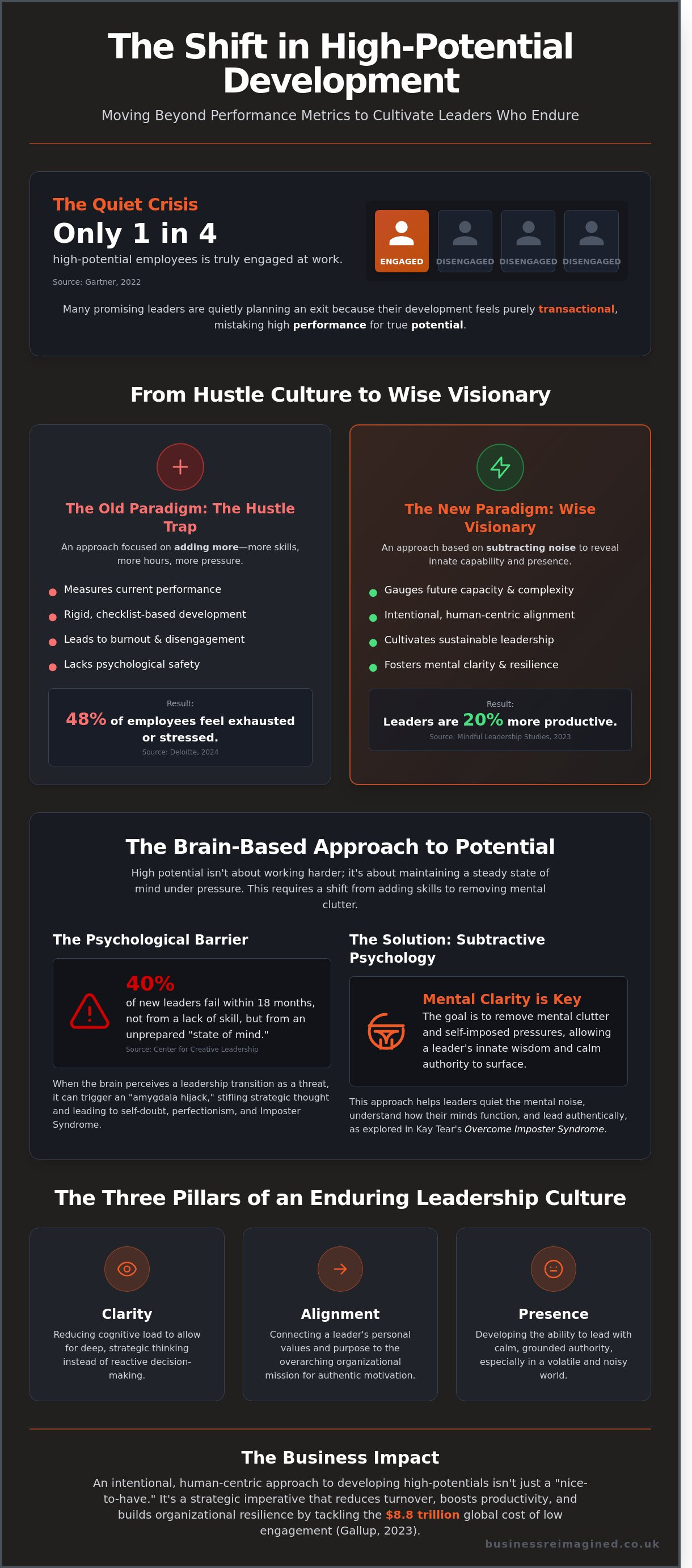
What if your most promising leaders aren't looking for a faster ladder to climb, but a more meaningful ground to stand on? A 2022 study by Gartner found that only 25% of high-potential employees are actually engaged at work, while many others are quietly planning an exit because their development feels purely transactional. It's a quiet crisis that happens when we mistake high performance for true potential. Creating a high potential development plan in 2026 requires us to look beyond the spreadsheet and see the human. We must address the internal barriers that stall growth, such as the psychological hurdles explored in Kay Tear's book, Overcome Imposter Syndrome, which reminds us that leading authentically starts with understanding the mind.
You already know that traditional hustle culture is a fading relic that burns out the very people you want to keep. You're likely seeking a healthy leadership culture that supports long-term success without sacrificing well-being. This article promises to show you how to align strategic growth with psychological clarity and sustainable performance. We'll walk through a clear, actionable roadmap to help you distinguish potential from performance, improve retention, and cultivate a leadership culture that can actually endure through intentional presence and strategic spaciousness.
Key Takeaways
- Learn how to move beyond rigid HR documents by viewing leadership growth as an intentional process that prioritizes future capacity over current performance.
- Discover how "subtractive psychology" helps emerging leaders quiet mental noise and reveal their innate capabilities during high-pressure transitions.
- Gain strategies to navigate the "double bind" of self-doubt and lead authentically by applying insights from Kay Tear’s Overcome Imposter Syndrome.
- Master a five-step framework for creating a high potential development plan that replaces hustle-based metrics with objective, brain-based assessments.
- Explore how to foster a leadership culture that can actually endure by shifting from frantic scaling toward intentional, sustainable alignment.
Understanding the High Potential (HiPo) Development Plan
A high potential development plan is often mistaken for a rigid checklist or a static HR document. In the context of 2026, we view it differently. It's a leadership environment that supports long-term success. While high performance measures the results an individual delivers in their current seat, high potential gauges their capacity to lead through future complexity. True potential isn't just about doing more; it's about being more. We call this the Wise Visionary approach. It acknowledges the human behind the title. Creating a high potential development plan requires us to look past the surface of hustle metrics and focus instead on intentional alignment.
Why Traditional Talent Programmes Often Fail
Traditional talent programs often collapse under the weight of the Hustle Trap. By 2024, research from Deloitte indicated that 48% of employees felt exhausted or stressed. When we push high achievers to develop without providing spaciousness, we invite disengagement. These rigid frameworks often lack psychological safety, leaving leaders feeling like they must perform perfection. This pressure frequently triggers the internal dialogue explored in Overcome Imposter Syndrome by Kay Tear, where the fear of being found out stifles genuine growth. Without a bridge between business goals and individual leader purpose, the plan becomes a burden rather than a gift.
The Business Case for an Intentional Approach
The business case for a human-centric approach is grounded in measurable resilience. Leaders who possess mental clarity and presence are 20% more productive than those operating in a state of constant urgency, according to 2023 studies on mindful leadership. When you prioritize a leadership culture that can actually endure, you see a direct impact on retention. Gallup's 2023 State of the Global Workplace report found that low engagement costs the global economy $8.8 trillion. An intentional approach to creating a high potential development plan reduces the intent to leave by ensuring top-tier talent feels seen as a person, not just a resource. This is how we build organizational health that lasts.
- Clarity: Reducing cognitive load to allow for strategic thinking.
- Alignment: Connecting personal values to the organizational mission.
- Presence: Developing the ability to lead with calm authority in a noisy world.
Identifying Potential Through the Lens of Neuroscience
The brain doesn't naturally crave the complexity of leadership; it craves safety. When we consider creating a high potential development plan, we're often looking at how an individual manages this internal tension. Traditional models focus on adding more skills to an already overflowing plate. We propose a Quiet Rebellion against this volume-based approach. We should prioritize subtractive psychology instead. This involves removing the mental clutter and self-imposed pressures that prevent a leader's innate wisdom from surfacing. High potential isn't found in the person who works the longest hours. It's found in the person who maintains a steady state of mind under pressure. As Kay Tear explores in her work on overcoming imposter syndrome, authentic leadership emerges only when we understand how our minds actually function.
Research from the Center for Creative Leadership indicates that 40% of new leaders fail within their first 18 months. This failure rarely stems from a lack of technical skill. It happens because the "state of mind" of the individual isn't prepared for the psychological weight of the role. When the brain perceives a leadership transition as a threat, the amygdala can hijack the prefrontal cortex, stifling strategic thought. Identifying high potential means finding those who can stay grounded when the stakes rise.
The Role of Mental Clarity in High Potential
Mental clarity is the quiet power to identify the pivotal moment within a storm of data. Neuroscience tells us that a calm mind accesses the "flow state," where strategic decision-making becomes intuitive rather than forced. Leaders who break the habit of reactive management stop relying on old, tired patterns. They learn to respond to the present reality, not their past fears. This shift creates a leadership culture that can actually endure. It's about intentionality over activity.
Objective Identification: Beyond the Surface
We need to look deeper than standard performance reviews. Psychometric tools can reveal emotional agility and how a person handles cognitive load without burning out. When we gather 360-degree feedback, we must weigh "presence" and "human impact" as heavily as technical output. This ensures we're building a leadership environment that supports long-term success. High potential is the intersection of cognitive capacity and psychological spaciousness. If you're ready to explore how this looks for your team, you might find clarity through bespoke leadership support designed for the modern era.
Navigating the Psychological Barriers to Growth
The most sophisticated strategy fails if the person executing it is paralyzed by internal friction. When creating a high potential development plan, we often focus on external milestones while ignoring the internal landscape. Imposter syndrome is the silent killer of high potential. It doesn't just feel like a lack of confidence; it acts as a functional barrier to strategic thinking. This self-doubt creates a double bind for emerging leaders. They feel they must project a mask of total certainty to justify their position, yet this very performance prevents them from asking the vulnerable questions required for true growth.
To accelerate your career, you must treat your mind as your primary leadership tool. It's about shifting from performing a role to inhabiting a space of authentic leadership. This transition requires a quiet rebellion against the pressure to be perfect. By understanding how your thought patterns create "mental noise," you can clear the path for more intentional decision-making and sustainable success.
Overcoming Imposter Syndrome in Emerging Leaders
High achievers are often the most susceptible to feelings of fraudulence. This happens because they are constantly pushed into new, unfamiliar territories where they lack a track record. A 2020 study by KPMG found that 75% of female executives across various industries have experienced imposter syndrome in their professional lives (KPMG, 2020). This internal static limits a leader's ability to take bold risks. When you're busy making sure no one "finds you out," you don't have the mental spaciousness to innovate. You can learn more here about breaking free from self-doubt through Kay Tear’s latest book, which explores how understanding your mind leads to more authentic influence.
Building Authentic Presence
Authentic presence is the ability to stay grounded even when organizational stakes are high. There's a vital difference between "authority," which is granted by a title, and "authentic influence," which is earned through clarity and presence. A healthy leadership culture thrives when individuals stop trying to mimic a corporate ideal and start leading from their own values. This alignment is what makes a leadership culture that can actually endure. To stay present during a transition, try these grounding practices:
- Intentional Pausing: Take sixty seconds of silence before entering a high-stakes meeting to reset your nervous system.
- Reflective Inquiry: Ask yourself "What is actually true right now?" to separate facts from the stories your mind creates.
- Clarity Checks: Ensure your daily actions reflect your long-term values rather than immediate pressures.
By integrating these psychological shifts into the process of creating a high potential development plan, you move beyond simple skill acquisition. You begin to build a professional life that feels as good on the inside as it looks on the outside.
A 5-Step Guide to Creating Your High Potential Development Plan
Creating a high potential development plan requires a shift from viewing employees as assets to be optimized to seeing them as humans to be supported. In a leadership culture that can actually endure, we move beyond the frantic pace of traditional corporate growth. We focus instead on intentionality and the long-term health of the individual. By 2026, the World Economic Forum predicts that 42% of core business skills will have changed. This makes the "how" of development just as vital as the "what."
- Step 1: Define the "High Potential for What?" Stop chasing generic leadership. Align the individual’s path with future business needs, focusing on roles that require high emotional intelligence and strategic adaptability.
- Step 2: Identify through objective, brain-based assessments. Ditch the "hustle" metrics. Use cognitive assessments that measure how a person processes complexity and handles stress. According to a 2023 Gallup study, 76% of employees experience burnout at least sometimes; we must identify those who can lead without self-sacrifice.
- Step 3: Co-create the roadmap. True alignment happens when the individual has a seat at the table. In her book, Overcome Imposter Syndrome, Kay Tear explains that understanding your own mind is essential for leading authentically. This step ensures the plan reflects their personal values.
- Step 4: Implement "Spacious Development." Don't add learning to an already overflowing plate. Integrate growth into the flow of work. This creates room for reflection and deep work.
- Step 5: Measure through Wellbeing and Impact. Success isn't just a promotion. It's the ability to lead with clarity and health. Use these as lead indicators of organizational performance.
Crafting the HiPo Development Plan Template
A template shouldn't feel like a cage. It should include strategic goals, psychological growth areas, and specific wellbeing metrics. To keep the plan flexible, review it every 90 days. This allows the leader to adapt to rapid market transformations without feeling overwhelmed. When a plan prioritizes mental clarity over mere output, it feels like a breath of fresh air rather than another chore on a long list.
Strategic Mentoring and Coaching
There is a profound difference between technical training and executive coaching. While training focuses on skills, coaching explores the inner landscape of leadership. Select mentors who model a calm, sustainable approach to high performance. A true mentor doesn’t give answers but helps the HiPo find their own clarity. This partnership fosters a leadership environment that supports long-term success and genuine human connection.
Ready to build a leadership culture that lasts? Explore our bespoke leadership services to start your journey.
Reimagining Talent: From Hustle to Sustainable Leadership
The era of relentless scaling at any cost is fading. In its place, a "Quiet Revolution" is emerging, where success is measured by sustainable alignment rather than just quarterly growth. For organisations, this means creating a high potential development plan that doesn't just identify talent but actively nurtures the person behind the title. Business Reimagined stands as your partner in this transition, helping you build a leadership culture that can actually endure. We move away from the noise of hustle culture to focus on what truly matters: intentionality and clarity.
The Clarity Wellbeing Programme: A Foundation for Growth
Leadership impact is directly tied to a leader's internal state. When your high potentials are trapped in a cycle of reactive pressure, their decision-making suffers. Research from the American Psychological Association in 2023 indicated that 71% of workers feel stressed during the workday, which often leads to cognitive narrowing. Our Clarity Wellbeing Programme addresses this by creating mental spaciousness. It allows leaders to move from managing pressure to leading with ease. By prioritising health, you're not just being kind; you're ensuring organisational effectiveness. This approach helps individuals Overcome Imposter Syndrome, which Kay Tear identifies as a primary barrier to authentic leadership. When leaders have the space to breathe, they have the space to lead.
Your Next Step Toward Strategic Transformation
Take a moment to reflect on your current trajectory. Is your talent strategy building people up, or is it slowly consuming them? A 2024 Deloitte study found that 60% of employees would consider leaving for a job that better supports their well-being. Creating a high potential development plan is an act of strategic foresight. It's time to move beyond the theory of "human-centric" work and into intentional action. We invite you to book a clarity call with us to discuss how we can help you reimagine your leadership development programmes for 2026 and beyond.
Cultivating a Leadership Culture That Endures
Leadership shouldn't feel like a race to exhaustion. It's about building a leadership culture that can actually endure by focusing on how the human mind really functions. Creating a high potential development plan requires us to look beyond the traditional hustle and move toward intentional, neuroscience-backed growth. Chantal Burns, an international speaker with over 20 years of experience, founded Business Reimagined to provide bespoke coaching grounded in the 3 Principles. This approach addresses the internal hurdles that often go ignored in standard corporate training.
In the book "Overcome Imposter Syndrome" by Kay Tear, we're reminded that understanding the mind is vital to breaking free from self-doubt and leading with genuine authority. It's time to trade the frantic search for talent for a steady, human-centric strategy that values well-being as much as performance. Your path to sustainable success starts with a commitment to clarity and a deeper understanding of your people. You've got the vision; we provide the grounded strategy to make it real.
Learn how to lead authentically and accelerate your career
Frequently Asked Questions
What is the difference between a high-performer and a high-potential employee?
High performers excel in their current roles, while high potentials possess the specific capacity to thrive in future, more complex leadership positions. A 2023 study by Gartner revealed that 70% of high performers lack the critical attributes needed to succeed in a higher-level role. Performance is about what's happening today; potential is about what can bloom tomorrow through intentional growth and alignment.
How often should a high potential development plan be reviewed?
You should review your progress every 90 days to ensure your goals remain aligned with your evolving professional life. Creating a high potential development plan isn't a one-time event but a living conversation that requires quarterly reflection. This steady rhythm allows for adjustments that prevent burnout and keep your trajectory sustainable. Does your current schedule allow for this kind of regular, quiet reflection?
Can Imposter Syndrome actually prevent someone from being a high potential?
Imposter syndrome doesn't prevent someone from being a high potential; rather, it often signals a deep level of self-reflection and care. In her book, Overcome Imposter Syndrome: Understand your Mind to Break Free from Self-Doubt, Lead Authentically, and Accelerate Your Career, Kay Tear suggests that recognizing these feelings is the first step toward leading authentically. Self-doubt is a natural human response to growth, not a barrier to your inherent talent.
What are the most effective development activities for HiPos?
The most effective activities include stretch assignments, cross-functional projects, and mentorship that prioritizes internal alignment. Research from the Center for Creative Leadership indicates that 70% of development happens through these on-the-job experiences. Instead of traditional classroom learning, focus on real-world challenges that require a gentle shift in perspective and strategy. This approach fosters a leadership environment that supports long-term success.
How do you measure the success of a high potential employee program?
Measure success by tracking retention rates and the internal promotion speed of your participants. A 2022 report from McKinsey shows that organizations with strong leadership pipelines see a 2.1x increase in revenue growth compared to their peers. These numbers offer clarity on whether your program is building a leadership culture that can actually endure. Success is personal, but its impact is visible in the health of the entire organization.
Is it better to tell employees they are on a high-potential track?
Yes, transparency is vital for building trust and ensuring the employee feels seen in their journey. Data from SHRM in 2021 shows that 90% of employees who are told they are on a high-potential track report higher levels of engagement. Honesty creates a sense of spaciousness. It allows the individual to plan their future with confidence and calm authority rather than guessing where they stand.
How can I integrate wellbeing into a high-performance development plan?
Integrate wellbeing by setting boundaries that treat rest as a strategic asset rather than a reward for exhaustion. When creating a high potential development plan, include specific metrics for sustainable energy levels and mental clarity. This approach ensures you're building a leadership culture that can actually endure, rather than one that consumes its best people. We must ask ourselves if our current pace is truly sustainable for the long haul.