
Beyond the Hustle: Reimagining a High-Performance Culture Through Mental Clarity
What if the secret to a sustainable high-performance culture isn't found in a more rigorous tracking system or a louder motivational speech, but in the quiet spaces between your thoughts? You likely recognise that the relentless pace of modern business is no longer sustainable for you or your team. A 2023 study by Deloitte found that 77% of employees have experienced burnout at their current jobs, proving that the traditional hustle model is reaching a breaking point. It's exhausting to feel that culture initiatives are merely box-ticking exercises while decision fatigue continues to cloud your vision.
You deserve a leadership culture that can actually endure, one that values alignment over sheer volume. This article explores how to cultivate peak performance by shifting your focus from external pressure to internal mental clarity. We'll examine how grounding your leadership in a calm, intentional state of mind allows for natural growth and a team that thrives without the frantic energy of the status quo. By prioritising this inner spaciousness, you can create a professional life where success is a natural byproduct of a clear mind.
Key Takeaways
- Discover the profound difference between the frantic urgency of traditional hustle culture and a grounded approach that prioritises presence and long-term clarity.
- Recognise how a leader’s internal state of mind acts as a "weather system," directly shaping the collective effectiveness and climate of the entire team.
- Learn how to cultivate a high-performance culture that can actually endure by moving beyond rigid KPIs toward internal alignment and shared insight.
- Explore the "subtractive" method of performance, which focuses on achieving better results by identifying and removing the mental noise that clouds leadership decision-making.
- Transition from the exhaustion of "doing" high performance to being a team that operates with natural excellence and a sustainable rhythm.
What is a High-Performance Culture Reimagined?
We've long been told that success is a product of grit and relentless speed. But what if we've been looking at it the wrong way? A true high-performance culture isn't about how hard a team grinds; it's a leadership environment that supports long-term success through clarity and presence. As a "Quiet Rebel," we choose to step away from the adrenaline-fueled hustle that dominates the corporate world. We've seen that performance isn't something to be forced. It's a natural state that surfaces when we reduce the mental noise that clouds our judgement.
Organizational culture is often described as the shared values and beliefs of a group, yet it's the individual state of mind that forms the bedrock of these collective habits. When leadership prioritises mental clarity, the results are sustainable. A healthy leadership culture must be built on the foundation of how we show up internally before we ever attempt to manage the external output of our teams.
To better understand how leadership shapes these environments, watch this helpful video:
The Myth of Constant Urgency
We often equate speed with effectiveness. In strategic decision-making, this is a dangerous fallacy. High-intensity environments frequently mask low-quality thinking; we're moving fast, but we're heading in the wrong direction. A 2021 study by Deloitte found that 77% of employees have experienced burnout at their current job, often driven by this high-performance culture of "always on." We need to introduce "spaciousness" as a vital business metric. It's the gap between a challenge and a response where the best ideas are born.
Why Traditional Culture Initiatives Often Fail
Most organisations fall into the box-ticking trap. They paint values on the office walls but ignore the internal state of the people reading them. External incentives like bonuses can't compensate for a poor internal state of mind. If the mind is cluttered with stress, those values remain abstract concepts. To truly shift the dial, we must look at how we understand our own minds. This is a core theme I explore in my work, helping leaders align their internal state with their professional ambitions. Success is personal; it's time we built a leadership culture that can actually endure.
The Psychology of Performance: State of Mind as a Cultural Lever
High performance isn't something we construct through rigid processes or relentless tracking. It's already present within your team, waiting to be uncovered. By stripping away the layers of stress and over-analysis, we find a natural state of flow. This shift begins with understanding the mechanics of our own experience. We often think our stress comes from a looming deadline or a difficult client, but it actually originates from our internal state of mind. When we recognise this, we stop trying to fix external circumstances and start looking at the source of our clarity.
Understanding the 3 Principles in Business
The 3 Principles of Mind, Thought, and Consciousness provide a simple framework for understanding human performance. Mind is the intelligence behind life; Thought is the power to create our individual reality; and Consciousness is what allows us to experience that reality as real. In a professional setting, these principles act as a foundational logic for how we interact. When a team understands that their feelings are a real-time reflection of their thinking, they stop reacting to every passing mood. This awareness reduces friction in team dynamics and creates a leadership culture that can actually endure. Instead of managing people, we manage the quality of thought within the room.
The Impact of Mental Noise on Team Dynamics
A leader’s state of mind acts as a weather system for the entire group. If you enter a meeting with a cluttered, frantic mind, you inadvertently broadcast that tension to everyone else. This creates "mental noise." In a thought-heavy environment, team members become defensive and retreat into silos. Collective intelligence drops because the mental space required for innovation is occupied by self-doubt and over-thinking. Clarity is simply the absence of this unnecessary mental interference. It's the spaciousness that allows for fresh ideas to emerge without effort.
In her book, Overcome Imposter Syndrome, Kay Tear explores how this internal noise creates barriers to authentic leadership. When self-doubt is loud, we lose our ability to listen and connect. Research by Campbellsville University suggests that the Characteristics of High Performance Culture rely heavily on open communication and empowered employees. These traits cannot flourish in a noisy environment. When we quiet the mental chatter, we unlock a high-performance culture that feels intentional rather than forced. This isn't about working harder; it's about working from a place of internal alignment. If you feel your team is currently operating under a cloud of mental noise, you might consider how a shift in perspective could help you reimagine your leadership approach.
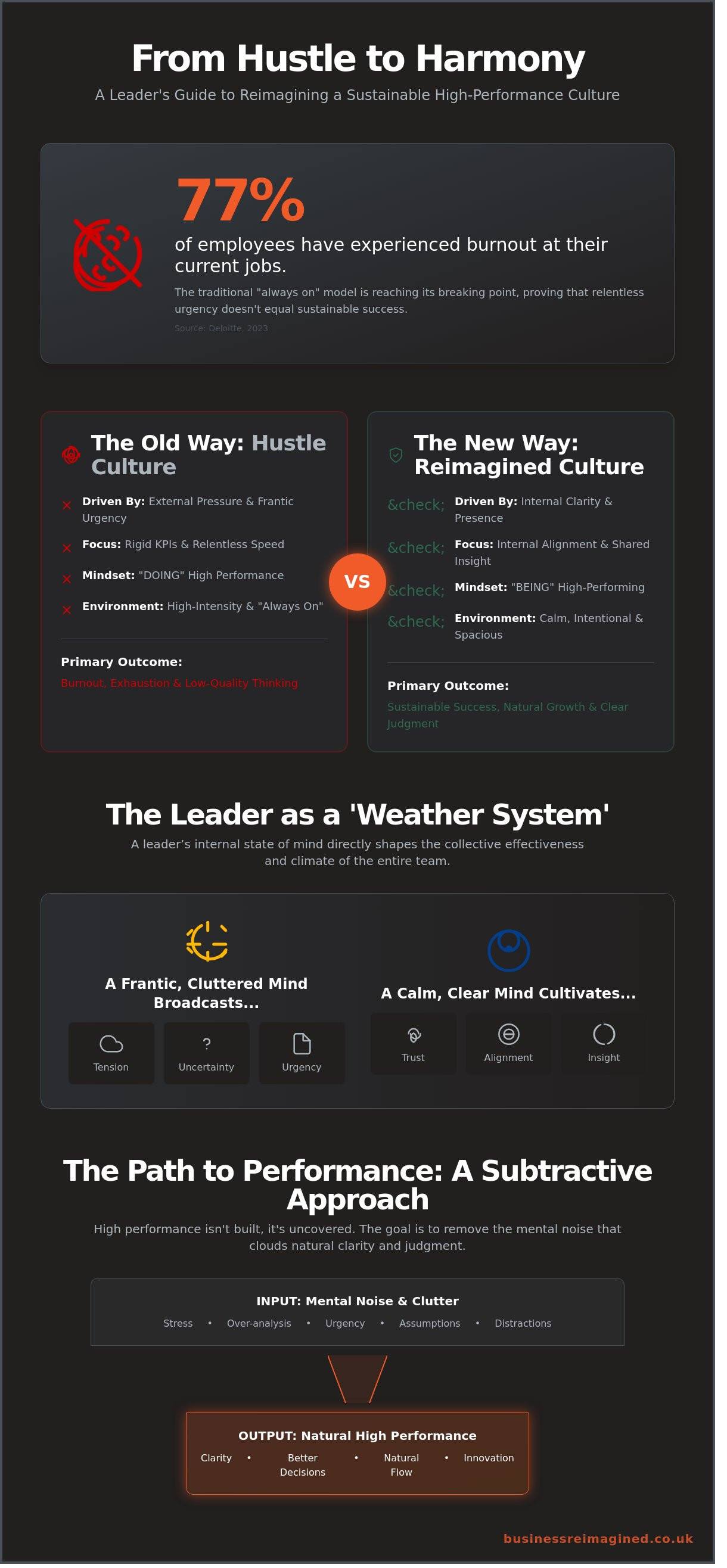
Hustle vs. Harmony: Choosing a Leadership Culture That Can Endure
Traditional leadership models often rely on a high-octane mix of relentless KPIs, internal competition, and constant pressure. While this might trigger a temporary spike in output, it's a fragile foundation for any organisation. True success doesn't grow from frantic energy. It stems from clarity, alignment, and deep insight. Many leaders find themselves trapped in a double bind, feeling they must choose between driving hard results or protecting their team's wellbeing. This is a false choice that ignores the biological reality of how we work best.
When you choose to Build A High-Performance Culture grounded in psychological safety, you aren't just being "nice." You're making a calculated strategic decision. A 2022 report by Deloitte revealed that poor mental health costs UK employers approximately £56 billion annually, a 25% increase since 2019. Choosing harmony over hustle isn't about lowering standards; it's about creating a leadership environment that supports long-term success without the inevitable crash of burnout.
The Hidden Cost of the "Grind"
The physiological toll of a "hustle" culture is often invisible until it's too late. Senior leaders operating under chronic stress experience a constant flood of cortisol, which eventually impairs the prefrontal cortex. This is the area of the brain responsible for complex decision-making and emotional regulation. Research indicates that high-stress environments can reduce a leader's cognitive flexibility by up to 20%, effectively narrowing their strategic vision when they need it most.
Hustle is a short-term tactic. It destroys long-term strategic value by prioritising immediate activity over thoughtful direction. As explored in our analysis of the Neuroscience of Leadership, moving from mental noise to strategic clarity is essential for sustainable growth. Without this shift, the financial costs of executive turnover and decision fatigue will eventually outweigh any short-term gains.
Building for the Long-Term
A leadership culture that can actually endure market volatility is built on intentionality rather than reactivity. It requires a move away from management by fear, which only serves to trigger the "freeze" response in employees. Instead, we look toward leadership through presence. This approach encourages a high-performance culture where people feel safe enough to innovate and honest enough to flag risks before they become crises.
- Intentionality: Making choices based on long-term values rather than immediate fires.
- Presence: Being fully available to the team, which fosters trust and reduces anxiety.
- Clarity: Ensuring every team member understands their role in the wider vision.
Moving away from the "grind" allows for a sense of spaciousness. In this space, innovation flourishes. When the internal noise of an organisation is lowered, the collective intelligence of the team can finally be heard. This isn't just a better way to work; it's a more profitable way to lead.
How to Build a High-Performance Culture: A Subtractive Approach
Creating a high-performance culture rarely requires adding more to your team's plate. Most leadership teams operate under the weight of accumulated processes, "urgent" digital notifications, and outdated habits. Subtractive psychology suggests that excellence emerges when we remove what is in the way. Instead of seeking the next productivity hack, we look for the mental noise that prevents clarity and intentional action.
A 2021 study published in Nature by researchers at the University of Virginia found that people are naturally predisposed to add features rather than subtract them, even when subtraction is the more efficient solution. To counter this, leaders must intentionally audit their mental environment. This begins with four clear steps:
- Audit mental noise: Identify the recurring anxieties within the leadership team that cloud decision-making.
- Create space for pivotal moments: Insights don't arrive during back-to-back meetings; they occur in the gaps between them.
- Align team dynamics: Foster a shared understanding of how the mind works to reduce friction and blame.
- Implement sustainable rhythms: Replace frantic energy with a steady pace that supports long-term success.
Removing the Barriers to Insight
We often assume that performance issues require more training. However, a leadership culture that can actually endure recognizes that habituation is the real enemy. This is the tendency to stop noticing inefficient or stressful patterns because they've become the norm. To break this, try "dropping the noise" for two minutes before high-stakes meetings. Silence allows the prefrontal cortex to reset, making room for fresh perspectives rather than recycled arguments.
Cultivating Collective Intelligence
A high-performance culture thrives when it's safe to fail. Innovation requires a level of psychological safety where team members feel heard and understood. When leaders practice deep listening and presence, they tap into the collective intelligence of the room. This isn't about being nice; it's about strategic alignment. If you feel your leadership team is struggling to find this clarity, Executive Business Coaching can provide the individual support needed to reimagine your approach.
True success is personal. It shouldn't consume your life. By choosing a subtractive path, you build a healthy leadership culture that values well-being as a primary driver of profit. If you're ready to shift from frantic to focused, book a discovery call to discuss how we can refine your team's state of mind.
The Path to Transformation: Reimagining Your Organisation
True high performance isn't found in a spreadsheet or a frantic pursuit of KPIs. It's a fundamental shift from "doing" to "being." When a team operates from a place of internal clarity rather than chronic stress, a high-performance culture becomes the natural byproduct of their collective state of mind. Business Reimagined provides the services needed to spark this evolution. This isn't about adding more tasks to an already overflowing plate; it's about removing the psychological clutter that prevents your people from thriving. Our Clarity Wellbeing Programme specifically addresses leader resilience, acknowledging that your internal state sets the tone for the entire room. Data from the Deloitte 2024 Mental Health Report shows that poor mental health costs UK employers approximately £51 billion annually. This figure highlights that investing in the "being" of your team isn't just a soft skill; it's a strategic necessity. You're at a pivotal moment of decision. You can continue with the traditional hustle, or you can choose a path that values spaciousness and sustainable growth.
Tailored Team Development
We don't believe in off the shelf solutions that fail to address your specific challenges. Our bespoke workshops are designed to reset your team’s internal operating system, moving away from reactive habits toward intentional, grounded action. By utilizing transformation and change accelerators, we help your organisation navigate strategic transitions with less friction and significantly more focus. This approach ensures that a high-performance culture isn't just a corporate buzzword, but a lived reality for every employee. For those seeking a deeper exploration of these concepts, the Business Reimagined YouTube channel offers a library of insights on leading with presence and purpose.
Next Steps for the Wise Visionary
Success is deeply personal. Your organisation's culture is a living reflection of your own leadership. It's a leadership environment that supports long-term success, built on the foundation of your own internal alignment. If you're ready to move beyond the noise and exhaustion of the modern workplace, let’s begin a different kind of dialogue. You can book a discovery conversation today to explore how we can align your business strategy with your team's wellbeing. There's a profound strength in simplicity. True power doesn't need to shout; it resonates most clearly from a quiet, high-performing mind.
The Choice to Lead With Clarity
True transformation doesn't require a faster pace; it demands a quieter mind. By moving away from the frantic noise of hustle culture and embracing a subtractive approach, you create space for genuine innovation to emerge. A sustainable high-performance culture isn't built on the back of exhaustion. Instead, it flourishes when leaders prioritise mental clarity and internal alignment over external pressure. Performance is a natural byproduct of a clear state of mind, not a result of endless grinding.
Since 2011, Business Reimagined has brought over a decade of executive coaching experience to help leaders find this balance. As specialists in the 3 Principles and Subtractive Psychology, and creators of The Clarity Wellbeing Programme, we help you cultivate a leadership environment that supports long-term success. It's time to stop adding to the weight of your team and start revealing the natural potential that already exists within your organisation.
If you're ready to move beyond the grind and foster an intentional, grounded workplace, we're here to guide the way. Book a Clarity Call to reimagine your team’s performance and discover how a steady, strategic partnership can help you thrive without the burnout. You deserve a business that supports your life, rather than consuming it.
Frequently Asked Questions
What is the most important element of a high-performance culture?
The state of mind of leadership is the most critical element of a high-performance culture. While 85% of executives in a Deloitte study focus primarily on metrics, true success stems from a leader's internal clarity. When you operate from a place of presence, you make better decisions and inspire others naturally. This creates a leadership environment that supports long-term success without relying on the frantic pressure of short-term targets.
Can you have a high-performance culture without burnout?
High performance is only sustainable when it isn't fueled by adrenaline or constant urgency. By practicing subtractive psychology, you remove mental noise and unnecessary stress from the workday. Research from the World Health Organisation shows that workplace stress costs the global economy $1 trillion annually in lost productivity. Shifting to a leadership culture that can actually endure allows teams to achieve more through spaciousness rather than sheer effort.
How long does it take to change an organisational culture?
Cultural transformation can happen immediately when you focus on the psychology of the core leadership team. While traditional change programmes often take three to five years, shifting the internal state of mind creates a rapid ripple effect. When leaders change their perspective, the way they communicate and delegate evolves instantly. This organic shift bypasses the friction of forced initiatives, leading to a more grounded and intentional way of working.
How do we measure the success of a high-performance culture?
Success is measured by the quality of decision-making and the reduction of organisational mental noise alongside traditional metrics. A 2023 Gallup report found that engaged teams see a 23% increase in profitability. We look for indicators like team resilience and the ability to find fresh insights under pressure. A healthy leadership culture is evident when people remain present and capable even during periods of significant change.
Is high performance different for remote or hybrid teams?
The principles of a high-performance culture remain identical whether your team is in an office or working remotely. Clarity and high-quality communication become even more vital when you lack physical proximity. According to a 2022 Buffer study, 25% of remote workers struggle with unplugging. Success in a hybrid world relies on trust and presence rather than physical oversight, ensuring that every interaction is intentional and grounded.
What role does the ego play in performance?
The ego acts as the primary source of mental noise, often blocking access to a leader's best thinking. When you're preoccupied with being right or protecting your image, you lose the ability to tap into collective intelligence. As Kay Tear explores in her book, Overcome Imposter Syndrome, understanding your mind is essential for leading authentically. Moving beyond the ego fosters a leadership culture that can actually endure by prioritising wisdom over individual validation.